

Good morning and happy Monday.
Talk about giving a lot of notice.
State Street is planning to liquidate four ETFs, the company said in an announcement last week. ETF closures are a fact of life these days, and on their own, they’re not huge news. What’s interesting here is that State Street is giving shareholders a full six months to get out. Fidelity, for example, provided just over a month before the pending liquidation next month of five ETFs, most of which are ESG-themed funds, like the State Street ETFs. “We are giving clients an opportunity to assess the impact of this change on their portfolio and decide when it would be best to redeem their holdings,” State Street Investment Management Chief Business Officer Anna Paglia said in a statement, in a nod to the tax consequences of selling shares.
Also curious: The State Street SPDR MarketAxess Investment Grade 400 Corporate Bond, SPDR S&P SmallCap 600 ESG, SPDR MSCI USA Climate Paris Aligned and Nuveen Municipal Bond ESG ETFs are among the dozens the company recently renamed to reflect the manager’s brand. Looks like the rebranding and closure discussions were separate ones.
Investors Now Want Crypto Just as Much as ETFs

The people want ETFs. And in those ETFs they want equities … and crypto.
Those are the two most important categories to retail investors, according to data from a survey commissioned by BlackRock, which included 5,000 respondents in July and August. The report, published Thursday, shows changing priorities, particularly among young investors. While 66% of US investors said they owned individual stocks, 43% reported holding mutual funds. Bonds (29%), crypto assets (27%) and ETFs (23%) were behind. Still, ETFs are the fastest-growing category, and investors who already own them said they are most likely to buy equity (83%) and crypto (36%) funds during the next year. But among those who don’t yet own ETFs and plan to, there is nearly equal demand for equity (51%) and crypto (47%).
“We’re witnessing a pivotal moment as individual investors embrace ETFs for their efficiency and transparency,” BlackRock head of US direct investing Amy Jenkins said in an announcement. “The predicted surge in first time ETF investors reflects a broader shift in investor preferences toward simplicity, accessibility and digital-first experiences.”
An ETF Buffet to Rival Golden Corral
Next year, of course, they’ll have plenty of options. The Securities and Exchange Commission has all but turned on a fire hose for new products, recently allowing the big exchanges to use generic listing standards for new ETFs. That’s a golden ticket for issuers who have been waiting for months to launch spot-price crypto ETFs, including those focused on a smorgasbord of meme coins. Some products have already started coming to the market, the most recent of which include index funds of spot crypto: the 21Shares FTSE Crypto 10 Index ETF (TTOP) and FTSE Crypto 10 ex-Bitcoin Select Index ETF (TXBC). Those ETFs, which launched Thursday, apply market cap weightings and hold a variety of Swiss-domiciled crypto exchange-traded products to fill in where spot-price products are not yet available domestically. Another Thursday debut was the Canary Capital XRP ETF (XRPC).
“It feels just like another S&P 500 ETF,” said Federico Brokate, global head of business development at 21shares, which has a tagline for the products similar to what index fund investors are used to hearing: “Stop chasing coins. Start owning the market.” Unlike most spot crypto products, the two new ones are registered as 1940 Act (rather than 1933 Act) products.
As to why investors choose ETFs, per the BlackRock survey:
- Diversification across companies and markets (47%)
- Ease of buying and selling (40%)
- Potential for returns (37%)
In Bitcoin They Trust: This all bodes well for BlackRock, which conveniently, is the world’s dominant asset manager, biggest ETF issuer and operator of the largest crypto ETP, the iShares Bitcoin Trust, which now represents about $80 billion. Only a few weeks ago, that ETF was poised to hit $100 billion in assets, though falling Bitcoin prices and a few days of net outflows have dragged its AUM down by $17 billion. It’s a reminder, especially for those new to investing, that if they like the idea of crypto, they better like volatility.
Research that Spans Many Generations of Investing
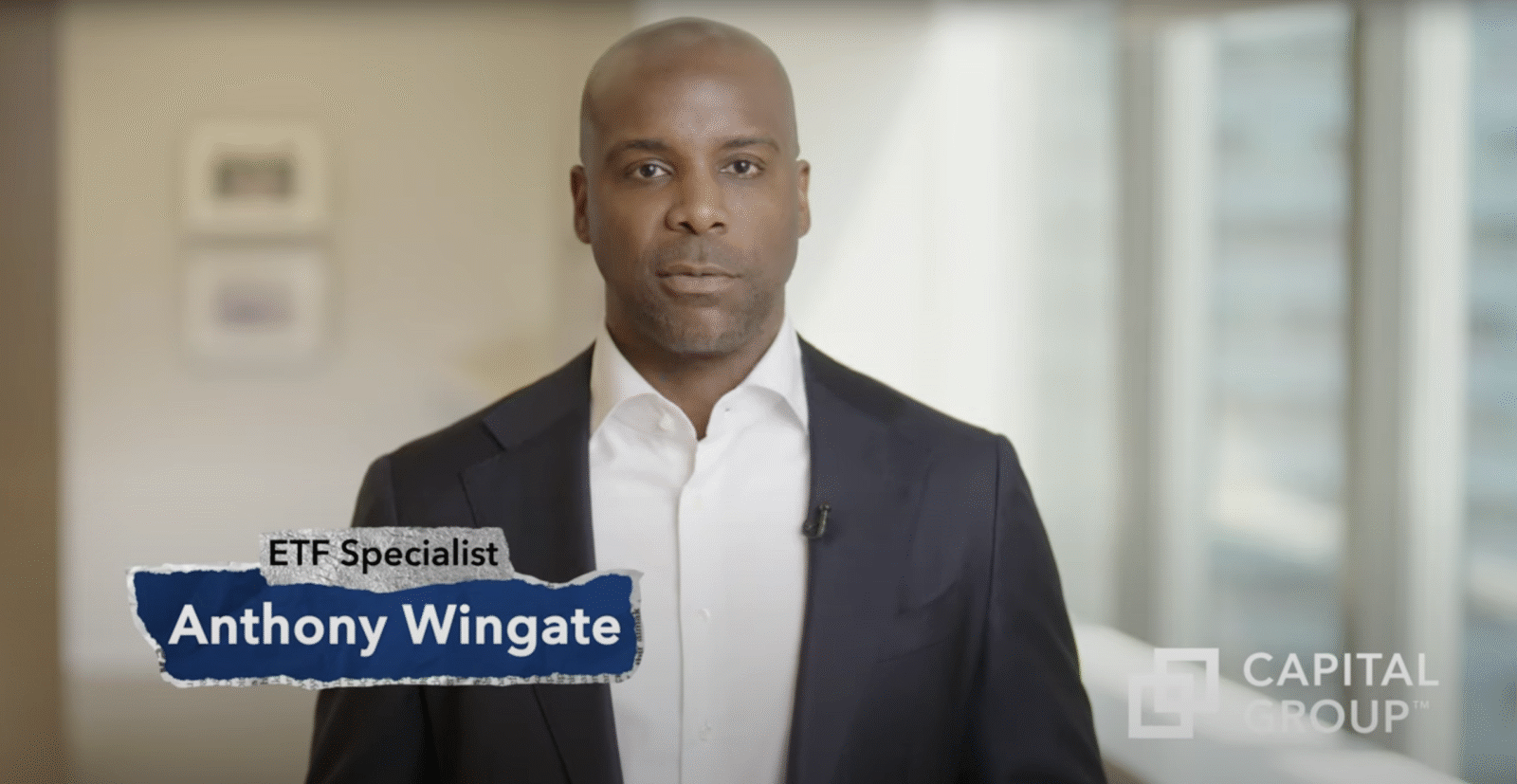
“Actively managed strategies involve bottom-up research and investing in highest conviction ideas,” says Capital Group’s Anthony Wingate.
With Capital Group’s active ETFs, conviction is rooted in decades of accumulated knowledge along with new analysis to refine the outlook. This experience helps managers spot the long-term opportunities and risks that rules-only strategies can miss.
Wingate highlights three ways that depth translates into decisions:
- Decades of company relationships can review signals others may overlook.
- Historical insight, paired with fresh analysis, sharpens perspective.
- Institutional memory adds context that models alone can’t provide.
That depth is what Capital Group believes sets its active ETFs apart.
See how deep research shapes Capital Group’s active ETFs.
Capital Client Group, Inc.
Capital Group, Goldman, T. Rowe Hit ETF Milestones

That didn’t take too long.
Several major asset managers are crossing asset milestones in their ETF businesses amid a record year for inflows industrywide. Capital Group’s three-year-old line of ETFs just hit a total of $100 billion in assets under management. Of course, no one comes close to BlackRock’s iShares or Vanguard, which at $3.9 trillion and $3.7 trillion are the dominant players in the market. But the rising profile of Capital Group, and other semi-recent entrants like T. Rowe Price, highlights the demand for new exchange-traded funds — and actively managed ones in particular.
“We didn’t have them for a long time,” said John Queen, fixed income portfolio manager at Capital Group. “Even when active [ETFs] became available, we wanted to really make sure we understood the details of how they were going to play out and what the transparency meant before we started them up.”
Wind in the Sales
About $1.1 trillion poured into US ETFs this year through October, which was more than in all of 2024. Of that, $378 billion went into active ETFs. Total assets are now more than $13 trillion. Some of the other firms that recently surpassed or are about to hit assets-under-management milestones:
- Invesco is nearly at $800 billion across its 240 US ETFs, according to data from VettaFi.
- Goldman Sachs crossed over the $50 billion mark among its 45 US ETFs.
- T. Rowe Price now has more than $20 billion in its line of 24 ETFs.
Model Behavior. As niche ETF issuers have flooded the market with leveraged and thematic new funds, Capital Group and many other big asset managers have kept a focus on core-style products. To help distribute those ETFs, firms have increasingly added model portfolios. The top area where they’re building out models is now in active ETFs, according to a recent report from Morningstar. As of March, when Capital Group launched its first active ETF model portfolios, the firm was the third-largest provider, at $61 billion in assets under management, behind Wilshire ($68 billion) and BlackRock ($168 billion).
“It has been an incredibly important connection with our clients and advisors, because it’s what they wanted all the time,” Queen said of Capital Group’s model portfolios and funds of funds. “It’s been a huge and important growth area for us.”