

Good morning.
Somewhere Gordon Gekko is smiling. Securities and Exchange Commission Chair Paul Atkins yesterday called on the regulator to ease several notable disclosure rules. Among the targets: a 2017 rule that requires companies to report the ratio of their CEO’s total compensation to that of their median employee. Using the resulting data, the AFL-CIO found that the average S&P 500 CEO made $18.9 million last year, up 7% from 2023. The CEO-to-worker pay ratio was 285-to-1, up from 268-to-1.
In other words, if the intent was to shame companies into paying CEOs less, it hasn’t worked. In his annual Thanksgiving letter to shareholders, Berkshire Hathaway CEO Warren Buffett, a longtime critic of excessive pay, argued that the “good intentions” of compensation disclosure “backfired.” “The new rules produced envy, not moderation,” he wrote. “What often bothers very wealthy CEOs — they are human, after all — is that other CEOs are getting even richer. Envy and greed walk hand in hand.” Greed may not be good, but it’s ever a good motivator.
Behind Sam Altman’s ‘Code Red’ Response to OpenAI Competitors’ Gains
“I expect the vibes out there to be rough for a bit.” So said Sam Altman in a memo to staff last month. And the vibe shift has indeed been fast and furious.
OpenAI’s leader declared a “code red” to staff in a new memo, first reported by The Information, as the world’s most valuable startup comes under siege from a wave of emergent AI rivals.
The Replacements
Altman’s memo went out just as Google launched its impressive new Gemini 3. The Alphabet subsidiary said its new chatbot bested ChatGPT and Anthropic’s Claude in a series of key tests, and Altman conceded the release could “create some temporary economic headwinds” for OpenAI. Take it from one convert, Salesforce CEO Marc Benioff, who last month tweeted: “I’ve used ChatGPT every day for 3 years. Just spent 2 hours on Gemini 3. I’m not going back.”
ChatGPT still maintains a massive, 800 million-strong and growing weekly user base and is backed by OpenAI’s world-class research. In this week’s memo, Altman promised the release of a new reasoning model next week that bests Gemini. Still, the Google chatbot’s user numbers are soaring, up to 650 million in October from 450 million in July. The search giant has the built-in advantage of offering Gemini through integration with its other products. Calling it a “critical moment,” Altman will focus on improving ChatGPT at the expense of other projects including health, shopping, and personal assistant AI agents. A quick look at the financials makes clear why shoring up the company’s core product is imperative:
- Anthropic, whose Claude has won business customers for its powerful coding capabilities, forecasts it will break even in 2028, according to documents obtained last month by The Wall Street Journal. OpenAI, meanwhile, expects $74 billion in operating losses that year, equal to 75% of revenue, and doesn’t foresee a profit until 2030.
- With $1.4 trillion in computing commitments through 2033, OpenAI needs continued growth to keep up with its expected cash burn. HSBC analysts determined that, even if its revenue reaches $200 billion by 2030 (up from some $20 billion this year), the company will need to bridge a $207 billion shortfall with debt, equity fundraising or expedited revenue growth.
It’s All Connected: Google’s AI advances are delivering headaches all around. The search giant trains Gemini on its own Tensor Processing Units (TPUs), rather than semiconductor giant Nvidia’s graphics processing units (GPUs) that are popular with rivals. While Nvidia’s chips are more versatile, the purpose-built AI TPUs come cheaper and use less power, and Google’s AI rise has led to some jitters among investors. Nvidia is down roughly 1.2% since Gemini 3 was released on November 18, while Broadcom — which helped develop Google’s chips — is up 11.5%.
Rearmament Is Here, and Nations Across the Globe Are Bulking Up

Last year notched a post-WWII record: sixty-one active conflicts across the globe.1
NATO members have pledged hundreds of billions toward military modernization, and global defense budgets hit $2.7 trillion in 2024, the fastest one-year climb since the Cold War.2
The Global X Defense Tech ETF (SHLD) offers strategic exposure to this wave of spending and rearmament:
- The geopolitical landscape continues to underscore national security priorities, and Global X’s Charting Disruption: Outlook for 2026 and Beyond research expects structural factors to sustain elevated defense spending through 2030.3
- Next generation military technology has arrived, and militaries are rapidly upgrading their tech capabilities.
This once sleepy part of the economy has awakened, and the floodgates of innovation have blown wide open with a new arena of contractors.

Boeing Charts Flight to Positive Cash Flow as Archrival Airbus Hits Turbulence
Up is suddenly down in the world of aviation. And no, we’re not talking about pilot controls or making a cryptic Stranger Things reference.
On Tuesday, Boeing’s CFO said the company has finally achieved escape velocity from its turbulent recent history, projecting billions in free cash flow next year. The good news comes just after rival Airbus hit a quality control rough patch of its own.
Headwinds, Tailwinds
In case anyone forgot, Boeing is just a year or two removed from an epic tailspin that featured disasters, near-disasters, whistleblowers, modestly terrifying results from a Federal Aviation Administration safety audit and a prolonged worker strike. As a result, the company hasn’t turned an annual profit since 2018 and is on track for a $2 billion cash burn this year despite looking at its highest annual delivery total in seven years. Now? CFO Jay Malave told an investor conference the company is on course for free cash flow in the “low single digit” billions of dollars next year, thanks to improvements in its production cadence. Eventually, Malave says the company will hit the $10 billion free cash flow cruising altitude that executives had previously promised for 2025.
The rosy projections sent Boeing shares up more than 10% on Tuesday, rubbing salt in the wounds of its archrival. On Monday, Airbus confirmed a Reuters report that it is facing quality problems on fuselage panels on some of its A320-family jets, which just so happen to have flown past Boeing’s 737 this year as history’s most delivered jetliner. The industrial problem came after Airbus was forced to ground 6,000 A320 aircraft for a software update; its shares have plummeted roughly 10% in the past month.
Still, as Boeing regains ground on its chief rival, years of negative headlines remain a drag on its top-flight speed:
- Boeing still expects to face a significant fine from the US Department of Justice next year as it resolves a case born from the two fatal crashes of its 737 Max in 2018 and 2019.
- Meanwhile, Malave also said on Tuesday that commercial service certification for its 737 Max 10 planes is unlikely to come until late next year, pushing some scheduled deliveries into 2027.
Trans-Pacific Flight: And just as Boeing gets the wind beneath its wings, a new challenger is taking flight. Last month, the Chinese state-owned aerospace firm COMAC took its long-awaited C919 aircraft, a Boeing 737 competitor, to the Dubai Air Show. It’s part of a push to sell the plane in various global markets as it continues to lack certification from Western regulators.

A Prime Acquisition Target. Apple and Tesla are pushing deeper into the smart home, and one massive category is still untouched: window shades. RYSE is leading it with 10 patents, $15 million in revenue, and 2x annual growth. Backed by top investors, shares are $2.35. Invest now.
Can Samsung’s TriFold Steal Thunder from Apple’s Next-Gen Mystery Phone?
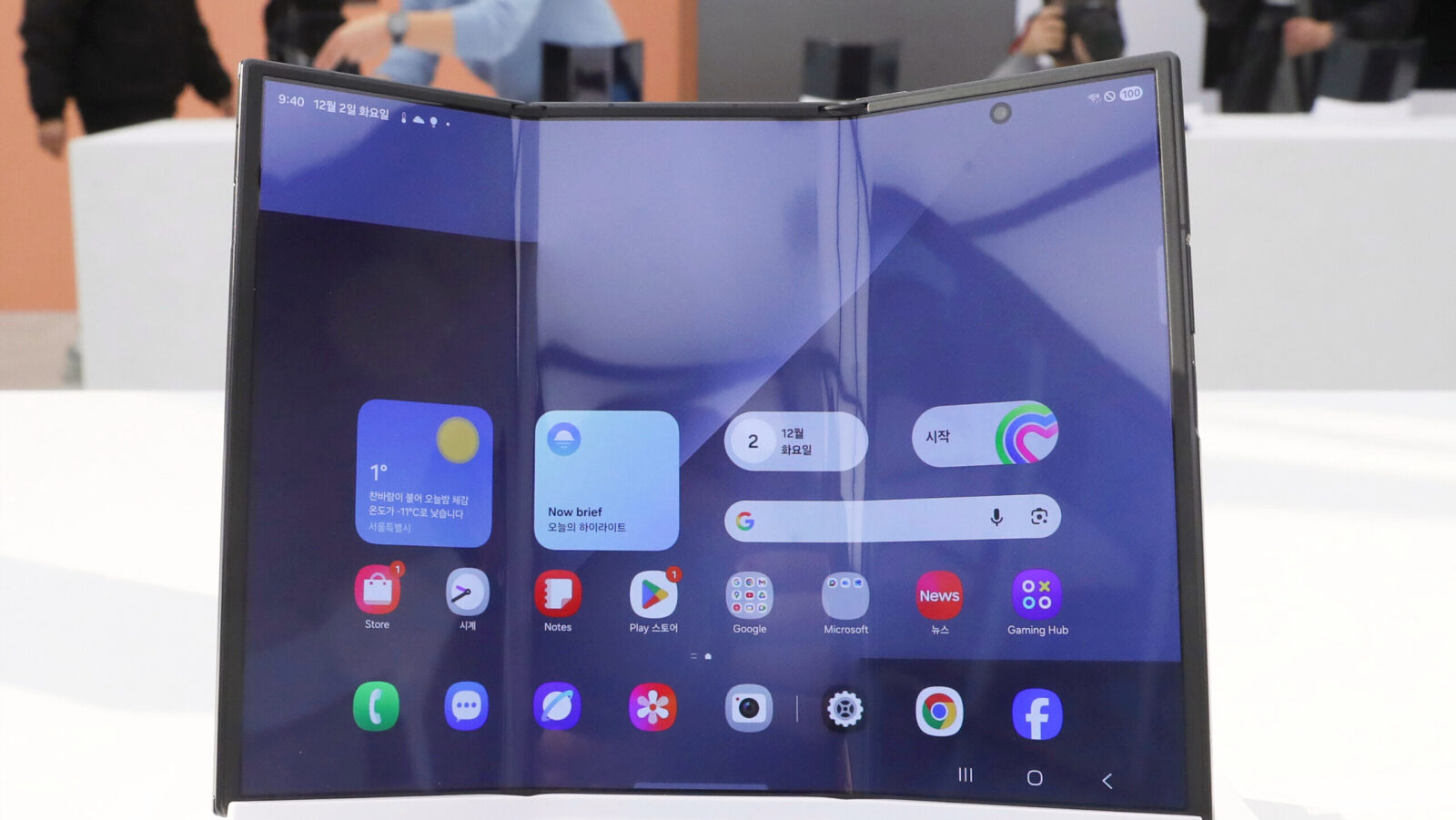
With Apple rumoured to be releasing its first foldable sometime next year, its smartphone archrival is doubling down. Or more precisely, tripling down.
On Tuesday, Samsung introduced its Galaxy Z TriFold, featuring a tablet-sized 10-inch display when folded twice — the largest screen ever on a Galaxy phone, according to a company statement. Samsung says the new phone also has the largest battery the company has ever put in a foldable phone.
“Through years of innovation in foldable form factors, Galaxy Z TriFold solves one of the mobile industry’s longest-standing challenges: delivering the perfect balance between portability, premium performance and productivity all in one device,” TM Roh, the newly appointed co-CEO and head of the Device eXperience division at Samsung Electronics, said in the statement.
The phone will go on sale in South Korea on Dec. 12, with a price tag of 3.59 million won (roughly $2,450), per Bloomberg. Afterward, it will roll out to markets including China, Taiwan, Singapore and the United Arab Emirates. Shoppers in the US will be able to buy it during the first quarter of 2026, though the pricing hasn’t been shared yet.
Smart Phone Wars
While Huawei Technologies already beat Samsung to the tri-fold arena, with its Mate XT in 2024, Apple’s expected entrance to the broader foldables market next year signals that competition is likely to grow even fiercer:
- Just last week, Counterpoint Research said that Apple is on track to beat Samsung in shipments for the first time in 14 years and keep that top spot through 2029.
- “Samsung’s first trifold model will ship in very limited volume, but scale is not the objective,” Counterpoint Research analyst Liz Lee told Bloomberg. “With competitive dynamics set to shift materially in 2026, especially with Apple’s expected entry into the foldable segment, Samsung is positioning this device as a multi-fold pilot to reinforce its technology leadership.”
Next Year’s Boom: Growth has slowed in shipments of foldable phones in recent years, but that may end in 2026, according to a July report from TrendForce: “Advancements in technology and declining prices are gradually positioning foldables as a key innovation in the mid- to high-end smartphone segment and a powerful tool for brand differentiation.” But will consumers welcome Apple into the fold?
Extra Upside
- Food Court: The City of San Francisco filed a lawsuit against major food makers including Kraft Heinz and General Mills, alleging they committed “unfair and deceptive acts” in marketing unhealthy foods.
- Holding Up: The global economy is proving surprisingly resilient to tariffs, according to new OECD forecasts, which nevertheless expect growth to slow to 2.9% next year from 3.2% in 2025.
- The Defense Tech Sector Is Taking Off. Global defense spending hit $2.7 trillion in 2024, the fastest surge since the Cold War. NATO members pledged to double military budgets by 2035. The Global X Defense Tech ETF (SHLD) tracks companies defining the next generation of military tech. Explore SHLD now.*
* Partner
Just For Fun
Sources
- Peace Research Institute Oslo (PRIO). (2025, January). Trends in Armed Conflict, 1946–2024.
- Stockholm International Peace Research Institute (SIPRI). (2025, April 28). Military Expenditure Database.
- Liang, X., Tian, N., da Silva, D.L., Scarazatto, L., Karim, Z.A., Ricard, J.G. (2025, April). Trends in World Military Expenditure, 2024. Stockholm International Peace Research Institute. As cited in Global X Charting Disruption: Outlook for 2026 and Beyond (2025) www.ChartingDisruption.com.

