

Good morning and happy Sunday.
Is Boeing ready for takeoff? In 2025, for the first time in seven years, the US planemaker landed more aircraft orders than longtime rival Airbus, signaling its budding recovery from a string of flight safety failures and harsh regulatory scrutiny.
What that means for the longtime rivalry between the two giants, where Airbus retains a significant edge on cash-generating deliveries, is the subject of today’s deep dive.
But first, a word from our sponsor, Oracle NetSuite.
From C-Suite execs to interns, AI is empowering every team member to do more.
But as finance teams accelerate with automation and advanced analytics, a critical blind spot threatens that newfound impact (and it can’t be fixed with a prompt):
CFO-level leadership capability.
No AI can replace the influence and storytelling required to motivate teams and translate AI insights into enterprise-wide action.
Don’t wait until it’s too late, read Oracle NetSuite’s AI and Soft Skills guide. It teaches CFOs and finance leaders how to inspire teams, align stakeholders and connect AI to strategic priorities on a human level.
As AI becomes ubiquitous, the orgs that can combine technical AI adoption with strong leadership skills will outperform those that don’t.
Boeing Regains Its Swagger in Heated Rivalry with Airbus
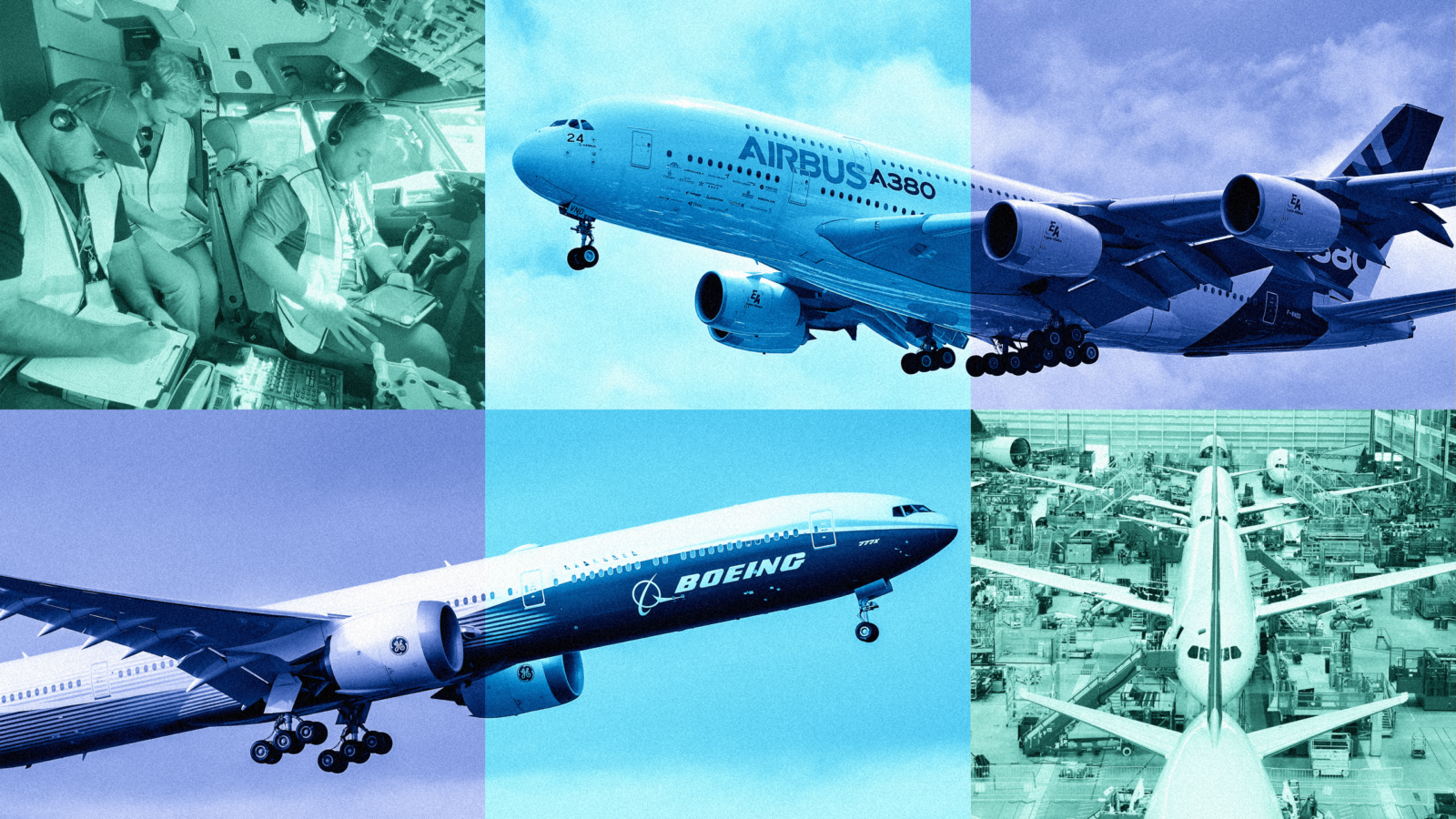
Booking commercial jet orders? That’s as easy as shooting fish in a barrel. Trying to fulfill commercial jet orders? More like catching a 1,500-pound tuna on a dinghy in the middle of the Atlantic.
OK, that comparison may contain a little hyperbole. Still, it illustrates the magnitude of the challenge facing both Airbus CEO Guillaume Faury and his Boeing counterpart, CEO Kelly Ortberg, as their rivalry heats up anew, with the beleaguered US planemaker working to regain ground lost due to safety failures and regulatory penalties.
Both are focused on deliveries, when planemakers receive the bulk of their payments. While Dutch-domiciled, French-run Airbus last week predicted fewer this year than Wall Street expected, it still holds the advantage.
The company reported handing over 793 commercial jets to customers in 2025, some 32% more than the 600 Boeing delivered, even though the US planemaker won the most orders in 2025 for the first time in seven years.
There’s more to the story, however.
Airbus topped its target of 790 deliveries mostly because it was reduced from 820 at the 11th hour due to problems with fuselage panels in its supply chain. Ultimately, Airbus achieved a modest increase from the 766 commercial aircraft delivered in 2024.
Boeing, on the other hand, made good on much-needed turnaround efforts. Its deliveries bested analyst forecasts of roughly 590 and, more crucially, represented a major recovery from 2024, when the company suffered a 35% decline in deliveries to 348. A prolonged strike and persistent issues with production quality did the company no favors.
Now, as Boeing targets a 10% increase in deliveries this year, narrowing the gap with Airbus’s planned deliveries of 870 aircraft (less than the 880 analysts expected), it can point to momentum on its assembly lines.
From Chaos to an Order Win
Boeing hasn’t generated this much customer enthusiasm since 2018, when it broke a six-year streak of Airbus booking wins. For a moment, the rivals appeared equally matched.
But then Boeing produced a series of own goals that, if there were a corporate hall of shame, would likely warrant a permanent exhibition.
Fatal crashes of Boeing’s then-new 737 MAX single-aisle planes in 2018 and 2019, and the fleet’s subsequent grounding due to production defects, were followed by quality-control lapses, allegations and admissions of lax safety standards, the machinist strike in 2024 and production caps imposed by regulators. The issues contributed to tens of billions of dollars in core operating losses, leaving Boeing’s balance sheet redder than a Delta Airlines logo painted on the side of a 747.
When Orberg took over in 2024, becoming the company’s third leader in less than five years, he went all-in on improving quality controls and coordination along its supply chain. That includes the recently completed re-acquisition of supplier Spirit AeroSystems, which was the subject of intense scrutiny along with Boeing after an improperly bolted door plug blew out on an Alaska Airlines flight in 2024, depressurizing the cabin and leaving it open to the atmosphere. (The plug was a panel, roughly the size of a door, used to seal optional emergency exit openings in an aircraft’s frame.)
As issues with production and parts have been resolved to the satisfaction of regulators, who blamed the accident on assembly-line missteps, the US Federal Aviation Administration has lifted restrictions on Boeing, allowing deliveries and order backlogs to recover.
Boeing logged net orders for 1,173 airplanes in 2025 to Airbus’s 889, though the European company still has a deeper backlog of orders to fill, thanks to years of better sales. As of the end of January, the company reported a commercial aircraft backlog of 8,777 compared with Boeing’s 6,770.
“The fact that we have been ahead on orders for five years means our order backlog is much higher than that of our main competitor,” Faury told France Inter in November.
The Trump Bump
For all the hard work of its executives and assembly line workers on the turnaround, one man outside the company has played a major role in Boeing’s recent success.
“Boeing gave me an award for the greatest salesman in the history of Boeing,” President Donald Trump joked in December. “I think I’ve sold 1,000 Boeing planes.”
Indeed, the president advocated for Boeing plane sales through a series of trade-for-diplomacy deals struck last year as part of his administration’s economic agenda.
According to the US Commerce Department, government-assisted foreign contracts almost tripled in 2025 to $244 billion from $87 billion a year before. Roughly $215 billion of that was attributable to sales of Boeing planes and GE Aerospace engines. The aircraft manufacturer particularly benefited from a $96 billion deal struck with Qatar Airways that Trump announced during a trip to the Gulf region.
It also inked more than $30 billion in agreements with Vietnamese carriers last month, with Trump removing Vietnam from a technology blacklist around the time of the announcements.
The Next Steps
Airbus won 2025 on deliveries and has been ahead on orders for years, leaving it with an undisputed advantage. It also has a larger and more diverse global manufacturing footprint than Boeing, which concentrates its production in the US.
Boeing orders are still ramping up, however, and the US planemaker hasn’t yet reached full speed. Presuming the turnaround continues, the two companies will have to achieve similar goals, and overcome similar challenges, as they duke it out in the years ahead.
Both struggled with production in recent years because of pandemic-era factors. There were the supply-chain bottlenecks that every industry dealt with. Those are gone, but are reflected in record backlogs.
They also lost skilled workers to layoffs, early retirements and other industries during the pandemic. Some former Boeing workers and industry observers attributed quality control issues to the less-experienced workforce left on the assembly line after those departures.
Perhaps most importantly, however, the pandemic years provided a reminder of the global aerospace supply chain’s fragility, even on a good day.
When Airbus cut its delivery target in December as the year wound to a close, the planemaker identified the cause as a problem with fuselage panels delivered by Spanish supplier Sofitec. Shortly afterward, Faury blamed the disappointing delivery forecast for 2026 on power plant deliveries: Supplier Pratt & Whitney was unable to provide enough engines, and Airbus’s other engine supplier, CFM, couldn’t deliver more at short notice.
Keeping the Faith
Airbus’s Paris-listed shares have tumbled 6% this year and dipped since the company issued its lackluster full-year delivery forecast.
But, given the volume of the company’s backlog and the fact that there’s no sign that demand for commercial jets is waning, analysts have little doubt about its long-term prospects. Disruptions in the supply chain might put short- and medium-term pressure on the stock, but that’s the nature of the business.
Of 22 analysts who cover Airbus’ Paris-listed stock tracked by S&P Global Market Intelligence, 16 have the equivalent of buy ratings.
Boeing has its own healthy backlog and benefits from the same demand, giving it similar upside. Of 26 analysts who cover the company, 20 have buy ratings.
In the past 12 months, Boeing has also proven the better return on investment, with its shares up 32.1% compared with Airbus’s 11.6%.
Last year, Airbus forecast global demand for over 43,000 new passenger and freighter aircraft in the next 20 years, as passenger airline traffic grows 3.6% annually.
That will benefit both companies enormously, perhaps sufficiently to suggest there’s room enough for two to thrive in this duopoly.
AI Is Leveling the Playing Field. Here’s How to Pull Ahead

As AI takes on more daily tasks, CFOs need advanced leadership skills (like storytelling and influence) to make strategic decisions and gain a competitive edge.
Oracle NetSuite had to solve this, and now it’s sharing the playbook AI and Soft Skills to help other finance teams thrive in an increasingly-AI landscape.
Inside the no-cost guide:
- Which soft skills to focus on, and how AI changes them.
- Mastering storytelling to win over stakeholders.
- Real-world examples and strategies to learn from.
Download the guide and make leadership your unfair advantage.