Cash Flow vs. Upside: Navigating the Tradeoffs in Covered Call ETFs

We had the chance to sit down with Barry Martin, portfolio manager at Shelton Capital Management, to get the low down on options-based ETFs and covered call strategies.
Clients, especially those nearing or in retirement, are protective of their assets, and covered calls have the potential to cushion portfolios from wild market swings. Let’s dive in.
The Daily Upside: What’s been behind the explosion of options-based ETFs, and what advantages do they offer clients?
It really has been a hockey-stick move. In 2020, the Morningstar Derivative Income category had about $10 billion in assets under management. Today, that figure has grown to more than $200 billion.¹ We’ve seen tremendous growth across the category, and Shelton has been part of that trend.
A big driver has been demographics. Many investors who are in retirement or approaching retirement are looking for cash flow, along with a more conservative way to maintain equity exposure. Rather than owning stocks outright without any risk management overlay, many are drawn to strategies designed to generate cash flow while also helping moderate risk.
That is the role SEPI is designed to play. The Shelton Equity Premium Income ETF (SEPI) seeks to deliver enhanced cash flow and capital appreciation by utilizing covered calls on portfolio positions, which can help enhance distributions to shareholders.
This combination of cash flow, equity participation, and a risk-conscious approach has resonated strongly, particularly with baby boomers.
1Morningstar as of January 2025.
The Daily Upside: Covered called strategies are very popular with clients, especially those approaching retirement, as they can mitigate downside risk. What are the most interesting use cases that you’ve seen investors taking advantage of?
For many of our clients, income is the primary objective of this strategy. That aligns with findings from our recent survey of 300 investment professionals, most of whom manage more than $100 million in assets under management.2 Among those using derivative income strategies, income generation was the most common objective, cited by 41%, while 32% said they use them for capital appreciation. I also view this type of strategy as a risk-mitigation tool. A simple analogy is a pilot taking a slightly longer route to avoid a storm. The trip may take a bit more time, but the ride is smoother along the way.
2 Shelton Capital Management commissioned a survey conducted by Centiment, surveying over 300 U.S. financial professionals between February 3 to February 11, 2026.
The Daily Upside: How do you determine how much to give away in exchange for that protection?
When you’re writing covered calls, you’re making a tradeoff: upside is capped, but some downside risk remains. Typically, the more upside you give away, the higher the distribution may be. The real question is how to strike the right balance based on the goals of the client or the portfolio. If a strategy is distributing 12%, 13%, or 14%, that income often comes at the cost of more limited upside, which can constrain growth over time. Our approach is designed to create a more balanced outcome, emphasizing cash flow while still allowing for meaningful equity participation.
The Daily Upside: So this is really a play for nearing retirement or having protection from catastrophic markets?
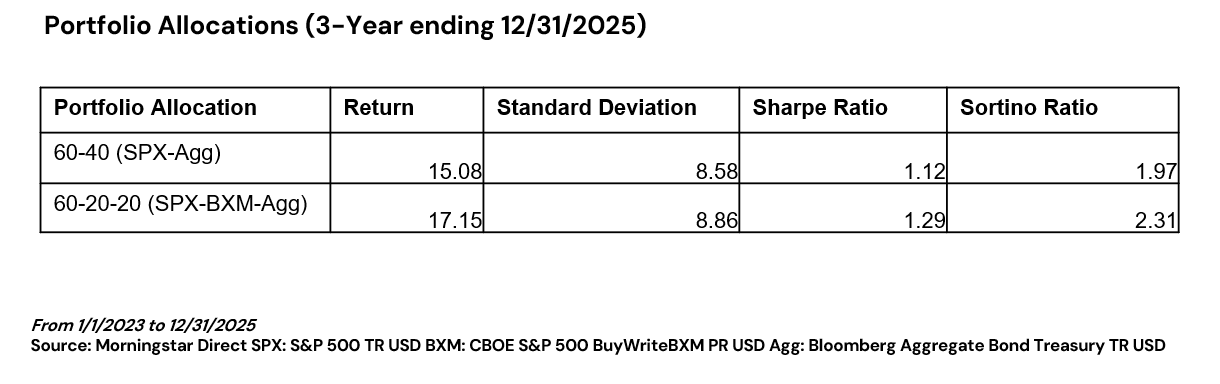
Investors are increasingly looking beyond the traditional 60/40 portfolio in search of stronger risk-adjusted returns. A new allocation framework is emerging: 50/30/20, where 30% in an options-based strategy. According to our Morningstar analysis, this mix has delivered stronger Sharpe and Sortino ratios over the past three years for example, reflecting better risk-adjusted returns.3
3 Source: From 1/1/2023 to 12/31/202. Morningstar Direct 50% SPX: S&P 500 TR USD, BXM: 30% CBOE S&P 500 BuyWriteBXM, 20% USD Agg: Bloomberg Aggregate Bond Treasury TR USD.
The Daily Upside: Where do you see covered calls fitting in best with the asset allocation. Is it core? The income sleeve? Is it just mitigating some volatility?
Today, advisors and investors are using covered call strategies in several roles: as a core cash flow sleeve within equity portfolios, as a complement to fixed income, and as a potential volatility dampener within multi-asset allocations. We have seen the most consistent adoption among those looking to de-risk traditional equity exposure while maintaining participation in the market.
The Daily Upside: What sorts of market conditions are best suited for these and what are some of the environments that maybe could be less effective?
Historically, this strategy has been well suited for range-bound, more volatile markets, where covered call premiums can help enhance total return and reduce overall portfolio volatility, particularly in environments resembling recent market conditions. Put simply, the strategy seeks to generate additional cash flow by monetizing market volatility through the sale of covered calls.
An important trade-off to consider, however, is opportunity cost. By selling covered calls, the strategy gives up a portion of the upside beyond the strike price. As a result, if a stock rallies sharply, gains may be capped, and the strategy may underperform a fully unhedged equity position in strongly rising markets.
The Daily Upside: Thank you very much Barry. We’d encourage everyone to explore Shelton Capital Management.
IMPORTANT INFORMATION
The Shelton Equity Premium Income ETF (the “Fund”) objective is to seek to achieve a high level of income and capital appreciation (when consistent with high income) by investing primarily in income-producing U.S. equity securities.
The Shelton Equity Premium Income ETF is distributed by Paralel Distributors LLC, Member Firm. Shelton Capital Management is not affiliated with Paralel Distributors LLC.
SEPI Fund Disclosures
An investor should consider the investment objectives, risks, charges, and expenses of the Fund carefully before investing. To obtain a prospectus containing this and other information, please call (800) 955-9988 or visit www.sheltoncap.com/sepi. Read the prospectus carefully before investing.
Exchange Traded Funds (“ETFs”) are subject to the possible loss of principal. The value of the ETFs will fluctuate with the value of the underlying securities. ETF Shares may trade at prices above or below NAV. Liquidity isn’t guaranteed, and trading may be halted due to market-wide or security-specific events, delisting, or exchange actions.
The Fund is new with a limited operating history.
The value of the Fund’s equity holdings may decline, sometimes unpredictably, due to broader economic, political, or market conditions not specific to individual companies. Because the Fund is primarily invested in U.S. stocks, its value will fluctuate with overall market movements and may decline during market downturns, potentially resulting in losses. The Fund’s use of call and put options can limit upside potential and increase costs, particularly if market movements render the options ineffective or result in expired contracts without value.
Investments in derivatives may be riskier than other types of investments. They may be more sensitive to changes in economic or market conditions than other types of investments. Many derivatives create leverage, which could lead to greater volatility and losses that significantly exceed the original investment. Positions in equity options can reduce equity market risk, but can limit the opportunity to profit from an increase in the market value of stocks in exchange for upfront cash as the time of selling the call option. Unusual market conditions or the lack of a ready market for any particular option at a specific time may reduce the effectiveness of option strategies and could result in losses.
Cash flow is the money generated or available to distribute to shareholders. Distributions may include option premium, ordinary dividends, interest income, capital gains, and return of capital. Distributions may coincide with a decline in NAV. Distribution levels may vary and no minimum distribution amount can be guaranteed.
INVESTMENTS ARE NOT FDIC INSURED OR BANK GUARANTEED AND MAY LOSE VALUE.
3 Sharpe Ratio: A measure of how much excess return an investment generates per unit of total risk (volatility).
Sortino Ratio: A measure of how much excess return an investment generates per unit of downside risk, focusing only on harmful volatility below a target or required return.
Standard Deviation: A statistical measure of the variability or volatility of an investment’s returns.
SEPI105