

Good morning.
They’re here.
Less than a year after the White House announced Trump Accounts, savings funds for newborns seeded with $1,000 and invested in equities until age 18, the app has arrived in app stores.
Parents can contribute up to $5,000 annually, but one editor at Business Insider said she and her husband don’t plan to add money just yet. For now, they’re happy to take the free grand and know their daughter has some type of financial head start.
Nearly 6 million children have already been enrolled, according to the Treasury Department. If the White House wants even more families using the app, we recommend the U2 strategy: automatically download it onto everyone’s phones whether they asked for it or not.
Succession Planning Is Going Backwards
The wealth management industry has been talking about the succession crisis for years now. Here’s where the talking got us: just 42% of independent advisors have a written succession plan — the lowest rate since DeVoe & Co. started tracking the data in 20191 .
Meanwhile, more than a third of US advisors plan to retire over the next decade, taking roughly $10 trillion in client assets with them2. 40% of that group has no formal plan at all.
The cost of waiting is concrete: advisors with executed plans typically retain 80%+ of their clients through transition3. Those without one find out what the other number looks like.
Cambridge’s Six Steps to Succession Planning whitepaper walks through how to build one.
This Week’s Highlights
These Costly IRA Mistakes Can Crush Retirement Savers

With great power comes great responsibility.
Individual retirement accounts are a powerful wealth accumulation vehicle, with Americans now owning $19 trillion in such assets, per the Investment Company Institute. But what can’t be denied is the complexity that comes with spending down those accounts in retirement, and income taxes are just the beginning. Factor in required minimum distributions, early withdrawal penalties and the potential for some mistakes to entirely undo the accounts’ tax-exempt status, and it’s a lot for clients to manage. Advisors simply must be well-versed in the rules to effectively serve their clients, according to Denise “the IRA Whisperer” Appleby, founder and CEO of Appleby Retirement Consulting. Those who aren’t could risk serious conflict with the IRS.
“I advocate for screening incoming clients for serious unchecked IRA mistakes, because they’re out there,” Appleby said. “It can be a huge headache to address them, to the point that you probably don’t want these people as clients.”
Caught Out
One common misstep occurs when IRA owners make early withdrawals. Many advisors are aware of the 10% early withdrawal penalty assessed on top of normal income taxes. They overlook, however, how the actual payment of the penalty happens, as many assume the IRA custodian sends the required amount directly to the IRS, Appleby said.
IRA custodians do not automatically calculate, deduct or send the 10% early withdrawal penalty to the IRS on your clients’ behalf, she warned. The custodian may automatically withhold a flat percentage (typically 10% to 20%) to cover income taxes. This goes toward the individual’s overall tax burden, however, not the specific 10% penalty. Instead, the custodian reports the total distributed amount to the IRS (and to the taxpayer) using IRS Form 1099-R.
“The IRA owner gets real sticker-shock from this added payment during tax season,” Appleby said. “They are often in a tough spot, because they probably took an early withdrawal because they needed liquid funds in the first place.” In fact, Appleby has seen some people resort to tapping home equity to settle unexpected tax burdens tied to early IRA withdrawal penalties. Other traps include:
- Individuals are limited to one indirect IRA rollover per 12-month period, though unlimited custodian-to-custodian rollovers are permitted.
- Clients cannot directly convert a required minimum distribution into a Roth IRA.
Don’t Jump the Gun. The IRA rules are nothing if not strict, and even a single day can make a difference in some cases. “Many people are out there waiting eagerly for age 59.5, when they can make penalty-free withdrawals,” Appleby said. “Be careful, because withdrawals made even one day early can be subject to the penalty.”
Another area for serious diligence is around Roth conversions. By IRS rules, the client’s total yearly RMDs must be fully withdrawn from their traditional accounts before they can perform any Roth conversions. Furthermore, the RMD money itself cannot be used to fund the conversion.
Fee Wars Are Changing Which ETFs Go to Market. Here’s How

The biggest ETFs are usually pretty cheap. Launching one isn’t.
The costs associated with broad market index ETFs are rising, putting pressure on providers and limiting the number of new, large index funds, according to recent research from Morningstar. The so-called “fee wars,” in which fund managers are putting downward pressure on each other to provide the lowest fees possible, have fed into another trend: managers venturing into new areas to charge higher prices and stay competitive.
“For smaller or upstart ETF issuers, they’re largely not able to compete with the economies of scale of a Vanguard or iShares,” said Morningstar analyst Zachary Evens. “So they’re instead launching products in categories where those large incumbents don’t have current offerings,” he explained.“If a firm is charging 70 or 80 basis points, you need fewer assets to make that product viable.”
That S&P’s Taken
Smaller issuers are increasingly going where the bigger players won’t: According to Morningstar, a large portion of funds launched last year (322) fell into the trading-leveraged equity category — funds that tend to have higher fees, meaning issuers can reap more revenue from them. “The trading-leveraged equity category kind of blew every other category out of the water,” Evens said. The trend makes sense from an economic perspective, he added, since the broad index market is already highly saturated. “There’s a reason why nobody’s launching any new S&P 500 ETFs,” he said. “VOO, IVV, SPY and SPYM, they own pretty much the entire market. And each of them charges three basis points or less, except for SPY.”
According to the Morningstar report:
- The three most common types of ETFs launched in 2025 were trading-leveraged equity funds, derivative income products and defined outcome strategies.
- The average fee of new ETFs reached 0.74% in 2025, its highest ever.
Barbell ETF Press. The Vanguards and iShares of the world can afford to launch and maintain cheaper funds because they have such large economies of scale. The current landscape looks like a barbell, Evens said, with a ton of assets and interest on the cheap, passive side, but increasing interest in the expensive side — categories such as derivative income, defined outcome and active ETFs more broadly. Still, achieving comparable success with the new funds isn’t a given, since investors still overwhelmingly prefer the cheaper options.
“Fee revenue is the lifeblood of asset management,” Evens said. “For relatively commoditized products like an S&P 500 ETF … investors are going to choose the cheapest one, all else equal.”
Salesforce Delivers a SaaSpocalypse Reality Check
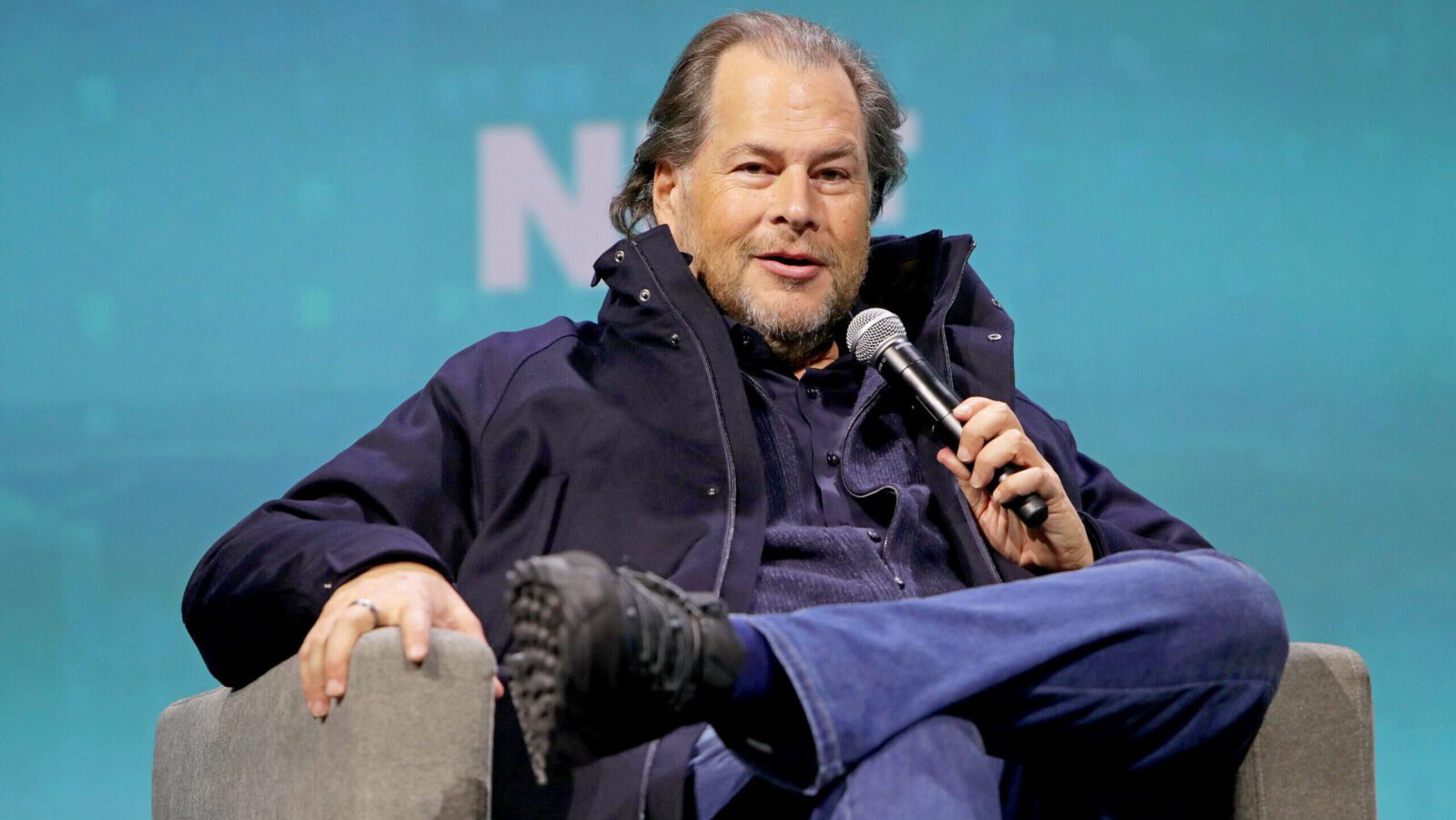
After becoming the unwilling poster child for the so-called SaaSpocalypse earlier this year, Marc Benioff & Co. used Salesforce’s quarterly earnings report Wednesday to make the case that Wall Street’s software pessimists are little more than Chicken Littles of the AI age. Their evidence? Record revenue and Salesforce’s own continued embrace of agentic AI.
Is The Sky Falling?
The narrative that put Salesforce at the center of the SaaSpocalypse is a simple one: In a world of highly capable AI-coding agents, every company can follow Klarna and Palantir’s lead and build a customer relationship management system of its own, lickety-split, saving tens of thousands of dollars in yearly expenses. Shares of the company have plummeted 30% this year as the world got Claude-pilled, and have lagged behind peers amid a post-repricing SaaS rebound. The iShares Expanded Tech-Software Sector ETF, for instance, has gained about 24% from an April 10 low, while Salesforce shares have rebounded less than 10%.
Last week, Bank of America analyst Tal Liani reinstated coverage of the company with a note reiterating an underperform rating, writing that “we expect a structural reset driven by AI transition that raises three core concerns: muted net new customer additions, limited up-sell potential, and an underwhelming AI monetization pathway.”
Company leaders essentially spent the earnings report attempting to refute the points, one by one:
- Salesforce posted revenue of $11.1 billion, a record and up 13% year over year. While that’s slower than the growth the company routinely achieved earlier this decade, Salesforce said it would deliver organic revenue acceleration in the second half of the year.
- Annual recurring revenue for Data 360 and Agentforce, its agentic AI tool, rose 200% from a year ago to nearly $3.4 billion. Meanwhile, “Agentic Work Units,” the company’s outcomes-based pricing metric for Agentforce, jumped 111% from the previous quarter, and more than half of bookings on Agentforce and Data 360 came from existing customers, a sign that clients are adopting the new AI-driven tools.
Force Majeure: Wall Street didn’t exactly bite. A lower-than-expected revenue forecast for the current quarter of $11.3 billion (below consensus estimates of $11.4 billion) dulled any enthusiasm for evidence that the corporate world isn’t quite ready to jump ship from its entrenched CRM platform. “We are not sure this will be enough to drive a meaningful reaction,” Barclays analyst Raimo Lenschow wrote in a note following the after-the-bell earnings call. Shares of the company fell as much as 1.6% in after-hours trading, suggesting the SaaSpocalypse narrative hasn’t exactly been slain.
Edited by Sean Allocca. Written by Emile Hallez, Griffin Kelly, John Manganaro, Lilly Riddle, and Quinn Waller.
Advisor Upside is a publication of The Daily Upside. For any questions or comments, feel free to contact us at advisor@thedailyupside.com.
Disclaimer
*Member FINRA/SIPC
1Kelly. G. (2025). Less Than Half of RIAs Have Succession Plans. The Daily Upside.
2Bloomberg Staff. (2025). Inside the Financial Advisor Succession Crisis. Bloomberg.
3Pershing. (n.d.). The Succession Challenge: What’s Your Gameplan? Pershing Advisor Solutions.