

Good morning and happy Wednesday.
When it comes to ETF investing, boring ain’t bad.
Though an iconic stockpicker himself, Warren Buffett has often recommended investors buy exchange-traded funds that track a broad index instead of holding individual stocks. In 2014, he even specifically suggested investors consider the Vanguard S&P 500 ETF because of its extremely low cost of just $3 for every $10,000 invested. Had an investor parked $10,000 in the fund when Buffett recommended it, they’d now be sitting on nearly $43,000.
That’s about half of the nearly 20% annual returns boasted by Berkshire Hathaway during Buffett’s six decades at the helm, but it’s a lot better than novice stock pickers can do on their own. To quote the Oracle of Omaha himself: “Games are won by players who focus on the playing field, not by those whose eyes are glued to the scoreboard.”
What the FIFA World Cup Means for ETFs

The FIFA World Cup has always been a spectacle of national pride, athletic drama and of course … billions of dollars in ad revenues.
As the tournament returned to North America this month, investors are increasingly asking not just who will lift the trophy, but how to get a piece of the economic action. Advertisements, streaming subscriptions and travel demand represent a meaningful slice of global consumer spending, not to mention opportunity for American brands to capitalize on new exposure to global consumers, said Jon Clements, managing director and co-founder of MarketDesk.
“Often, the best investment opportunities are found in secondary effects that are less obvious,” he said. “The World Cup is generating a lot of attention around US brands right now.”
New in Town?
You may have seen the memes: traveling sports fans experiencing American goodies for the first time, expressing awe online for treasures like Waffle House and Texas BBQ. That’s driving attention to American brands and opening them up to new demographics. It could also generate interesting signals for momentum investors over the following months, Clements said.
“You have a lot of global travelers in the US experiencing US brands, everything from Costco to food chains to different retail products that maybe are not available in their local markets,” he said. “Most US companies [already] operate on a very global basis, but I would imagine they’re collecting a lot of important data and information in terms of where there might be interest to expand markets.”
World Cup matches obviously also create demand spikes in the hospitality, airlines, ticketing platform and consumer discretionary sectors. Some of the largest funds in related themes include:
- The Gabelli Opportunities in Live and Sports ETF (GOLS) holds Manchester United (which has several players currently represented in the cup) and is up 2.97% this year.
- The US Global Jets ETF, which invests in commercial airlines and is up 10.98% over the same period.
- Funds that track host countries at the macro level, like the iShares MSCI Mexico and Canada ETFs (which have the tickers EWW and EWC, respectively) could also benefit.
Data, Data, Data: Still, it’s going to take some time for the verdict to come in on which brands and regions show the most growth potential, Clements said. “Whether it’s Japanese tourists in Texas falling in love with different elements of US culture, these companies … [are] also collecting a lot more data,” Clements said. “Data is being collected in real time that I think you’re going to see being spoken about on earnings calls over the next two to three quarters.”
39% of the Market Sits in 10 Stocks. What’s Next?
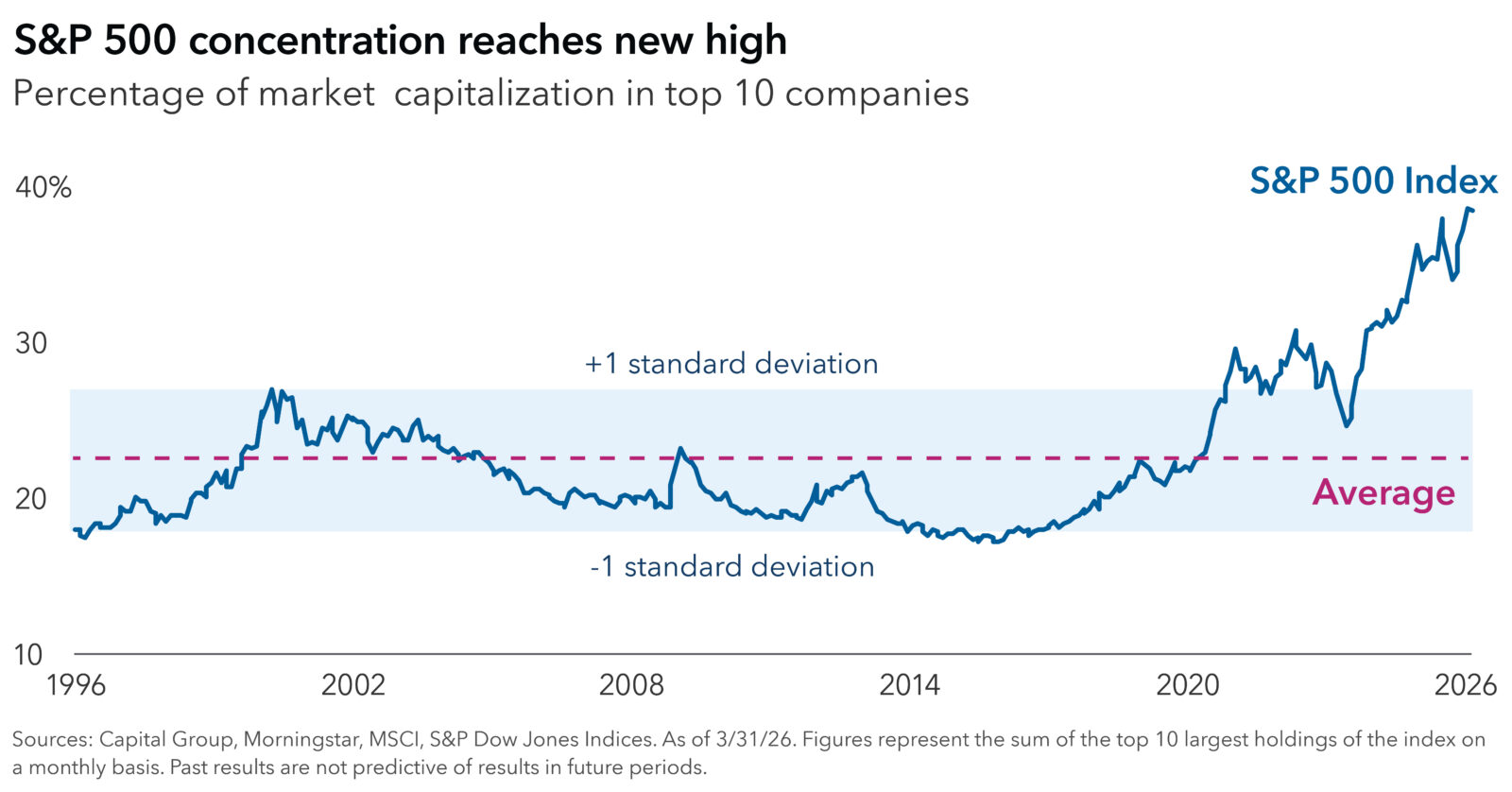
Concentration risk is looming, many US valuation measures are high and inflation worries are surfacing again. Yet, markets continue to surge with leadership broadening beyond Big Tech.
Flexibility matters in this environment. That’s why more advisors are considering a pivot to active management.
Capital Group’s investment process combines collaborative research, diverse perspectives and a long-term view.
It’s built for greater resilience and returns across various market cycles.
See how Capital Group’s active approach can strengthen your US equity allocation.
Active ETFs Approach Record $2.5T in Assets
Taylor Swift isn’t the only one who can’t stop breaking records.
Actively managed ETF assets have hit a new high, reaching nearly $2.5 trillion at the end of May, breaking April’s record of $2.3 trillion, according to data from ETFGI. It’s the 74th consecutive month of net inflows in actively managed exchange-traded funds, as the wrapper’s tax efficiency, liquidity and low cost continue to attract investor interest. The SEC’s decision to allow firms to launch ETF share classes of existing mutual funds has added to the momentum. While only about a third of ETF inflows went to actively managed funds in 2025, that market share is expected to grow.
“We’re still in the relatively early innings of the transition from mutual funds to ETFs,” said Matt Barry, vice president of ETF capital markets at Touchstone, adding that the SEC’s share class exemptions could be a “game changer.”
Actively Managed, Actively Growing
Actively managed assets have increased nearly 30% since the beginning of the year, with the majority of inflows going to equity-focused ETFs and a third going to fixed income-focused vehicles. “The majority of new launches that we see are in the active category now and that’s partially because many would think that the index space is covered very well and is very competitive,” said Deborah Fuhr, managing partner and co-founder of ETFGI. Firms also can’t charge as much for plain vanilla funds, and managers feel they can stand out from the crowd with active strategies. The research also found:
- Dimensional is the largest issuer with almost $297 billion in active ETF assets under management.
- JP Morgan Asset Management is a close second at $291 billion, followed by iShares with $169 billion.
Double-Edged Sword: While many investors like the flexibility of being able to trade ETFs throughout the day, mutual funds may continue to provide unique benefits, said Wes Crill, senior client solutions director and vice president at Dimensional. “Let’s say I’m someone who wants to make a one-time trade in a very large quantity … depending on how you’re putting that trade through the market, you might end up having an order that goes beyond the available liquidity in the marketplace for that ETF,” he said. “So, there might be additional costs in terms of the trading that wouldn’t be relevant for a mutual fund.”