
Good morning and happy Monday.
Private equity group Apollo said Friday that hackers breached its IT systems earlier this summer and stole personal information. The looted data includes names, birthdates, home addresses and Social Security numbers. Apollo did not detail how the breach occurred, except to say it was the result of a “social engineering incident.” That typically refers to tactics where attackers manipulate people to gain access to a system, such as phishing messages or phone calls posing as tech support.
And there are plenty more phish in the sea: Reuters reported earlier this month that hackers have set up websites intended to steal passwords from private equity firms, while the Financial Times reported hedge funds Point72, Citadel and Millennium Management have been targeted by cyberattacks. Apollo is offering those impacted by its breach complimentary credit monitoring and third-party identity protection services. For everyone else, the next time a suspicious “IT administrator” you’ve never heard of sends a link, do what you’d do on a dating app: Ghost it.
Warsh Goes to Wyoming. Will He Bring an Inflation Plan?

For Kevin Warsh, this week brings high stakes in the Grand Tetons, where the world’s business leaders will travel to look for clues about Federal Reserve economic policy.
The Fed chairman is slated to give his inaugural address to the Jackson Hole Economic Policy Symposium, where central bankers, Wall Street power brokers and government officials are hosted annually by the Kansas City Fed.
Quiet, Please
Since the 2008 financial crisis, central banks all over the world have boosted the volume of communications and guidance they issue. It began as a way of managing public expectations around then-unorthodox measures like zero interest-rate policies, allowing officials to explain the logic behind them and keep market anxiety in check.
Since he became Fed chair in May, Warsh has made clear that he believes, with interest rates now well above zero, the central bank should play a quieter role, returning to the more circumspect posture of longtime chair Alan Greenspan. “Financial markets perform best when they react to incoming data,” he said at a June press conference. “Financial markets work less efficiently when they ask a question: How will the Federal Reserve react to that incoming information?”
While Warsh has kept mum on what scenarios could spur the central bank to change intereest-rate policy, Fed watchers and investors still hope he addresses the elephant in the room: inflation. The shocks of the Covid pandemic, global tariffs and the Iran war have kept inflation well above the Fed’s 2% target for years now, with the July CPI reading coming in at 3.4%. Warsh says he wants to tackle the issue, but has given scant details as to how. Last week, the breakeven rates of the five-year and 10-year Treasurys in the bond market hit their highest levels in months, a sign that inflation worries are rising among investors. Some experts say even a morsel of information in his address this week could calm markets:
- “The best thing he can do is give some type of reaction function here,” TD Securities US rates strategist Molly Brooks said on Bloomberg Television, using the term for a guideline a central bank might use to make policy decisions in response to trends such as inflation or growth.
- Markets are currently pricing in a 40% chance of a rate hike next month and a more than 70% chance by the end of the year, according to CME Fedwatch.
Do Not Yield: Analysts at Standard Chartered wrote Friday if Warsh offered clarity around the Fed’s reaction function, it could “ease some monetary policy uncertainty” and, with it, pain in the bond markets. Yields on long-term Treasuries are rising over worries around America’s $40 trillion debt pile and persistent deficits, threatening to make it more expensive for the US government to borrow.
Anti-Data-Center Fever Sweeps America, Stalling Construction
In a new commercial for Garage Beer and canned water brand Liquid Death, former NFL-er Jason Kelce finds an apt visual metaphor for America’s growing frustration with sprawling AI infrastructure. (All we’ll say is that it involves a well-known side effect of beer consumption, so consider yourself warned if you decide to Google it.)
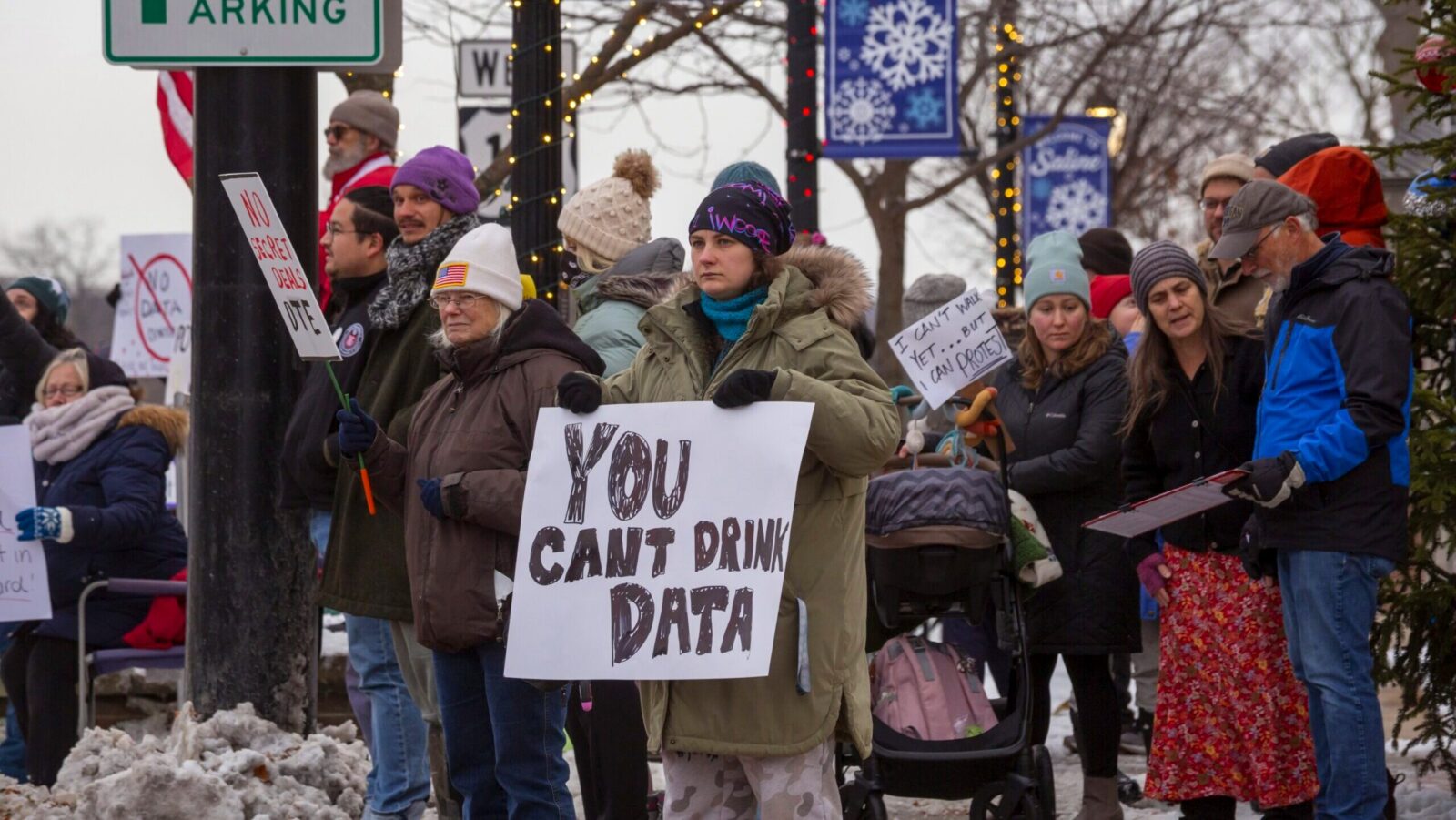
The massive data center buildout has emerged as a salient political issue ahead of this year’s midterm elections, flagged by both sides of the aisle. Last week, a survey published by Pew Research confirmed the zeal of the anti-data-center sentiment, which is now scoring some very real wins against Silicon Valley.
NAIIMBY (No AI In My Backyard)
Anti-data-center crusaders have objected to the energy, water and land demands of the massive server farms. But the Pew survey reveals an even more basic reason for their ire: Americans are worried that AI will take their jobs: Some 71% of survey respondents said they’re worried that AI will lead to fewer jobs in the next 20 years, with younger people even more fearful. In May, Gallup reported that 48% of survey respondents said they strongly oppose the construction of data centers in their local area, while another 23% said they would somewhat oppose it.
It’s been a strong enough pushback to stop some data center projects dead in their tracks, forcing tech giants to go on local-level charm offensives:
- At least 75 data center construction projects worth some $130 billion were either blocked or delayed by local opposition in the first quarter of the year, according to a recent report from AI safety group Data Center Watch. That’s roughly equivalent to all of the projects halted by local opposition last year.
- Meta earlier this month extended a $1 billion olive branch in the form of its “Future Is For Everyone” fund, which will distribute money back into communities near its data centers. OpenAI recently promised $80 million in community funds and $71 million in coding credits to a Georgia community where it hopes to build a data center.
Trade-Off: One group benefiting big time from the buildout: tradespersons. Tech firms are hiring armies of construction workers, electricians, HVAC specialists and more to complete the buildout, and are spending a fortune to train the next generation of trade workers, too. Some 216,000 construction jobs have been born out of the data center buildout since 2022, according to a Goldman Sachs study published in March. As one electrician-in-training set to soon join the data center buildout effort in Detroit recently told The New York Times: “Everybody wants that money.”