

Good morning and happy Sunday.
The US dollar was piloting through strong headwinds long before Washington’s abrupt imposition of high tariffs sent shock waves through global markets, fueling the “Sell America” trade. The greenback’s 9% drop as a result made 2025 the worst year for the currency since 2017, a decline arrested this year by the outbreak of war with Iran. What happens next, and whether the dollar’s long-term advantages will help it weather China’s growth on the world stage and the toll of mounting public debt, is the subject of today’s deep dive.
But first, a word from our sponsor, Oracle NetSuite.
Finance leaders: How do you know you’re using the right KPIs to steer your organization?
Business coach Bernie Smith believes he’s identified the 23 core KPIs every company should use to drive profit and sustainable growth, taken from his career with UBS, Tesco Bank, RSA and his own business.
Download Oracle NetSuite’s latest guide to learn how elite finance teams translate these key metrics into success, complete with case studies and step-by-step instructions to help dial in your strategy.
- Tested templates for all 23 core KPIs.
- Three “golden rules” for choosing your KPIs.
- How to quickly test your KPIs for validity.
And Smith’s #1 piece of advice on KPIs? Start the journey now.
What’s Good for Gas Is Good for the Greenback. But for How Long?
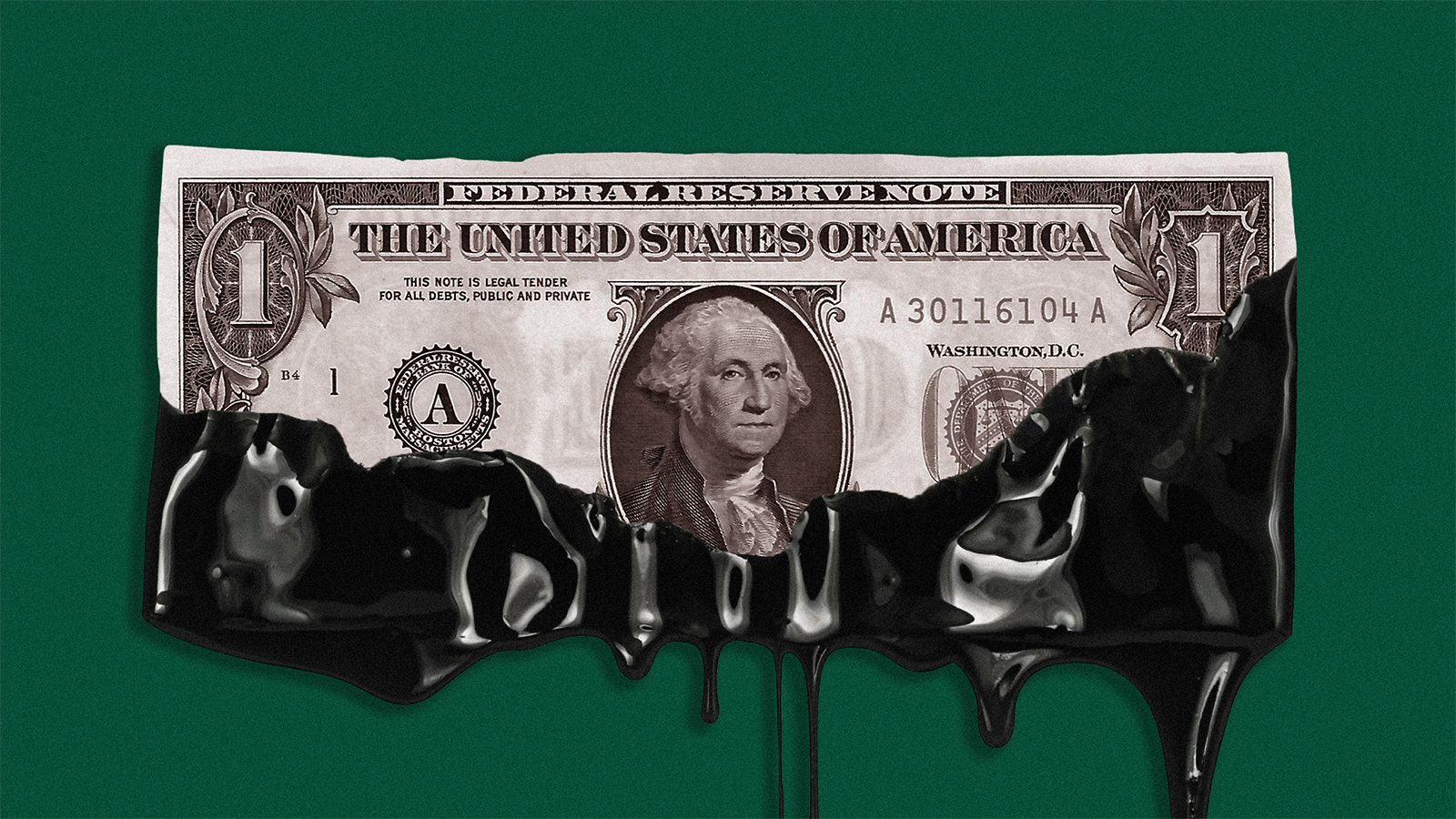
Two months have now passed since the US and Israel launched a series of strikes on Iran, sparking a regional war that has temporarily culminated in a fragile ceasefire as President Donald Trump tries to negotiate a more permanent arrangement.
The resulting uncertainty has upended global energy markets, driving inflation higher and depressing consumer confidence and growth forecasts. The price of oil by the barrel and gas by the gallon climbed faster than whiskey during prohibition (though, unlike whiskey, the costly act of filling up the tank hasn’t prompted rounds of Irish folk sing-alongs).
What’s good for gas, if not for gas buyers, has proved good for the US dollar, too, reigniting safe-haven demand for the world’s leading reserve currency after a bruising 2025. Not only did the greenback advance through March against other currencies, but it has also risen further in the past two weeks as the timeline for peace talks remains hazy.
But will the dollar’s relatively ebullient start to 2026 hold up? Many currency traders and analysts aren’t betting on it.
Selling America
In the last year and change leading up to the war, some economists and market watchers said the greenback had fallen prey to the “Sell America” trade. Investors reduced exposure to US assets after President Trump’s Liberation Day tariffs, though some, like JPMorgan Private Bank analysts, have held that “worst-case threats are unlikely to materialize.”
Nevertheless, the haste with which the Trump administration introduced its tariffs (many of which have since been struck down by the US Supreme Court) prompted some investors to shore up their own financial stability by reducing dependency on a less predictable America.
Central banks trimmed their greenback holdings, exacerbating so-called de-dollarization, or the reduction in use of the US currency in global trade and transactions. The causes of the phenomenon, which has been gradually unfolding for years, aren’t limited to the current administration or its trade policies.
For example, the rising public debt in the US, which ratings agencies have flagged as a reason to be concerned about the country’s long-term fiscal outlook, has fed into worries about the dollar’s resilience. Additionally, the Justice Department investigation of Federal Reserve Chair Jerome Powell, which was dropped earlier this month to the relief of markets, made some investors anxious about the independence of the central bank (and, thus, its monetary policy).
There’s also the BRIC group of emerging market countries, including Brazil, Russia, India, China and South Africa, which analysts say have added incentive to diversify away from the dollar after sanctions the West placed on Russia over its invasion of Ukraine. De-dollarization has also been evident in a massive spike in gold-buying by central banks and institutional investors, which represents a broader hedge against fiat currency, as well as in digital assets and currency swaps.
Facing these and other pressures, the US dollar fell more than 9% in 2025, marking its worst performance since 2017. According to HSBC, it was the worst-performing currency in the G7.
Financial Backbone
The weakening of the dollar can reinforce de-dollarization, since it increases the risk of negative returns on Treasury bonds, thereby boosting appetite for other assets.
All told, the dollar’s share of global reserves has declined from its 72% peak in 2001 to 57% in the fourth quarter of 2025, according to the International Monetary Fund.
Currently, it represents around the lowest level of foreign reserves since the mid-1990s.
While US policy has contributed to and possibly accelerated de-dollarization, and the rise of China as an economic superpower has prompted more renminbi-denominated global transactions, the greenback maintains a position of relative strength.
Simply put, it remains the backbone of global finance. There’s no evidence to suggest that will change in the short or medium term, either.
In addition to accounting for more than half of the world’s foreign exchange reserves (more than double the euro’s share, and more than 25 times that of China’s renminbi), the dollar last year was involved in a whopping 89% of foreign exchange market trades and 54% of global export invoicing, according to the Atlantic Council.
Furthermore, the dollar underpinned 60% of foreign-currency debt issuance, 87% of EU fuel imports, and roughly 80% of trade finance, according to the UK’s Centre for Inclusive Trade Policy, which noted its own country has become more dollar-dependent since leaving the European Union.
Dollar vs. Digital Gold
Institutional investors and US allies and foes may all be seeking alternatives and diversification as a hedge against dollar volatility, but that won’t change the simple reality of the dollar’s financial entrenchment. Pile up all the gold bars worth their weight in, well, themselves or stock up on digital assets like they’re Pokémon collectibles, and that won’t suddenly change.
After last year’s steep decline, the US dollar index (which tracks the greenback against a basket of foreign currencies) has risen a comparatively rock-solid 0.4% this year as the Iran war reaffirmed its traditional status as a safe haven.
Historically, there was limited correlation between the dollar and oil prices, but as the US has become an oil exporter, the two have become increasingly synchronous in recent years.
The war, of course, has sent oil prices above $100 a barrel, which has also created another force uplifting the currency: Pricier energy is expected to mean higher inflation, which will limit the Federal Reserve’s ability to cut interest rates.
This, logic holds, will make US Treasury bonds more attractive to investors, whose business would strengthen the dollar. Indeed, inflation rose in March, and economists now expect Fed policymakers to punt on rate cuts until next year.
But these factors depend heavily on continuing uncertainty over the war and the Strait of Hormuz, where Iran has blockaded the world’s most crucial crude chokepoint. While favorable for the dollar in the short term, if the US and Iran do strike a deal, these currents lending strength to the dollar could soon fizzle.
The Trump administration, which has frequently advocated for a weaker dollar to boost exports, may be just fine with that.
Analysts at Morningstar viewed the dollar as 10% overvalued before the Iran war, implying it still has considerable room to depreciate once global economic conditions normalize.
Meanwhile, the ceasefires in Iran and Lebanon have led many traders to assume the worst of the current conflict is over and have offered hope that the Strait of Hormuz, where 20% of the world’s crude is trafficked, could be reopened when a permanent resolution is agreed upon.
Pain and Petrodollars
If the conflict remains in a holding pattern or the ceasefires don’t hold, the forces strengthening the US dollar would likely persist. That could be a pain for some.
Notably, countries that rely on energy imports might be squeezed by continued high oil prices, which could also push their currencies down against the dollar. US Treasury Secretary Scott Bessent has already said that “many” Persian Gulf allies have requested currency swap lines as a backstop against this risk.
And when a formal agreement to the conflict is reached, Deutsche Bank analysts wrote last month that the dollar could be in for its own walloping in the form of another sustained wave of downward pressure.
“The world saves in dollars because it pays in dollars,” they wrote, adding that the “foundations of the petrodollar regime” are at risk. The petrodollar refers to the global practice of buying oil in dollars, which is especially prominent in trading in the Middle East.
“The long-term legacy of the Iran conflict for the dollar could be the way it tests the foundations of the petrodollar regime,” Deutsche analysts said, “If fault lines are further exposed, there could be significant downstream effects to the dollar’s use in global trade and savings, and the dollar’s role as the world’s reserve currency.”
The greenback remains the undisputed anchor of global reserves, yet geopolitical volatility has turned its long-term trajectory into a “known unknown.”
When Did You Last Audit Your KPIs?

Last quarter? Five years ago? Never!?
Look, using the wrong KPIs in your business is like sailing across the ocean with a broken compass: You’ll just drift aimlessly until you sink.
With Oracle NetSuite’s latest guide, 23 Essential Financial KPIs, you can “audit” your KPIs, testing for validity and seeing which KPIs would actually serve your business better.
- Clear definitions of the KPIs used by top financial teams (Working Capital Ratio, Cash in Bank, Cash Forecast and more).
- Examples of how to apply them to your business.
- Common mistakes made with each KPI.