

Good morning and happy Monday.
They’re in the Army now. The Pentagon on Friday announced deals with eight tech companies to use their AI tools in its classified networks. Amazon Web Services, Google, Microsoft, Nvidia, OpenAI, Oracle, Reflection AI and SpaceX will join the likes of Palantir to bolster US military operations.
Notably absent was Anthropic, designated a supply chain risk by the Pentagon after it objected to its technology being used in mass domestic surveillance or autonomous weapons: A federal judge blocked the move in March, and the DoD has pledged to appeal. But the Pentagon now says its blacklist doesn’t apply to Anthropic’s powerful cybersecurity-focused model, Mythos, which has been kept from public distribution due to its powerful hacking capabilities. In other words, they really want it.
Point72 Founder Steve Cohen Makes More Room at the Top as Hedge Fund Expands

Batter up. New York Mets owner Steve Cohen is letting another heavy hitter step up to the plate at his hedge fund Point72 Asset Management.
Cohen is relinquishing the title of president to his co-chief investment officer, Harry Schwefel, as he works on forming an executive committee to assist him in the firm’s strategy, according to Bloomberg, which cited an internal memo. He’ll still be chairman and CEO. “Over the past few years, our firm has grown across virtually every metric — AUM, headcount, global footprint,” Cohen wrote. “As we continue to pursue the growth of existing and new strategies, I want to ensure our management structure matches our current scale and growth ambitions.”
Growing the Roster
The Mets may be pricey losers at the moment, holding titles for both the team with the worst record and the second-highest payroll, but Cohen’s other venture has been on a comeback tear. After the war in Iran rattled markets in March, hedge funds worldwide took a hit, with Point72 losing 0.7%. But the firm recouped losses in April, gaining 3.5% through April 23 and pushing its returns for the year up to 7.5%, Bloomberg reported.
Point72 and most of its top-tier rivals, including Citadel and Millennium, run multi-strategy funds or “pod shops,” which generate returns (and ideally, reduce risk) by diversifying their strategies. For Cohen, whose $3.4 billion payday last year made him the world’s highest-paid hedge fund manager, the strategy has paid off. As of April 1, Point72 has more than $50 billion in assets and over 3,300 employees globally. It has broken into strategies including macro, private credit and venture capital.
So it makes sense that Cohen is looking to add more players to the field with a new committee (though Cohen will still oversee investments, run daily morning risk meetings and mentor traders, and has no plans to leave Point72 anytime soon). It’s common for hedge fund founders to have an Elon Musk-like persona in which they’re just as well-known as the firms they run, but lately some major players have invited other leaders into the fold:
- Millennium Management founder Izzy Englander sold a minority stake in his investment firm last year, and Citadel’s Ken Griffin said in 2024 he’d be open to doing the same.
- The D.E. Shaw group, founded by David E. Shaw in the ’80s, is now led by a seven-person executive committee. Balyasny Asset Management continues to add members to its leadership team, too.
Little League Letdowns: Smaller hedge funds are facing an increasingly competitive market dominated by behemoths like Point72 and Citadel. AllianceBernstein shuttered its hedge fund AB Arya last month. Eisler Capital shut down following poor performance and high costs last year.
Traditional Retirement Is Dying (And That’s a Good Thing)

For most high-performers, the idea of retiring at 65 feels a little … premature. You aren’t done building, contributing or creating; in fact, you’re just getting started.
That’s why Life After Work is quickly replacing traditional retirement.
Instead of stopping work completely, Life After Work allows you to transition to something that’s more flexible, fulfilling and aligned with your personal goals or interests.
And another huge benefit? It means you can keep generating income. Cha-ching!
BEW’s guide explains how to correctly adapt your investment strategies for Life After Work. From Social Security and healthcare to liquidity and market timing, this playbook gives you the confidence to make “retirement” your most meaningful years yet.
SoftBank Maps Out $100 Billion Robotics Spinoff

Every rose has its thorn, and SoftBank’s unwieldy portfolio of AI investments is starting to feel a bit prickly.
Masayoshi Son’s solution? Bundle a bouquet of existing SoftBank bets together into a new venture that exists at the intersection of AI and robotics, name it Roze AI, and take it public sometime in the next seven to 19 months, according to a Financial Times report last week.
AI, Brought To You By AI
Just about everyone in the AI world sees so-called “physical AI” as the next great frontier; at the Consumer Electronics Show earlier this year, Nvidia CEO Jensen Huang famously declared that robots were about to have their “ChatGPT moment.” For SoftBank, Roze AI would represent a critical move to both catch the next AI wave and reduce exposure to the data center infrastructure and frontier model-making it has thus far invested in heavily. Per the FT, key SoftBank lieutenants are growing wary of the company’s costly alliance with OpenAI, with the tens of billions of dollars the group has invested and loaned to the firm potentially weighing on its balance sheet.
Launching Roze, at a valuation as high as $100 billion, might help ease some of the financial burden. The timing could be critical:
- To fund its AI investments, and bets on OpenAI in particular, SoftBank last month signed a $40 billion bridge loan, its largest-ever lending facility denominated solely in dollars, per Bloomberg. Meanwhile, The Wall Street Journal reported last week that SoftBank has considered selling its Intel stake to fund its investments; last year, it sold its $5.8 billion stake in Nvidia.
- Roze would feature many of SoftBank’s existing energy, land and infrastructure investments, sources told the WSJ, and would invest in the creation of robots that could, in turn, help with the massive buildout of data centers.
Slice of Life: Yes, that’s robots running AI models created in data centers being used to build more data centers to train more AI models to … well, you get it. Historically, SoftBank’s interest in robots has ebbed and flowed. An early attempt to build a robot dubbed Pepper was canned in 2021, while Zume Pizza, the robot-operated pizzeria startup it backed, shuttered in 2023. But last year, the company agreed to buy ABB’s robotics business, which builds bots for industrial settings, for $5.4 billion; sources told the FT that once the deal closes, ABB could be a centerpiece for Roze.
How Do You 2x the S&P for 9 Years Straight?
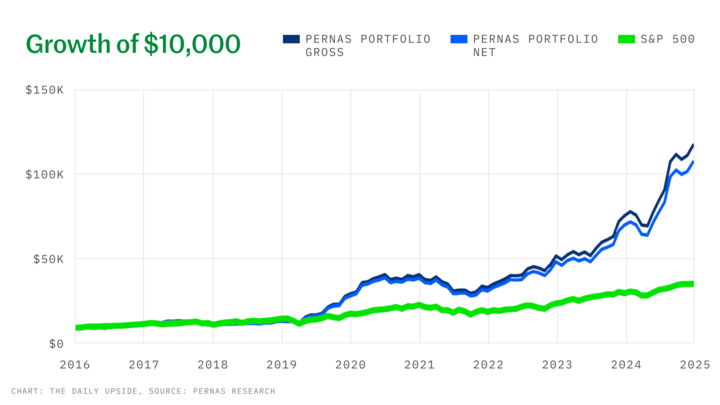
No clients. No capital to raise. No incentives beyond performance. That’s how the Pernas brothers have delivered 31.40% annualized returns since 2017 — more than double the S&P’s 15.10%. They share their highest-conviction picks with 13,000+ investors. Get the picks here for free.*
Graviton Draws Global Spotlight onto India’s Unicorns

India has a $1.3 billion high-frequency trading firm competing on a global scale with the likes of Jane Street and Citadel, Bloomberg reported. It’s called Graviton, not to be confused with the “Gravitron” rides at the state fair or Amazon’s AI chips of the same name.
The 11-year-old company quickly grabbed the majority of market share in block trades involving more than 0.5% of a company’s equity, maintaining its dominance on India’s NSE through last year. Graviton was primed and ready to execute trades faster than its competitors when retail traders flooded onto its platform during the pandemic. And in 2024, Graviton had a role in a quarter of large cash transactions on the NSE.
But the startup attracted competition from Wall Street stalwarts that saw the massive revenue opportunity Graviton was grabbing in India.
India’s Rising Unicorn Population
India is Asia’s third-largest economy and home to 120 startups with valuations exceeding $1 billion each. The Confederation of Indian Industry recently called India the world’s third-largest startup scene, with funding of more than $118 billion pouring into it. FinTech’s a key area of growth for the nation. Graviton, for instance, leverages customizable chips to speed up the processing and sending of each order by precious nanoseconds, fast enough to beat the humans with quick keystrokes that previously led the industry.
But as the financial scene grows in India, regulators are sharply eyeing the piles of money pouring in:
- India upped taxes on equity derivatives last month, and the central bank plans to further turn the screw with new rules. Together, Jefferies Financial Group expects the changes could slash options volume as much as 17%. Firms in India also have to meet new compliance requirements.
- The changes could make Indian markets less attractive for foreign investors who’ve pulled out of public markets in droves amid the Iran War.
Growing Pains: There’s a balance between enough regulation and too much. India’s regulators risk slowing the startup scene’s growth to a crawl that could push the companies to seek out opportunities elsewhere. Graviton, which had its offices raided by tax authorities in October along with other firms, is doing just that by diversifying its biz globally.