

Good morning.
Add a Coldplay jumbotron “kiss cam” moment to the “Spy Who Loved Me” outtakes we’ve all been drinking up. Three days after Nvidia CEO Jensen Huang admitted he had a romantic relationship with a suspected Chinese spy, The New York Times reported yesterday that Huang had an affair with Kimberly Powell, a top Nvidia executive who reports to him. (At least it wasn’t another honeypot, but the two were evidently caught on video canoodling in public by a bystander.)
Shortly thereafter, The Wall Street Journal reported that Nvidia’s board of directors is preparing to oust the chief executive. This would mean an unceremonious end to a meteoric business career, which saw Huang emerge as the charismatic face of the AI boom. It may also spell an end to sales of Tom Ford motorcycle jackets. Meanwhile, shares in Nvidia are down 7.9% in premarket trading this morning. And the company, which has no clear succession plan, warned of losing top talent in its latest proxy statement, noting “we are highly dependent on the services of our longstanding executive team.” They could try dialing the 402 area code: Isn’t Warren Buffett a free agent?
Anthropic’s IPO Is Both Boom and Bust for Big Tech
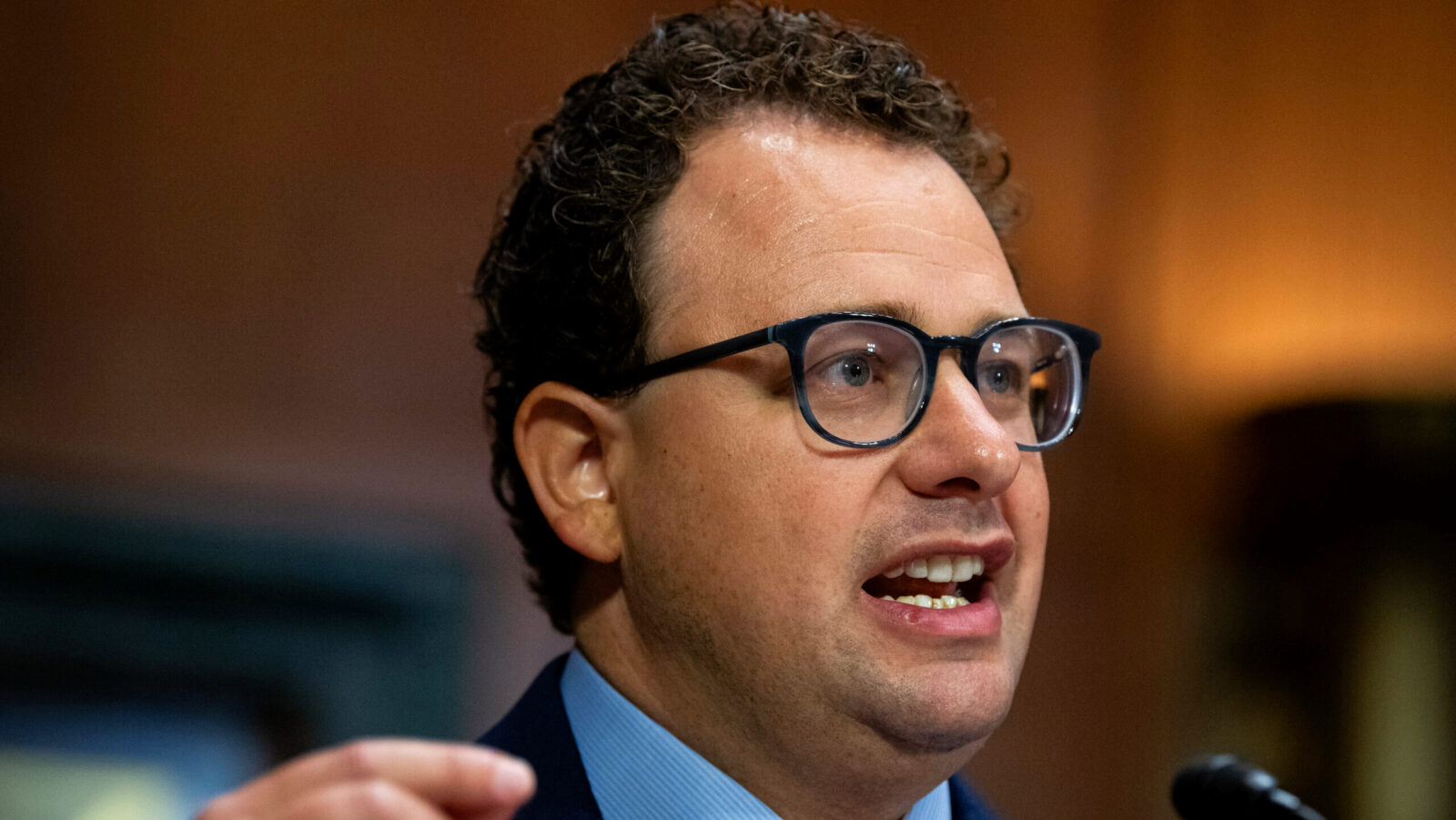
Dario Amodei had a message in the closing remarks of Anthropic’s IPO roadshow: “Cancer, Alzheimer’s, heart disease, mental illness, these will be relics of the past in less than a decade.”
It’s a big promise, and he seems to have secured some big buy-in; Bloomberg reported Wednesday that the orderbook for the IPO, widely expected to hit next Thursday, is already multiple times oversubscribed. In fact, at a price range of $70 to $78 per share the debut is likely to raise $90 billion, an all-time record. Take it as a sign that excitement for the first bite at a pureplay AI lab is enough to override bubble fears. Some of the biggest beneficiaries will be its (theoretical) bubble co-habitants.
Return to Office
The Claude-maker is targeting a valuation of around $1.4 trillion to $1.5 trillion, massive but a tick below previous expectations. Either way, Big Tech will be happy. Google and Amazon stand as Anthropic’s two largest outside shareholders, collectively owning about a quarter of shares after buying in low in the early days, while Microsoft also has a stake from an early investment. Amazon could see its $18 billion investment soar to a $250 billion valuation next week, large enough to “forever change” the e-commerce and cloud computing giant per CEO Andy Jassy.
That valuation is still based on a projection-slash-hypothetical “that there will be new commercial advancements and product developments in AI that will drive faster new spend that we can’t conceive of yet, that there will be another coding agent revolution,” Ara Kharazian, lead economist at Ramp, told The Daily Upside. The promise is strong enough for Goldman Sachs, the IPO’s lead investment bank, to forecast annual revenue of $600 billion by 2030, or roughly 12 times its expected revenue this year. In the meantime, Anthropic already has its next revenue stream idea in mind, and it’s one that its Big Tech backers are quite familiar with:
- On Tuesday, Anthropic unveiled a suite of office productivity applications including a video call assistant, a collaborative tool called Claude Whiteboards and Claude Sheets, which, yes, is just an AI-ified ripoff of Microsoft Excel and Google Sheets.
- Yes, that means Anthropic is directly squaring off with some of its biggest backers; Microsoft shares slipped 3% on Tuesday and more than 2% on Wednesday following the apparent asSaaSination attempt. On the other hand, adoption of the Claude tools could still benefit Big Tech backers, who sell Claude tools through their cloud computing platforms.
“There is a circularity in investing here, partly driven by not wanting to be left out,” Aswath Damodaran, a professor at Stern School of Business at New York University, told The New York Times.
Code Red: The second assumption of the AI trade, Kharazian says, is that “the coding agent revolution is still ongoing.” That will require much stronger adoption. Just 1% of businesses — primarily VC-backed companies in tech, finance and technical services using coding tools — drive 80% of OpenAI and Anthropic’s revenue, Kharazian’s analysis of Ramp’s corporate spending data found. “That spend is already starting to slow down because of a combination of factors, mainly price cuts, and that it’s just getting easier and more fashionable to control your AI spend,” he said. Translation: Tokenmaxxing didn’t even make it into the New Year.
Take a Nap, Bears: Revenue Surge at CoreWeave Calms AI Spending Worries

Winter is nigh upon us and CoreWeave would like to send the bears that dragged its stock down 30% on the year before Wednesday into hibernation.
The New Jersey-based cloud computing company has seen its capital-intensive business model come under heavy scrutiny in recent weeks, but shares in CoreWeave closed up 24.7% yesterday after its latest earnings report eased some of the market’s biggest concerns. Many analysts still aren’t holding their breath.
Anxiety Another Day
As a key infrastructure operator supporting the AI boom, CoreWeave has added customers galore in the last year. No problem there. It’s the company’s heavy spending on new projects and the resulting, even heavier debt load that left many investors seeing a big, giant flashing R-I-S-K sign. Since last month, the spread on five-year credit default swaps on CoreWeave, basically an insurance policy on the possibility that the company defaults, has exceeded 1,100 basis points over benchmark rates. Anything above 1,000 is widely considered distressed debt territory. The yield on the company’s 2031 bond was as high as 16% last week, and about 15% on Wednesday, which tells you all you need to know about the risk premium markets are demanding. And Wednesday’s report confirmed that CoreWeave’s interest expenses for the first nine months of 2026 were $2 billion, more than double the $841 million in the same period a year earlier.
What’s more, its $66 billion in debt and lease liabilities were up from $52 billion in the second quarter.
But CoreWeave’s third-quarter earnings rebuffed many doubters head-on. The company’s record $3.7 billion revenue grew 168% year over year and bested forecasts. Executives expect $4.8 billion of revenue in the final three months of the year, also better than Wall Street’s projections. Although the company’s net loss widened to $709 million from $110 million a year earlier, CoreWeave’s revenue backlog reached $132.5 billion, up from $104 billion at the end of the second quarter. The compute demand is real and the lineup of customers demanding its services is set to ease credit concerns. CEO Michael Intrator said during an earnings call that CoreWeave will rely less on debt to fund its capital spending, which is on pace to hit $39 billion in 2026. Instead, the company will use deposits and prepayments from customers, which it expects to receive $9 billion of in the current quarter alone. Even as analysts kept their guard up, they offered praise for the new direction:
- “They’re continuing to mature as a company, executing better with every print and managing the narrative more competently than they ever have. … But we just can’t get over our long-term fundamental concerns about this business model,” wrote Bernstein analysts in a note, adding “we want to be believers.”
- “We’re encouraged by this print, but investors need more confidence in the underlying economics of the business,” said UBS analysts.
AI Rising Tide: If anything, Wednesday showed what a key barometer CoreWeave has become for the AI trade as a whole. Shares in more than a dozen prominent companies tied to the AI boom climbed more than 10%, including cloud provider Nebius Group, data center fuel cell provider Bloom Energy, high-speed optical transceiver-maker Lumentum, AI-optimized server provider Dell and semiconductor designers Arm Holdings and Micron Technology. “You could almost hear the sigh of relief in the AI market as [CoreWeave] posted solid results,” wrote JPMorgan analysts.