

Good morning and happy Friday.
You didn’t need insider knowledge to see this one coming. The state of New York sued Polymarket Thursday, painting it as an illegal, unlicensed gambling operation. It’s the fourth case Attorney General Letitia James has brought against prediction market operators this year, with Kalshi, Coinbase and Gemini facing similar accusations.
Operators and the Commodity Futures Trading Commission have argued event contracts should be considered a derivative subject to federal regulation. But federal appeals courts are split. The 3rd US Circuit Court of Appeals sided with the CFTC and platforms in an April case brought by New Jersey, but last month, the 9th US Circuit Court of Appeals ruled against prediction markets in a Nevada case and ordered them to stop offering sports event contracts. This could set up a Supreme Court showdown: Traders on Polymarket currently put the odds of the nation’s top court taking up a sports event contract case by the end of the year at 22%. Just remember, if you have a sudden, uncontrollable urge to take that bet, you’re hooked on derivatives, not gambling.
Treasury Yields Touch 20-Year Highs, Fueled by Sticky Inflation, US Debt
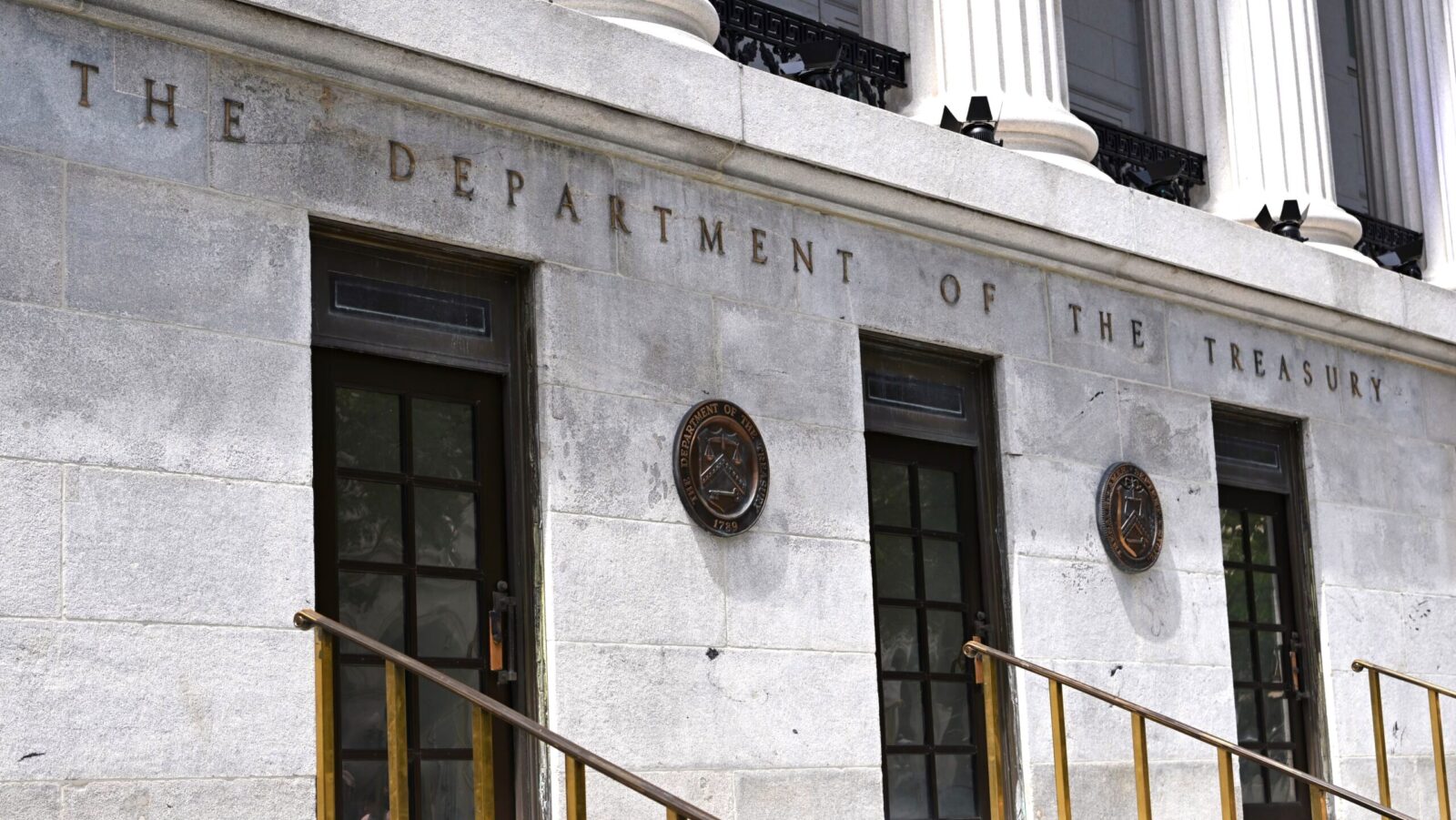
You know the deal by now. US bond yields are rising because investors are worried about persistent inflation, fueled by higher oil prices, which could drive up interest rates. At the same time, the rationale for rate hikes has been strengthened by a surprisingly resilient American economy that looks like it can absorb them. Meanwhile, the rapidly growing, supersized US debt pile means the Treasury has to keep issuing large amounts of bonds, whose higher yields could lure investors at the expense of equities.
On Thursday, this bundle of macroeconomic forces drove yields to the highest in decades. The 10-year US Treasury yield surged more than 10 basis points to 5.223%, the most in 19 years, while the 30-year yield hit 5.501%, the most since 2004.
The Yield Appeal
This week offered new evidence that the US economy has the wherewithal to withstand higher interest rates, a key tool for the Federal Reserve to curb inflation. S&P Global released data showing US business activity surged at the fastest rate in more than five years in September. That strengthened the odds that the Fed will raise interest rates in October to about 70%, up from 55% a week ago, according to CME FedWatch.
Bond yields tend to track interest rates, and there are concerns about what a 5% or higher yield on the 10-Year Treasury means for markets. Because Treasurys are backed by the US government, they’re considered virtually risk free. When yields surge, investors are forced to rethink their rationale for choosing between stocks and bonds. Equities with 5% to 6% annual yields, which aren’t guaranteed and are subject to stock market volatility, are suddenly a lot less appealing to long-term investors who can lock in guaranteed returns through higher bond yields. The resulting concern is that investors are incentivized to move money into the Treasury market at the expense of stocks. In reality, it may not be so simple:
- Investment bank Jefferies forecasts earnings at S&P 500 companies will climb 35% this year. Growth like that is more than enough to keep investors from decamping for bond yields.
- For small-cap companies, which are sensitive to higher rates because they are much more reliant on short-term bank loans and floating-rate debt, the road ahead looks much steeper.
Unlucky Number Seven: While the US economy remains resilient, there is one notable weak spot. The 10-year yield strongly influences consumer borrowing rates, and the average 30-year fixed mortgage rate rose to 7.03% on Thursday, the highest in 20 months, according to Freddie Mac data. The annualized pace of US home sales had already slowed for the past three months, and it’s hard to imagine people lining up for 7%+, 30-year mortgages.
Google Takes Data Centers to the Stars to Solve Earthbound Problems
Google has famously branded its high-risk, high-cost megaprojects moonshots. That label applies almost literally to its latest one. The tech titan yesterday announced plans to launch a satellite into space that will attempt to process AI queries above the Kármán Line. Eventually, the goal is to launch dozens of satellites that together will act like an AI data center.
The lofty ambitions are grounded in harsh realities down on the ground, as tech companies fight for data-center real estate and vast amounts of water and electricity — and as a growing number of constituencies fight them off.
The Brave Little Refrigerator
Google’s satellite, roughly the size of a refrigerator, contains four AI chips called tensor processing units that together have about as much compute power as a single server at a data center. Phase two of Project Suncatcher will involve launching a duo of AI satellites next year to test how well they communicate with each other using lasers. Eventually, Google has drawn up plans to launch even more complex systems but for now, Project Suncatcher is more of a proof of concept that could, possibly next decade, yield results.
Tech leaders including Elon Musk, Jeff Bezos and Sam Altman have supported space “data centers” as a potential solution to terrestrial troubles. Google’s first attempt at making the idea a reality shows the new problems that arise in the process:
- There’s a lot of space in space and no neighbors, but that’s not necessarily true forever. As satellites go defunct and are sent into the atmosphere for a fiery retirement, they could erode the ozone layer. And the leftover space junk that doesn’t burn up could create collision hazards.
- Google’s trying to solve the Earth’s power problem, meanwhile, by picking an orbital path that lets the satellites bathe their unfurled panels in the sun perpetually. The satellite also won’t use water to cool its chips, instead letting heat dissipate through putty-like material. It’s not a perfect system: The satellites have to take a break every 15 minutes to cool down.
Space Beef: Google has made it clear there’s a long runway ahead before it can reliably answer users’ “Do these eyeglasses look good on me?” queries from space. But the small start puts Google ahead of rivals, who’ve recently been arguing about the timeline for space data centers. Elon Musk said last month that SpaceX will launch AI data centers into orbit next year and reach significant scale the year after. His archenemy, OpenAI CEO Sam Altman, is openly skeptical.
Nearly 70% of Software Buyers Doubt Their Picks

If your team never fully adopted the last platform you bought, you’re probably not alone. Capterra found just 31% of buyers felt confident in their software purchase. This free guide fixes that in five steps, from a vendor scorecard to negotiating terms. Download it before your next contract goes the same way.