

Good morning and happy Friday.
Cash is king in some financial contexts, but not when it comes to gifting from donor-advised funds.
Almost three-quarters of dollars granted to charities from such funds on the DAFgiving360 platform during the 12 months through June were donated in the form of non-cash assets. The gifts took many forms, including both pre- and post-IPO shares of individual stocks, ETFs, mutual funds, private business interests, art and even cryptocurrencies. It’s a popular approach because donating appreciated assets, rather than selling the assets first and gifting cash, allows donors to eliminate capital gains taxes and claim a fair market value charitable deduction. An efficient tax-planning strategy, it can meaningfully increase the total dollars that go to charity.
So, before your clients sell assets to fund their charitable giving goals, they should probably consider in-kind donations.
End of Part D Subsidies Raises Stakes for Medicare Enrollment

They say being a smart shopper is the first step to financial stability.
Clients shopping for Medicare coverage should heed that advice if they want to avoid nasty surprises when paying for prescription drug coverage next year. Federal subsidies that have helped keep Part D drug plan premiums lower in recent years will stop after Dec. 31, which could impact both plan pricing and drug coverage, according to Kimberly Lankford, a Medicare expert and reporter at The Wall Street Journal. Making the wrong choice or simply failing to review one’s options could cause unnecessary strain on retirees’ budgets and even loss of access to preferred medications. Advisors can provide a huge benefit to clients grappling with the changes, but only if they’re up to speed on them.
“It’s always important to revisit Medicare decisions, but it’s even more important this year,” Lankford told Retirement Upside. “You have to look at all your options through the plan finder tools on Medicare.gov. Dig into the drug formularies and cost-sharing requirements. Do the whole analysis.”
Sayonara, Subsidies
The Trump administration’s choice to scrap the subsidies stole headlines last week, Lankford said, but the program was always temporary and would have phased out after 2027 anyway. They were created to help defray higher premium costs resulting from the Inflation Reduction Act’s capping of out-of-pocket spending for prescription drugs. About the cap:
- The annual spending cap is $2,100 in 2026, following an initial $2,000 cap implemented in 2025.
- The cap is linked to inflation and will increase to $2,400 next year.
“When the law passed, there was fear that the cap would disrupt Part D pricing or drug coverage,” Lankford said. “The Trump administration has voiced confidence that the market has now stabilized sufficiently and that ending the subsidies a year early isn’t a problem.”
Sticker Shock. The real effect on Part D premiums won’t be known until October, but even if premiums go up a lot, it’s important to keep the broader context in mind. “Some people might have a bit of sticker shock for their drug coverage options,” Lankford said. “Some might consider going down the Medicare Advantage route because of what seem to be attractive, low premiums. People need to be very careful about those decisions.”
That’s because Advantage plan premiums can look attractive, but that’s only part of the story. Advantage plans have limited provider networks and require more prior authorization for medical procedures, for example. There’s also greater cost sharing in general between the insurer and the insured.
Clients can always switch back to original Medicare later, but that comes with risks if their health declines, Lankford said. “It’s a very different animal, so again, it’s key to actually run the analysis and really look carefully at the total potential cost.”
Blending Private and Public Market Access

Your clients look to you for retirement guidance they can count on: New T. Rowe Price Goldman Sachs Retirement Blend Plus Trusts offer all-in-one strategies that fuse public markets and private equity, private credit, and private infrastructure.
Developed in conjunction with Goldman Sachs Asset Management’s private market capabilities, these trusts:
- Adjust to changing needs: Target date portfolios designed to evolve over time and deliver durable, long-term outcomes through retirement.
- Blend strategies with purpose: Meaningful allocations to active and passive strategies alongside a range of private investments.
- Diversify with a holistic lens: Globally diverse strategies selected for risk management.
The Father of the 4% Rule Has New Ideas About Retirement Income

If you’re reading Retirement Upside, you’ve probably heard of the 4% rule.
In case you haven’t, it’s generally considered a safe income planning guideline that lets retirees withdraw 4% of their total savings in the first year of retirement and then adjust that dollar amount for inflation every year afterward to make their nest egg last for 30 years. The rule is ubiquitous in the mainstream media and among popular financial planning voices online, thanks to its straightforward answer to a daunting financial planning question: How much can clients spend in retirement without risking poverty in old age? But they may be surprised to learn that the rule’s creator, Bill Bengen, never intended it to be a baseline for retirement income planning. Quite the opposite, in fact.
“It’s actually a rule that only applies for a very narrow segment of the population in practice,” Bengen recently told Retirement Upside. Ultra-risk-averse people living off a 401(k) account who want to make sure their retirement income plan would have worked out without adjustment during the worst period in the modern history of the stock market should follow it. Others who are accepting of more risk can afford to draw more income, especially if they’re willing to make adjustments along the way.
“I never intended it to be a panacea for ‘safe’ retirement income planning, but that’s kind of what it’s become,” Bengen said.
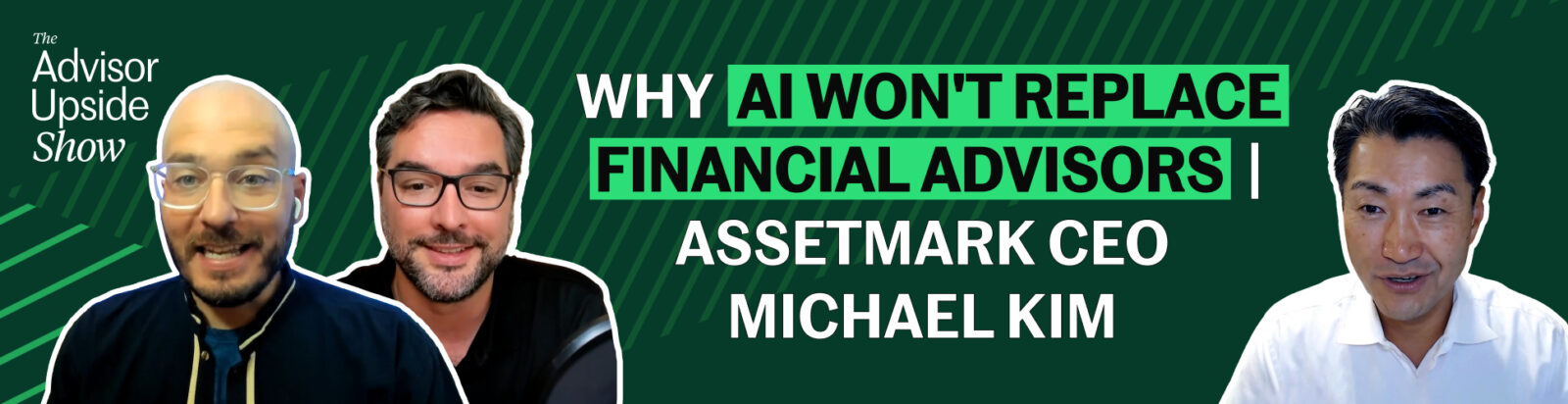
Relax, The Robots Aren’t Coming For Your Job. Every new AI tool renews the same fear: that machines will make financial advisors obsolete. AssetMark CEO Michael Kim joins Sean Allocca and John Manganaro to explain why demand for human connection will only accelerate as technology advances, and why going private freed AssetMark from the next quarterly print to invest for the long term. Plus: why interval funds are advisors’ go-to for private markets, and how family-office planning is trickling down to mass-affluent clients.
 Listen to this week’s episode here.