SpaceX, Private Ventures Fuel Elon Musk’s Trillion-Dollar Dreams
Tesla’s sleek cars and futuristic trucks have defined Elon Musk’s public image, but SpaceX is the real engine behind his growing net worth.

Sign up for smart news, insights, and analysis on the biggest financial stories of the day.

Elon Musk, often described as a modern-day Thomas Edison, may soon add an unprecedented title to his résumé: the world’s first trillionaire. Tesla’s sleek cars and futuristic trucks have defined his public image, but SpaceX is the real engine behind his growing net worth.
The buzz around a potential IPO valued at as much as $1.5 trillion for the high-flying government contractor has emerged as the primary swing factor in the entrepreneur’s net worth at the same time that Tesla shareholders have approved a massive, performance-based compensation package that could significantly expand his stake in the electric-car maker. Together, these developments have shifted Musk’s path to extreme wealth from incremental gains to a handful of high-stakes corporate milestones.
Musk’s net worth has surged nearly 50% year over year to an estimated $645 billion. In October, he became the first individual to surpass a $500 billion net worth, propelled by rising private-market valuations for SpaceX and renewed confidence in Tesla’s long-term strategy. If Musk meets the aggressive performance targets tied to his Tesla compensation plan, and if SpaceX continues on its current trajectory, he could break the trillion-dollar barrier.
Such an accomplishment would test the upper bounds of the Bloomberg Billionaires Index, created and named when the idea of a trillionaire still seemed unfathomable and absurd. Now, it no longer does. Already, Musk has been cast front and center, most recently by Forbes, as the maestro of this era’s wealth creation.
To the Moon with SpaceX!
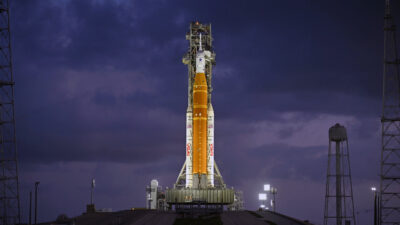
SpaceX, which has invested aggressively in reusable rockets, launch infrastructure, and satellites, is the single largest lever in the trillionaire equation. Musk owns an estimated 42% of the private rocket and satellite company, which recent secondary share transactions have valued at $350 billion to $800 billion in private markets; that makes his stake worth roughly $136 billion to more than $300 billion on paper today. The real upside comes from long-term growth and the potential for a public offering; if SpaceX lists at valuations some analysts forecast (up to about $1.5 trillion), Musk’s stake alone could exceed $600 billion, reshaping his net worth significantly.
Indeed, Starlink has rapidly become the financial backbone of SpaceX. The satellite internet service has added 1 million new customers in under seven weeks, bringing its total to more than 9 million active users across 155 countries and territories, according to the company, implying a growth rate of more than 20,000 new users per day since early November.
That momentum caps an explosive year. In December 2024, SpaceX reported 4.6 million Starlink customers; by August 2025, the figure had climbed to 7 million, before accelerating sharply in recent months. The service now operates on a constellation of more than 9,000 low-Earth-orbit satellites, enabling broadband connectivity in rural, maritime, aviation, and defense-critical regions beyond the reach of traditional networks (For my part, I can now use Wi-Fi on routes to and from New York and Hawaii, even over the Pacific Ocean — something that was previously impossible — because of Starlink.)
Musk has said Starlink is now “by far” the largest driver of SpaceX’s revenue — a distinction that has materially altered how investors assess the company.
Tesla Times Two
While SpaceX and Starlink represent the transformational upside, Tesla remains a critical component of Musk’s wealth trajectory. His 2018 compensation package, revived after the Delaware Supreme Court overturned a lower court ruling that had voided it, entitles Musk to acquire stock options tied to ambitious operational and market-capitalization milestones. Most of those milestones have already been achieved, giving Musk the right to purchase roughly 304 million Tesla shares at deeply discounted prices, currently valued at approximately $139 billion.
Adding to this, Tesla’s shareholders have also approved a new performance-based pay plan, further increasing Musk’s potential upside and consolidating his control over the company. If fully realized, these packages could add hundreds of billions in theoretical value, though the actual gain depends on hitting aggressive targets and on public-market conditions.
All told, the new performance plan positions Musk to unlock value as Tesla begins monetizing AI-driven initiatives, including full self-driving, autonomous fleet operations and robotics.
In this framework, Tesla serves as an accelerant rather than the primary driver of Musk’s net worth. Its gains are meaningful but incremental, constrained by stock performance, earnings multiples and investor sentiment. SpaceX, by contrast, offers the potential for sudden, transformative gains: an IPO, Starlink expansion or secondary-market repricing could add hundreds of billions almost overnight.
“Heading into 2026, this marks a monster year for Tesla and Musk as the autonomous and robotics chapter begins,” analyst Dan Ives writes in his latest report on Top 5 Names to Play the AI Revolution into 2026. “The AI valuation will start to get unlocked, and we believe the march to an AI-driven valuation for Tesla over the next six to nine months has now begun, with full self-driving and autonomous penetration of Tesla’s installed base and the acceleration of Cybercab in the US representing the golden goose for Musk & Co. We believe Tesla could reach a $2 trillion market cap over the coming year, and in a bull-case scenario, $3 trillion by the end of 2026.”
Other Ventures: Diversifying Upside
Beyond Tesla and SpaceX, Musk holds stakes in several ventures that extend both financial upside and strategic influence, positioning him across AI, social platforms, neurotechnology and infrastructure:
- xAI: Founded in 2023, xAI is Musk’s artificial intelligence startup, where he retains a majority stake. The company is focused on developing cutting-edge AI models and applications that complement Musk’s broader ecosystem, including social media platform X. Recent valuations range widely from $80 billion to 230 billion, reflecting both the early-stage nature of the business and high investor interest. xAI represents a strategic play to position Musk alongside leading AI players like OpenAI, while creating new revenue streams through AI-enabled products and services. Its integration with X also allows Musk to leverage social data to accelerate AI training and deployment.
- X (formerly Twitter): After purchasing Twitter for $44 billion, Musk rebranded it as X and reoriented it for AI-driven engagement, monetization and information distribution. While it was valued at $33 billion when taken over by xAI, its strategic significance extends beyond its valuation. X now hosts Grok, xAI’s generative AI assistant, which leverages real-time social data from the platform to provide conversational responses, insights on trending events, and even image generation. This integration allows X to function as a distribution layer for xAI, a live data source for AI model training and a testbed for monetization strategies that could scale across advertising, subscription and autonomous content moderation technologies.
- Neuralink: Musk’s neurotechnology venture developing brain-computer interface (BCI) technology to integrate human cognition with AI systems. Musk maintains a controlling stake, with valuations in the $5 billion to $9 billion range. If the technology reaches commercial viability, it could revolutionize healthcare, human-computer interaction and cognitive augmentation, providing an outsized strategic and financial payoff.
- The Boring Company: This tunneling and infrastructure venture is valued at roughly $5 billion to $7 billion. While smaller than Musk’s other holdings, The Boring Company exemplifies his approach to disruptive infrastructure solutions, including urban transit tunnels, hyperloop development and city-scale transportation projects.
In true “Musk fashion,” the venture was inspired when Musk was stuck in LA traffic.
Recent News
-
Wall Street Predicts Record Trading Revenue amid Market Jitters

Photo via Richard B. Levine/Newscom

-

Photo illustration by Connor Lin / The Daily Upside, Photos by Ljupco and Frentusha via iStock and Freepik

-
Photo illustration by Connor Lin / The Daily Upside, Photo by Klyaksun via iStock