

Good morning.
Phew. That was a close one.
The crypto market saw a sharp pullback over the past few days, with bitcoin falling to about $67,500 from its October high of nearly $126,000. Coinbase CEO Brian Armstrong may have dropped from the world’s richest people rankings, but thankfully, most advisors and their clients escaped with only minor scrapes. Just under a third of advisors allocated to crypto in 2025, typically in the low single digit percentages, according to Bitwise data.
One reason for that caution is simple: Crypto is less than 20 years old. That’s microscopic compared with stock markets, which date back centuries. Bond markets go even further, tracing their roots to ancient Mesopotamia, the world’s first civilization, by the way.
Maybe in another two millennia advisors will start taking crypto more seriously.
AI Anxiety Is Tanking Stocks. Here’s the HALO

I can see your halo, halo, halo.
Beyonce fan or not, a new trend may be taking over Wall Street with an investing approach that favors stocks with significant real-world assets and low chances of becoming obsolete. The Heavy Asset, Low Obsolescence strategy played out in the markets in recent weeks as investors piled into companies with hard assets, like refineries, airliners or data-centers, and ones that are much less likely to be displaced by large language models. Look no further than the prices of Charles Schwab, LPL, Raymond James and other brokerages that tanked earlier this week after news of a new AI tax tool shook investor confidence. That same anxiety is pushing money out of enterprise software companies and into businesses viewed as harder to disrupt, and it could become a dominant investment theme this year.
“This is the simplest idea in the world,” said Ritholtz Wealth CEO Josh Brown, who coined the term in a blog post over the weekend. “[Allocators] don’t want to go to sleep at night, wondering if they’re going to wake up the next day and Perplexity just took the f****** business.”
Getting Heavy
For investors, 2026 may be the year that AI disruption really shakes up the markets. Unfortunately, these new HALO stocks are sometimes hard to pin down (but not quite as hard as obsolescence is to pronounce). Not only do they span sectors, but there’s not a traditional framework to classify them. Examples include energy giants like Exxon, retailers like Walmart, fast-food chains such as McDonald’s and Starbucks, industrial and materials companies like Caterpillar, and consumer staples like Hershey. What unites them is dependence on physical goods, infrastructure or services.
“No matter what Anthropic disrupts next, it can’t make a can of soda,” Brown told Advisor Upside. “It can’t build a crane. It can’t build natural gas lines that took 50 years to build and [faced] licensing and regulatory hurdles.” There are some interesting ETFs tracking broad market segments that are illustrating the trend:
- The most popular energy fund, XLE, is up 23% year to date. There are other funds from State Street Investment Management that track materials and consumer staples, namely XLB and XLP, that are up 18% and 14%, respectively.
- Compare that with iShare’s Expanded Tech-Software Sector (IGV) that has shed 22% of its value this year as of Wednesday.
Rob Thummel, a senior portfolio manager at Tortoise Capital, said he wasn’t familiar with the HALO acronym but the US runs the largest energy pipeline network in the world, and almost all the operators are publicly traded with high free cash flows, high dividend yields, and solid balance sheets. “Said in a different way, there is no economy without energy. We study all new, emerging energy technologies and we don’t see anything on the horizon that will materially alter the US energy supply,” he said.
Coin It. The market is already re-weighting multiples as investments have been pouring out of enterprise software companies, Brown said. “We might have called these old-economy stocks, but I think the correct terminology is investors now want to own companies that have heavy assets and low obsolescence risk,” he said. “That’s HALO.”
Why Altruist’s New AI Tax Tool Spooked Investors in Schwab, LPL, Raymond James
Want to scare the big brokerages next Halloween? Dress up as AI.
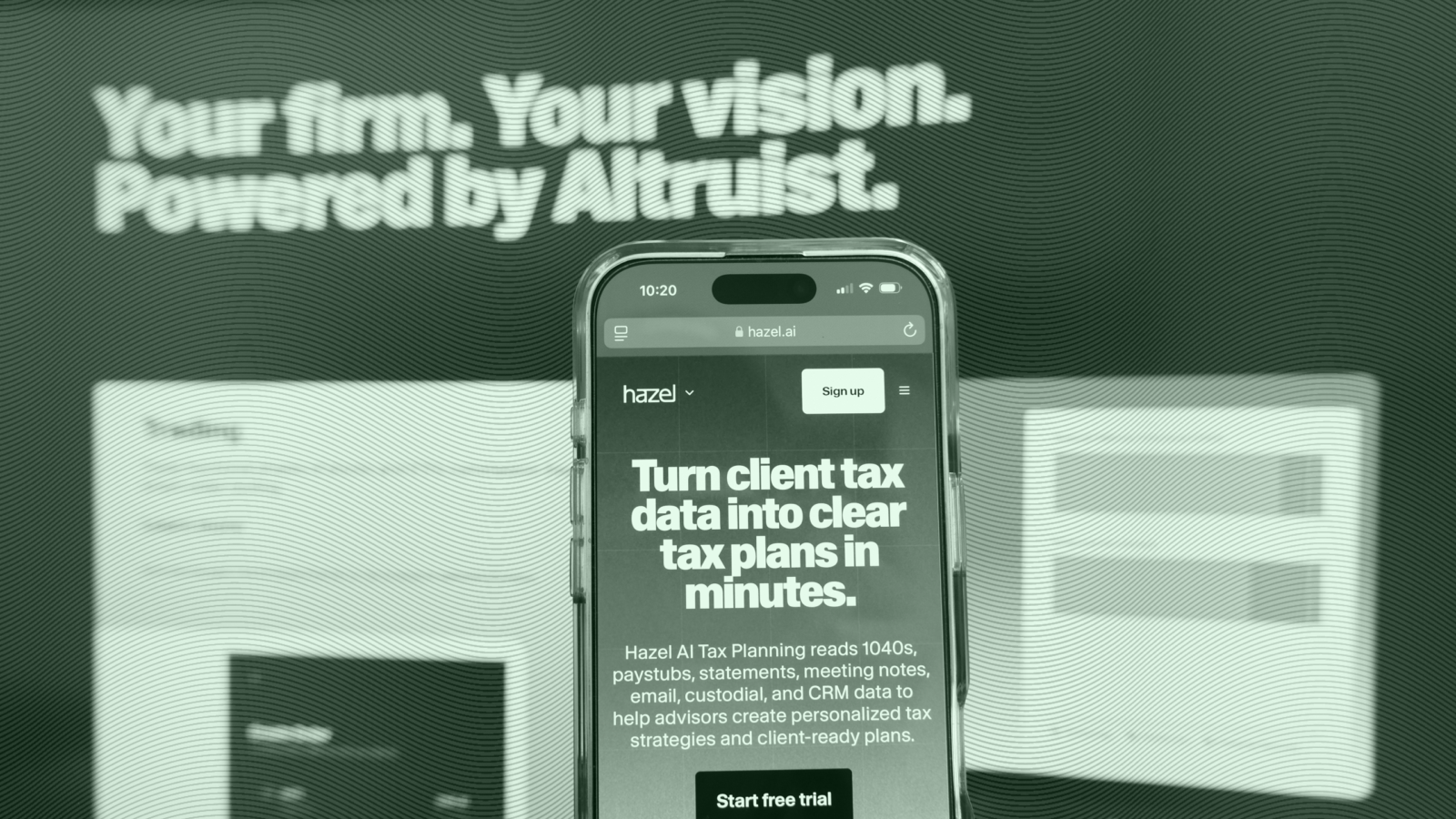
On Tuesday, the digital-first custodian Altruist launched a new artificial intelligence-powered tool on its Hazel platform designed to create tax strategies for clients based entirely on their documents. The launch caused the stock prices of several major wealth management firms to take a tumble, including LPL Financial, Raymond James and Charles Schwab. Experts said the selloff appeared to be an overreaction, but that whether any AI tool becomes a real threat to bottom lines depends on adoption.
“Hazel is significant, but not by itself,” said Bill Harris, CEO of Evergreen Wealth. “It’s part of a wave of AI tools for advisors.” He added that there is a large menu of wealth management tools — notetaking, marketing, report generating — that will “definitely change the way that advisors work.”
IRS Meets AI
Tax planning tools have been around for years, but until now they’ve been more manual, requiring users to enter information by hand. The Hazel upgrade, on the other hand, purports to generate tailored tax plans for clients based on the data in their 1040s, account statements, pay stubs and more. Harris said certain wealth management firms will go the way of mutual funds in the era of the ETF — just a lot quicker. “Mutual funds have not disappeared, but the growth is gone,” he said.
However, other advisors said the tool is not as big a threat as recent stock market shifts have indicated. “[Advisors] are here for interpretation more often than information, and the human layer is often what becomes the differentiator,” said Kyle Mostransky, CEO of Mostransky & Associates. “Most financial decisions are driven by fear, regret, greed, pressure, goals. AI can optimize the math, but not the meaning of those decisions.”
That didn’t stop many firms’ stocks from taking a hit, and some dropped further Wednesday:
- LPL Financial’s stock was down 5.7%, and Charles Schwab’s was down 4%.
- Stifel Financial and Piper Sandler Companies were down 1.5% and 4.5%, respectively.
Under My (Price) Umbrella. The real impact of AI tools may be on fees as they continue to push down the price of human advice, Harris said. “Right now, a wealth management firm offering a human financial advisor, as opposed to a robo advisor, is typically [charging] 1% per year of the assets or more,” he said. “That will erode.”