

Good morning and happy Wednesday.
Hear that sound? It’s another active ETF hitting the market.
Active ETFs have dominated the new product landscape in recent years, with 953 strategies launched in 2025 alone. That’s a whopping 84% of all new ETFs created last year, per Cerulli Associates, and the same pattern is unfolding in 2026.
ETF issuers are right to focus on active funds, according to Cerulli, as the category is enjoying tremendous flows. They need to be selective, however, since the rapid buildout also creates the risk of a closure wave if products don’t attract sufficient adviser and end-investor interest. This seems to be a particular issue with some defined outcome, levered and option income strategies, which together account for nearly one-third of all subscale ETFs with less than $50 million.
Passive ETFs aren’t going away, of course, but active ones have cornered the market on rizz for now.
Why Bond Ladder ETFs Are All the Rage

Everyone knows ladders are better than chutes.
Invesco last week introduced its latest suite of BulletShares Treasury bond ETFs, which expand its existing fixed-income lineup. The strategies use a method called laddering, in which a fund holds bonds maturing in specific calendar years so that as they mature, yields are invested back into other bonds with later payout dates. The popularity of these so-called defined maturity ETFs is growing as rising interest rates correlate with falling bond prices and investors seek safety amid macroeconomic and geopolitical turmoil.
With disruptions from tariffs and trade wars to the shutdown of the Strait of Hormuz and the impact of AI on the economy, “when you can buy a diversified portfolio [of] bonds, hold them to maturity and create a sleeve of visibility, it’s really nice to have,” said Jason Bloom, Invesco’s head of fixed income ETF strategy.
Climbing the Ladder
Part of the bond ladder’s appeal is that the securities are curated for higher credit quality, better pricing and improved liquidity. Bond ladders have been around for decades and were popular in the years before 2008 but became less common after the Great Recession due to the low interest rates at the time. Now, however, fund providers are getting back on the ladder: Vanguard launched its own so-called “BondBuilder” funds earlier this year. Another reason for their ongoing popularity is that they can provide a cushion in times of default, Bloom said. “If you only own 10 investment-grade corporate bonds and one of them defaults, that’s a huge hit to a low-yielding portfolio,” he said. “People thought, ‘Well, it’s investment grade, it won’t default.’ Well, actually, what that means is they rarely default, but in times of crisis, the risk-reward [outlook] hasn’t always looked so good.”
Other major players in the bond-laddering space include:
- State Street, which has offered its active target maturity ETFs since 2024.
- WisdomTree, whose WisdomTree Core Laddered Municipal Fund (WTMU) was introduced last year.
- BlackRock, whose iBonds ETFs allow for ladder customization with maturity dates up to 10 years in the future.
Rolling On The River: We’re currently in a period of “rolling recessions,” Bloom said, in which certain sectors of the economy have boomed while others are put under stress. Diversifying a bond portfolio is a good way to hedge against the ever-changing uncertainties, he added. “In an equity portfolio, a stock can go to zero and another stock could double in price to offset that,” Bloom said. “You can’t get that kind of offset in a fixed-income portfolio … You don’t want to be owning just 10 or 20 bonds in your personal account.”
When the S&P 500 Fell, Dividends Helped Returns
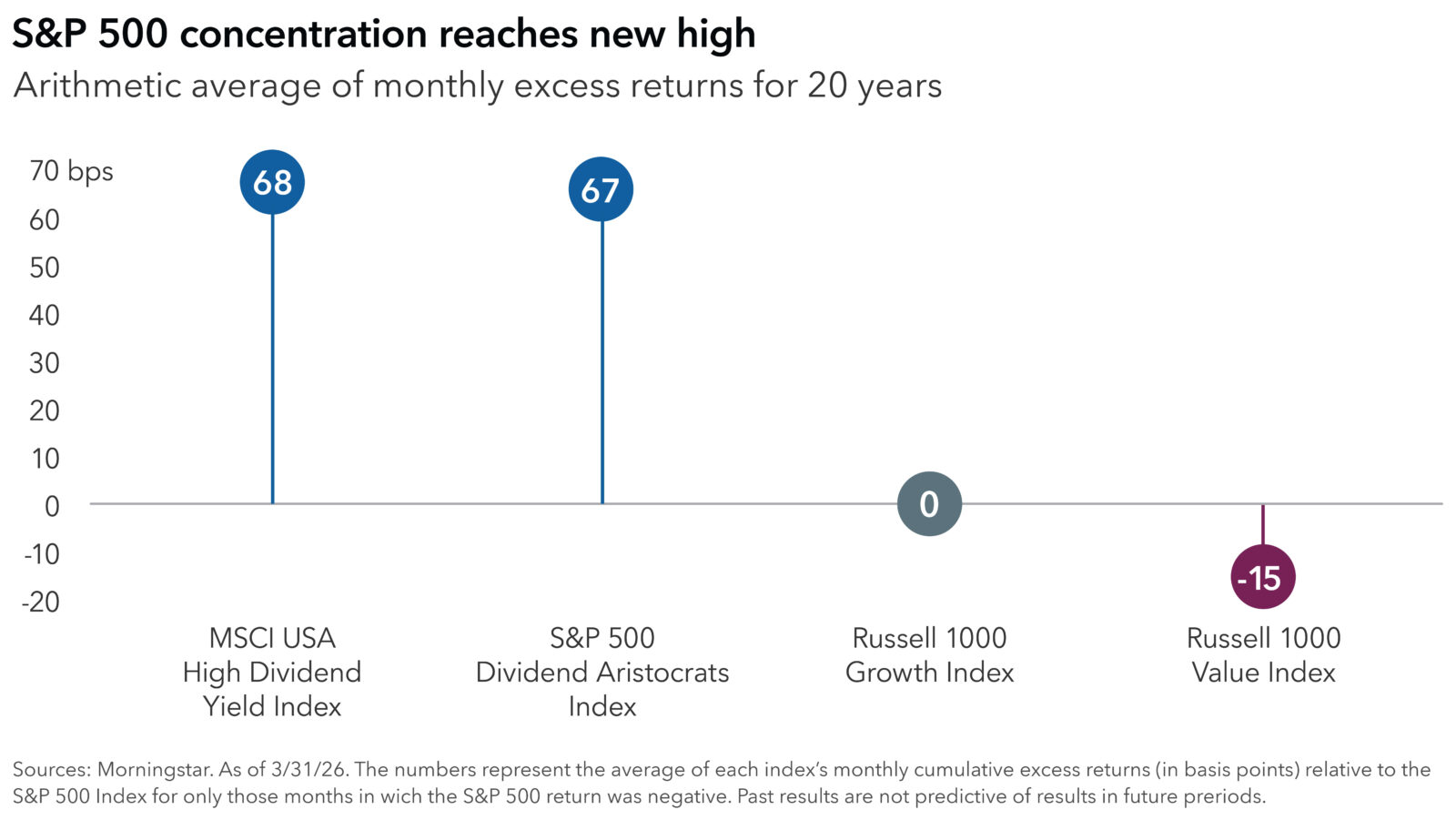
The S&P 500 is showing concentration risk with nearly 40% of its value in the top companies. Plus, growing uncertainty surrounding AI spending, inflation and the global economy are worrying more investors. This is why value investing is making a quiet comeback.
But over the past 20 years, in periods when the S&P 500 declined, so did value indexes. What held up?
The answer: Dividends.
CGDV – Capital Group Dividend Value ETF intends to allow you to participate in growth while defending with dividends. This approach has translated into higher yields, stronger returns and less downside than the S&P 500.
See how CGDV can strengthen your US equity allocation in this current market.
BlackRock Becomes First Mega Issuer to Launch Covered Call Bitcoin ETF

Hold our covered calls.
BlackRock was among the first issuers to launch a spot bitcoin ETF back in 2024 with the iShares Bitcoin Trust ETF (IBIT), which went on to become the fastest-growing ETF in history, amassing roughly $51 billion in assets. Now, the world’s largest asset manager believes clients may be able to squeeze even more out of their crypto exposure.
This week, BlackRock launched the iShares Bitcoin Premium ETF (BITA), which offers bitcoin exposure while generating monthly income through an actively managed options strategy. The fund, which charges 65 basis points, maintains most of its bitcoin exposure while writing call options on IBIT equivalent to 25% to 35% of the portfolio.
While a crypto covered call ETF isn’t an entirely new strategy, BlackRock is the first mega issuer to launch one. “BlackRock has been looking to build out its suite of crypto products, and this is a natural evolution,” Todd Rosenbluth, head of research at VettaFi, told ETF Upside. He said a clear sign of momentum in these types of products is the NEOS Bitcoin High Income ETF (BTCI), which launched in October 2024 and has already grown to $1.2 billion in AUM. “There’s advisor and client interest in income-generating vehicles and an interest in risk-taking crypto exposure,” he said.
Who Else Is Doing It?
While a bit more complex than your standard bitcoin ETF, crypto covered call funds have been around just as long:
- Roundhill Bitcoin Covered Call Strategy ETF (YBTC) launched in January 2024, and later that year, introduced its Ether Covered Call Strategy ETF (YETH).
- Grayscale, Global X and Amplify also launched similar funds in 2025.
- Goldman Sachs filed for a bitcoin premium income ETF in April, and it’s expected to launch in early July.
Rosenbluth added that Fidelity and Invesco, both firms with crypto and options-based products, could be next. “There’s a lot of interest in blending those two worlds,” he said.
In addition to IBIT and BITA, BlackRock also has a spot Ethereum ETF and a staked Ethereum fund, the latter of which launched in February. “They still haven’t done anything else in the crypto market,” said James Seyffart, senior analyst at Bloomberg Intelligence. “They’re really sticking to their guns, saying ‘These are the two currencies we want to focus on.’”
Something to Keep in Mind. Like the old saying goes: There’s no free lunch. Advisors should remind clients any income they receive from a covered-call ETF is generated by selling options, which means giving up some potential upside. “As we know, Bitcoin can be explosive in both directions,” Seyffart told ETF Upside. “Theortetically, the income will offset downsides in bear markets, but in rip-roaring bull markets, this would underperform a spot bitcoin ETF.”