

Good morning and happy Wednesday.
The SaaS is dead, long-live the SaaS!
Significant ink was spilled in early 2026 about the “SaaS-pocalypse,” but software stocks have now largely recovered big losses driven by fear of industry-wide disruptions due to the rise of artificial intelligence. Volatility in software stocks still persists, data from Vanda Research shows, but it doesn’t seem to be scaring investors away. Indeed, the largest ETF tracking US software stocks clocked its biggest single-day buy-in by retail investors on record on Monday, Reuters reported, with $46 million flowing into the iShares Expanded Tech-Software Sector ETF (IGV). That run surpassed the previous single-day record by roughly 40%, per Vanda.
It seems the rumours of SaaS’s demise have been greatly exaggerated. At least for now.
Don’t forget to subscribe to our brand new podcast The Advisor Upside Show to break down the trends shaping the wealth management industry. You’ll thank us later.
SpaceX IPO Pumps Rocket Fuel into Thematic Space ETFs

SpaceX’s IPO is almost here, and investors are looking to hitch a ride to the moon.
Ahead of the highly anticipated public debut of Elon Musk’s rocket company expected June 12, funds with exposure are quickly gaining popularity. While SpaceX is offering some of its IPO shares directly through brokerages including Robinhood, Fidelity and Charles Schwab, investors can also get a piece of the moon pie through a product that launched in March: Tema ETFs’ Space Innovators ETF (NASA). As of June 1, NASA has a 6.88% weighting in SpaceX via a special purpose vehicle, and investors are biting, with the fund gathering roughly $2.6 billion in assets since inception.
“What NASA did is totally unnatural,” Bloomberg ETF analyst Eric Balchunas said about the fund transitioning from a newborn to the top of the category in just around two months. The NASA ticker helped, but since the fund is from a small indie firm — and competing with heavyweights in the space ETF category such as Cathie Wood’s ARK Invest — exposure to the soon-to-be public company is the main driver, Balchunas added. “It’s the SpaceX effect.”
Cleared for Launch
SpaceX’s stock may have permeated the zeitgeist, but will those NASA ETF investors stick around for the long haul?
“If you are a believer in the space economy and the buildout and the expectations, you’ll hang around,” said Todd Sohn, chief ETF strategist at Strategas. “The other cohort is the fast money who are taking advantage of this run-up, and I suspect that they’ll leave pretty quickly.”
Single-theme ETFs are known to be boom and bust, he adds, pointing to fervor around cybersecurity and cannabis ETFs that eventually dwindled. A theme gets hot, multiple issuers come out with the same kind of product and volatility really starts to pick up, Sohn said. “I would just be very mindful of that, and that everyone is involved in this kind of IPO. I would expect more volatility to occur, and that may shake out some tactical holders.”
NASA isn’t the only space ETF benefiting from the upcoming listing:
- ProcureAM’s Procure Space ETF (UFO), which launched in 2019, crossed the $1 billion threshold last week.
- The ARK Space & Defense Innovation ETF (ARKX) and State Street SPDR S&P Kensho Final Frontiers ETF (ROKT) gained roughly 22% and 47% this year, respectively, through Tuesday morning.
Choosing a Trajectory. The thematic ETFs will probably get you the most bang for your buck when it comes to exposure to SpaceX, Sohn said. But for many investors, it probably makes sense to stick with a broad-based index fund that will offer you some exposure, albeit to a lesser degree.
When the S&P 500 Fell, Dividends Helped Returns
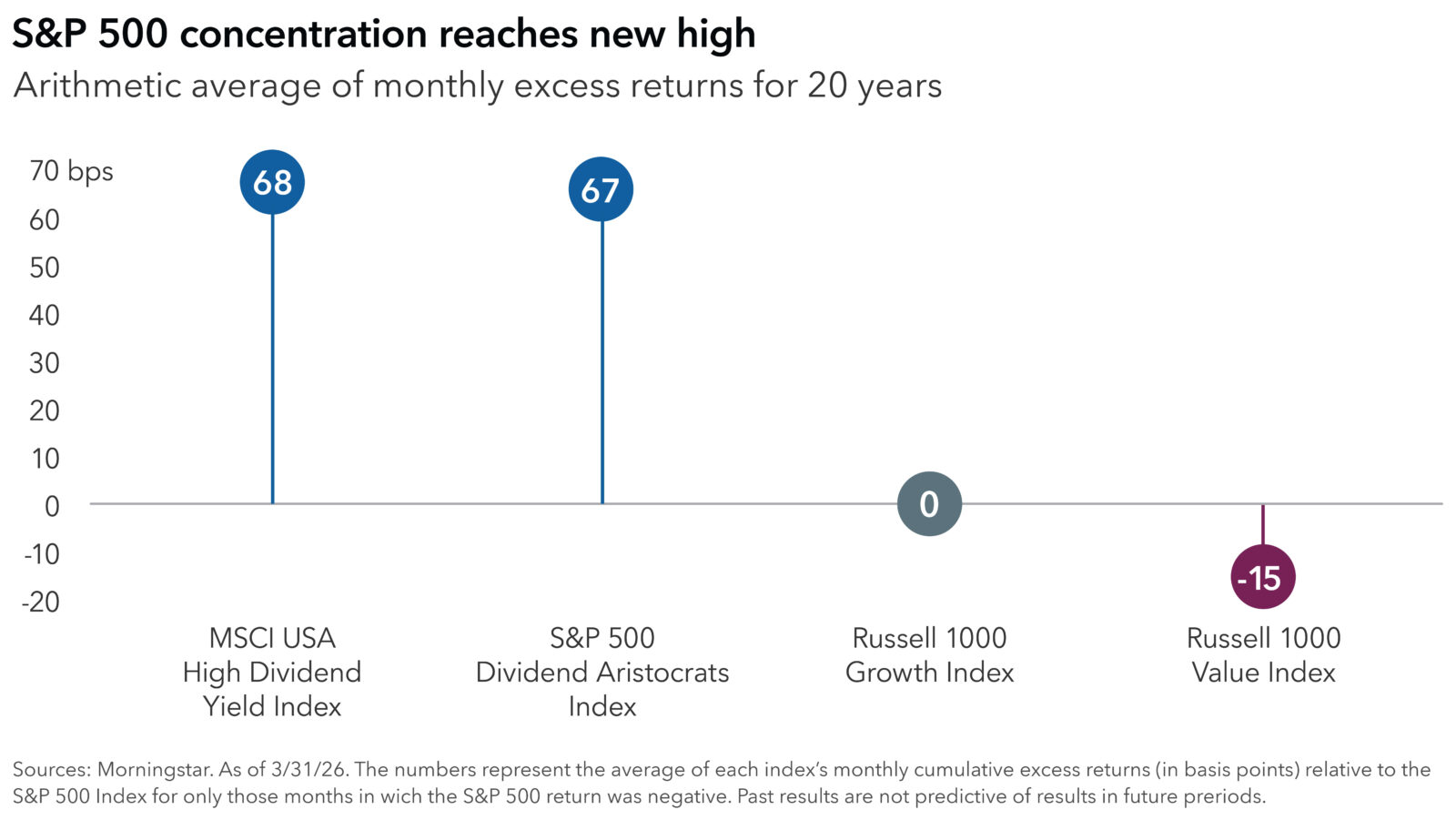
The S&P 500 is showing concentration risk with nearly 40% of its value in the top companies. Plus, growing uncertainty surrounding AI spending, inflation and the global economy are worrying more investors. This is why value investing is making a quiet comeback.
But over the past 20 years, in periods when the S&P 500 declined, so did value indexes. What held up?
The answer: Dividends.
CGDV – Capital Group Dividend Value ETF intends to allow you to participate in growth while defending with dividends. This approach has translated into higher yields, stronger returns and less downside than the S&P 500.
See how CGDV can strengthen your US equity allocation in this current market.
Here’s How Much ETF Employees Make and Why It’s a Problem

For an industry that loves a tight spread, there’s a mismatch in the ETF world that’s getting harder to ignore: compensation.
As investment in ETFs continues to surge, there’s a significant premium for employees who directly influence flows, liquidity and execution. Average salaries and bonuses total around $573,000 for trading roles, $369,000 for capital markets, $362,000 for sales and $350,000 for portfolio management, according to the recently released Blackwater salary index. But operations roles pay around $214,000 and research and strategy about $239,000. While most of America won’t feel sorry for employees making generous six-figure salaries, the gap could pose a problem for ETF issuers.
“As product complexity rises, the cost of underinvesting in research, operations and platform infrastructure also rises,” said Erum Stefan, managing director at Blackwater ETF.
Time for a Raise
To be fair, roles that are cost centers generally are paid less than sales and trading roles, which are revenue centers, said Deborah Fuhr, founder of research firm ETFGI. “ETF trading and capital markets is becoming more important and more challenging, given the growth in the number and types of ETFs and the various exchanges and countries where they are listed,” she added. “And the pool of qualified talent is small.”
But nearly half of ETF professionals think they’re underpaid, according to the data. The solution isn’t necessarily blanket pay inflation, Blackwater’s Stefan told ETF Upside:
- “The answer is more precise compensation design,” she said. “ETF issuers need to build pay bands by function, seniority, region and business impact.”
- Trading, sales and capital markets may justify higher premiums because they directly influence liquidity, flows and execution, Stefan added. But operations, research and strategy jobs need to be repriced if the roles carry platform risk and product-quality responsibility or affect client credibility. Bonus structures should also be more clear.
Mind the Regional Gap. US workers are also making significantly more than their overseas counterparts. Their average total compensation is approximately $471,000 compared with $340,000 in EMEA and $318,000 in the Asia Pacific region. “For global ETF businesses, this creates a real talent-planning issue,” Stefan said. “A single global compensation band no longer works. If a firm tries to hire or retain US ETF talent using European or APAC benchmarks, it will struggle.”