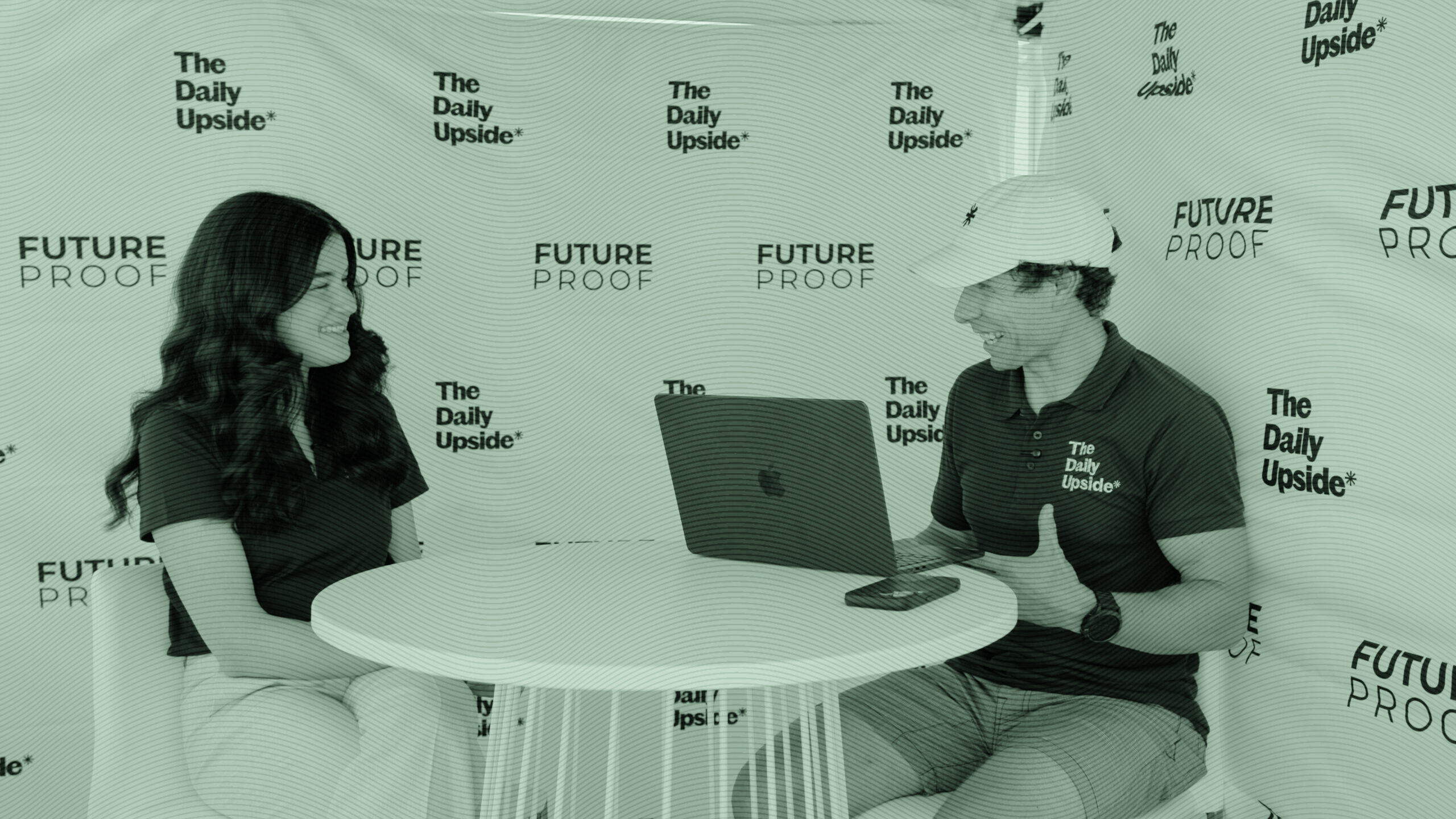
Arelis “Lis” Agosto, Director of Research & Strategy at Global X, looks for themes that cut across sectors or borders, play out over years, and have enough companies behind them to build real exposure. We sat down with Lis at Future Proof Festival 2026 to talk defense, the AI ecosystem beyond the hyperscalers, rates, and the grid underneath it all.
The Daily Upside: There’s been a lot of interest recently in thematic and concentrated strategies. How are you thinking about that? What should people have in mind?
Let’s perhaps take a step back and define what thematic investing is, and where concentration might make sense. If we think about thematic investing, it’s really trying to capture a broad long-term structural trend. And that long-term piece is important. Sometimes we think through a potential timeline of five to 10 years out to the full maturity of a theme. But we’re also looking at areas that are unconstrained by traditional sector definitions, geographic definitions. Most of the time when we’re talking about thematic investing, we’re thinking about opportunities that straddle two different sectors, or that potentially span across a variety of different geographies or nations. We know that innovation isn’t necessarily tied to one particular area.
The other part I’ll say is that investability piece, of how we think through when a thematic opportunity makes sense. Oftentimes it is how many publicly traded companies are available that we might be able to offer that really high bar of purity exposure, often with a 50% revenue screen. Some opportunities are of course going to be very broad in terms of how many companies play a role in that value chain. And others, that value chain might be a little bit smaller, whether because it’s a very nascent area or because it’s an industry that has consolidated over time and is now seeing a new growth driver.
The Daily Upside: What themes do you see picking up for investors in the second half of the year?
There’s so many that come to mind. One, for example, is defense technology. Of course, we’d be remiss to talk about artificial intelligence, but if we think about one of the potential applications of that, it is defense, and we’re seeing a variety of different tailwinds come together. We’re seeing geopolitics come top of mind, and not only in the US but across NATO, we’re seeing budgets increase across the board. But more importantly, where that money is going. It’s going towards cybersecurity, it’s going towards drones, it’s going towards low cost, highly technologically savvy technologies that can be deployed very quickly and are changing the broader way we think about defense.
Another that might be top of mind is electricity and energy generation as a whole. It’s one that plays a very close relationship to geopolitics, and we’ve seen some of the supply shocks in recent months. We expect electricity demand to increase 50% in the next 25 years. How do we potentially meet that demand, and how do we have a good composition of energy sources that insulates us from some of the energy shocks we have seen? Whether it be natural gas and LNG, whether it be the midstream potentially benefiting from increased volume going through it, whether it be nuclear or renewables. All of these are areas that should really be top of mind, and ones that perhaps are a little bit underappreciated in broad market indices.
We’re at record highs of concentration right now. 40% of the S&P is just those top 10 holdings. How do you potentially complement that exposure? To some extent it of course is coming through areas like energy and defense.
The Daily Upside: AI is something different issuers have applied to products in different ways. What opportunities do you see with it?
I would say that just how broad that ecosystem of AI is, I think it’s a little bit underappreciated or misunderstood by some investors. Of course, we understand the Mag 7 or some of the hyperscalers. We might even understand some of the immediate inputs that go into that, like semiconductors or memory. But take a couple steps back. We’re talking about data centers, data center construction. We’re talking about energy supply. Even minerals, so copper and silver, uranium, all of these really play a role. So the infrastructure that underpins AI is quite broad.
From an application standpoint, there are many others, whether the physical manifestation of AI being of course robotics, or industries that have been slow to see innovation or adoption from technology being unlocked through AI, like healthcare for example, potentially driving faster drug development with a higher hit rate. These are all areas that are really exciting, and I think it speaks to the ecosystem of AI.
Then look at data centers, a potential beneficiary of this hyperscaler buildout. Thinking through the current capacity, it’s about a 65% increase in just the cost per gigawatt for a data center. Thinking through what leasing rates currently look like, it’s 1.4% just in terms of vacancy rates. So very, very minimal room for us to potentially absorb that increase in capacity. That puts us in a position where we’re not necessarily looking at some of the inputs that might be top of mind right now in the markets, but digging deeper as to what’s actually driving some of that potential growth, or what those bottlenecks might be.
The Daily Upside: With energy prices being up, inflation being sticky, and rates being higher for longer, how should investors be thinking about all that?
I would say that it’s not necessarily right now thinking through what the Fed might do in the coming days or the coming months and rethinking what exposure we have. We have seen the equity sleeve continue to show structural growth. We’ve seen earnings be really strong. We’re also already seeing monetization come through for artificial intelligence. One of the questions I often get is, we’re seeing this massive AI infrastructure build out, $6.7 trillion from 2025 to 2030. How are we going to actually see revenue come through? And we’re already starting to see that play out, not only in terms of where that money will be coming from, but in what timeframe. I think earnings have certainly echoed that sentiment.
So as we think through what it might look like if the Fed were to raise, it’s keeping on some of that equity exposure and potentially complementing it with areas that might make more sense should inflation continue, whether it be energy or whether it be areas of income. And complementing those again with a really strong core of equity, where the broader belief is of structural demand that will continue to grow even if we potentially see some noise in the short term.
The Daily Upside: Global X has shown some interest in AI for some time, launching AIQ four years before ChatGPT came out. What’s going to be the theme in five years?
That’s a good question, and I think it changes so often. Earlier this year we were talking about, for example, cybersecurity and cloud. There were so many concerns about software being cannibalized from AI, and we were beating that drum for a while, seeing pockets of the software space that are well insulated and have a good value chain continue to succeed. People wondering, is cyber not going to be a thing anymore because AI is here? If anything, it is the opposite. Cybersecurity needs to be even more robust if we’re having models potentially have access to our data and potentially act independently. We’ve seen this play out to some extent over the last couple of months, and we’re still hopeful for moving forward.
The other one that comes to mind is US infrastructure. If we think through a data center build out, a potential US manufacturing build out, what actually allows those things to happen? It’s steel, grid infrastructure, concrete, manufacturing capacity and equipment. Since January 2025, $1.5 trillion has been committed towards US manufacturing capacity, and that’ll flow through manufacturing towards consumer electronics, healthcare, semiconductors and beyond. And again, building those facilities, building the roads to get to the facilities, having the grid infrastructure be available for them. It’s one that seems a little bit less exciting because it’s not perhaps as technologically siloed in the traditional way that we would think about it. But nothing else will occur if we don’t have a solid infrastructure to allow us to continue growing our footprint.
The Daily Upside: And that too further stresses our energy.
Absolutely. The American Society of Civil Engineers gives the US infrastructure a grade, and in the most recent report card it was a C. That’s the highest it’s ever been, but one of the subcategories that actually decreased in grade was energy.
We are putting such a strain on our energy ecosystem right now, specifically the grid, that not only do we risk not being able to meet demand, but it’s a safety concern also. Whether it is through a grid build out, unlocking potential through solar and wind, or through nuclear and small modular reactors, all of this is a broader ecosystem that we’re currently paying attention to.
If we don’t have enough energy supply, robotics doesn’t become a thing. We can’t manufacture to the extent that we want to. Data centers can’t be powered, electric vehicles can’t run. These are the potential bottlenecks, and what that might mean as an investment case is certainly top of mind.
Disclaimer:
Information provided by Global X Management Company LLC.
Investing involves risk, including the possible loss of principal. Diversification does not ensure a profit, nor does it guarantee against a loss.
This material represents an assessment of the market environment at a specific point in time and is not intended to be a forecast of future events, or a guarantee of future results. This information is not intended to be individual or personalized investment or tax advice and should not be used for trading purposes. Please consult a financial advisor or tax professional for more information regarding your investment and/or tax situation.
Recent News
-
Northern Trust Initiates Record-Breaking Mutual-Fund-to-ETF Conversion

Photo via imageBROKER/Steve Heap/Newscom -
AI Trade’s Breadth Buoys Strategies That ‘Calibrate’ Exposure
Photo by Luke Peters via Unsplash -
Transaction Inaction: RIA Deals Are Falling
Photo by Pixabay via Pexels -
New Eye Treatment Boosts Kodiak Into Ranks of Resurgent Biotechs

Photo via Dirk Shadd/ZUMA Press/Newscom -
Jefferies’ Record Investment Banking Results Raise Stakes for Wall Street Giants
Photo via Spencer Jones/Plexi Images/GHI/UCG/Universal Images Group/Newscom -
Nvidia Develops Tools to Tackle Rogue AI Risks
Photo via Jonathan Brady / PA ROTA – B68 / Avalon/Newscom -
Model Behavior: Providers Focus on Taxes and Alts
Photo by Wirestock via iStock -
Has Bitcoin Found Its Place in the Portfolio Sun?
Photo via Moe Zoyari/Sipa USA/Newscom -
Consumer Discretionary Is On Sale. Is Anyone Buying?

Photo by Getty Images via Unsplash -
Retirement Assets Account for a Third of Household Wealth
Photo by Towfiqu Barbhuiya via Unsplash