Nvidia’s GTC Highlights Power-Hungry Chips’ Need for Energy-Efficient Solutions
Like phones and laptops, artificial intelligence data centers have to be kept below a certain temperature to keep running.
Sign up for smart news, insights, and analysis on the biggest financial stories of the day.

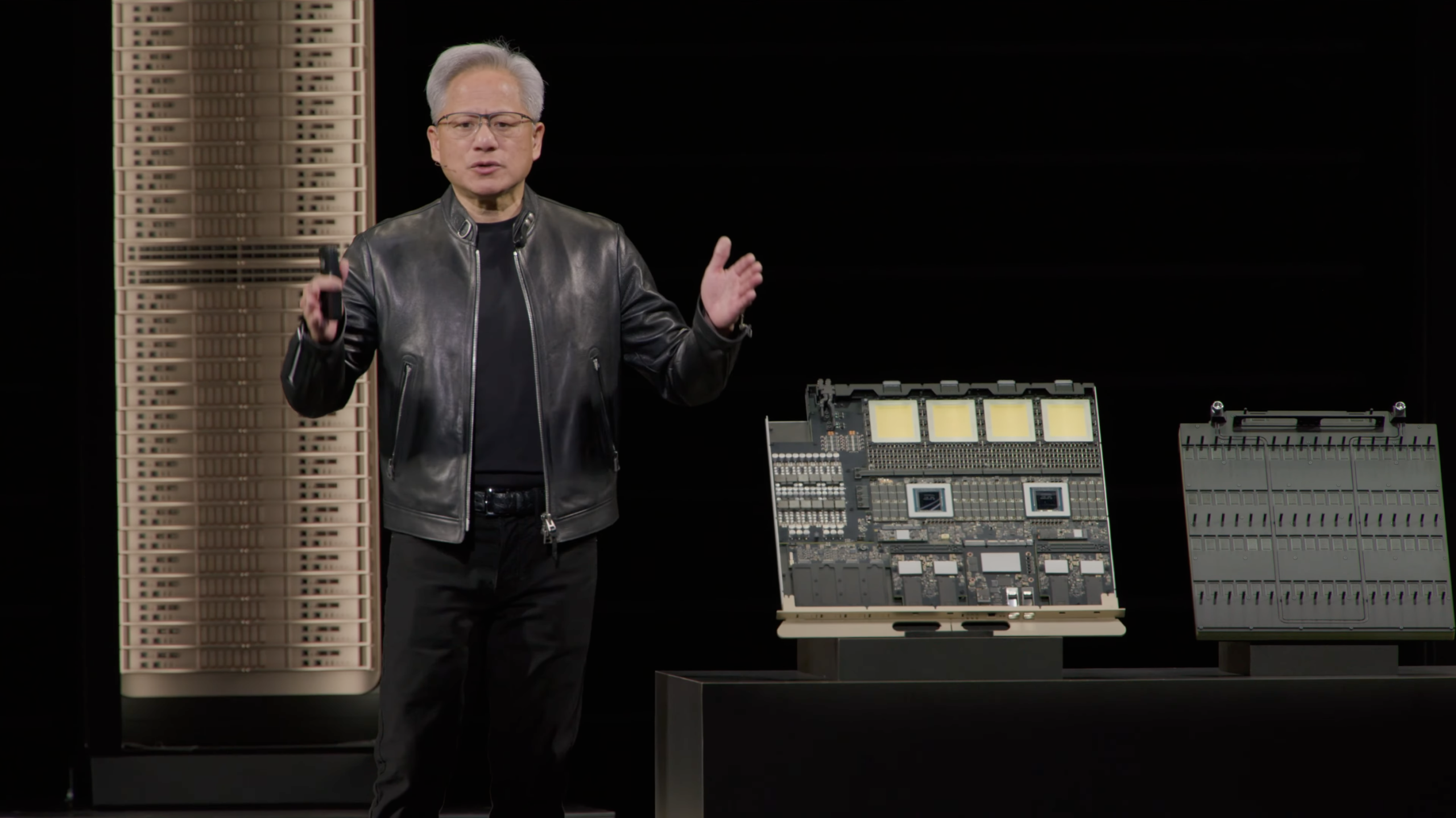
Jensen Huang and his signature lizard-embossed leather jacket hit the stage yesterday to lead the keynote for Nvidia’s annual GTC event, where he laid out massive growth ambitions.
Among the keynote’s big callouts: Huang doubled Nvidia’s previous revenue projection for its Blackwell and Vera Rubin chips (expected to launch this year) to $1 trillion through next year. The CEO also unveiled a new product that combines chips from Nvidia and the startup Groq (not to be confused with Elon Musk’s AI chatbot Grok), and a tech stack called NemoClaw intended to improve upon the popular AI agent OpenClaw.
As Nvidia scales up its business to meet the clamoring demand for AI, the industry is finding ways to make the power-hungry systems operate more efficiently.
AI Is too Hot to Handle
Remote workers who’ve tried to hit the beach only for their laptop to shut down in the sun will understand one key problem facing AI: Like phones and laptops, data centers have to be kept below a certain temperature to run.
The operating temperature of chips needs to stay below about 175 degrees Fahrenheit, an expert from UC Davis told Marketplace, and maintaining that level is an energy-intensive process. Data centers that depend on air cooling use as much as 35% of their incoming electricity just on cooling.
The solution? Energy-efficient liquid cooling, since liquid can transfer heat more efficiently than air. Nvidia has been moving toward liquid cooling since at least 2022, when it introduced a liquid-cooled version of its A100 chip that the company said used 30% less power than its air-cooled counterpart. Chips have only become more power-hungry since, stressing grids and creating a need for more efficiency.
AI investments are flowing into the liquid-cooling space:
- Frore closed a $143 million round on Monday that valued the startup at more than $1.6 billion. It was founded eight years ago with a focus on air cooling for devices that lack fans, like phones. It switched to liquid-cooling tech about two years ago after Huang suggested that data centers were increasingly relying on it.
- Frore sets itself apart from competitors by creating liquid-cooling systems in customized, stackable 3D shapes rather than cold plates, which are the current standard used by companies such as Nvidia.
Feeling Jumpy: At the same time, investors are sensitive to any perceived cracks in the foundations that infrastructure companies say they’re building. Companies that create chilling systems for liquid cooling slipped earlier this year when Huang said Nvidia’s Rubin chips can be cooled with warmer water that doesn’t need to be chilled by machines.
Recent News
-

Photo illustration by Connor Lin / The Daily Upside







-

Photo via Bob Henry/UCG/Universal Images Group/Newscom -
Photo via Florian Gaertner/IMAGO/BMF/Newscom