

Good morning.
We can all agree that being a financial advisor is one of the best occupations to choose. (If not, why the heck are you reading this newsletter?) But what are the best places for advisors to work? Well, there are a few answers.
Sage Advisory in Austin, Texas; VLP Financial Advisors of Vienna, Virginia; and Prentice Wealth Management in Rochester, New York, were the top three firms in InvestmentNews’ annual “Best Places to Work” list. The offices earned the distinguished merits for having exceptional benefits packages, work-life flexibility and career development opportunities.
Speaking of great places to work, we’re currently looking for a new wealth management reporter. Boom! Sneak-attack self-plug.
Beyond the Beach: Smarter Retirement Strategy
For many advisors and their clients, retirement is the singular goal that defines a working life.
Building that war chest that’s going to power you through your golden years.
Seasoned advisors know this: Retirement is about more than just piña coladas that come with miniature cocktail umbrellas.
Retirement is about building your legacy. Building a security blanket in the face of stubborn inflation and inevitable medical costs. Preserving lifestyle after the W-2 disappears.
There is an entire industry of financial products built to serve the needs of savers and retirees. Annuities. Insurance. Decumulation products. For financial advisors, it can be a jungle.
That’s why we launched Retirement Upside, a weekly newsletter that will illuminate the strategies and policy changes that impact how your clients should approach retirement.
Sign up now to grow your practice and provide the best advice possible with Retirement Upside.
This Week’s Highlights
Charles Schwab Chases Gen Z Crowd into Crypto
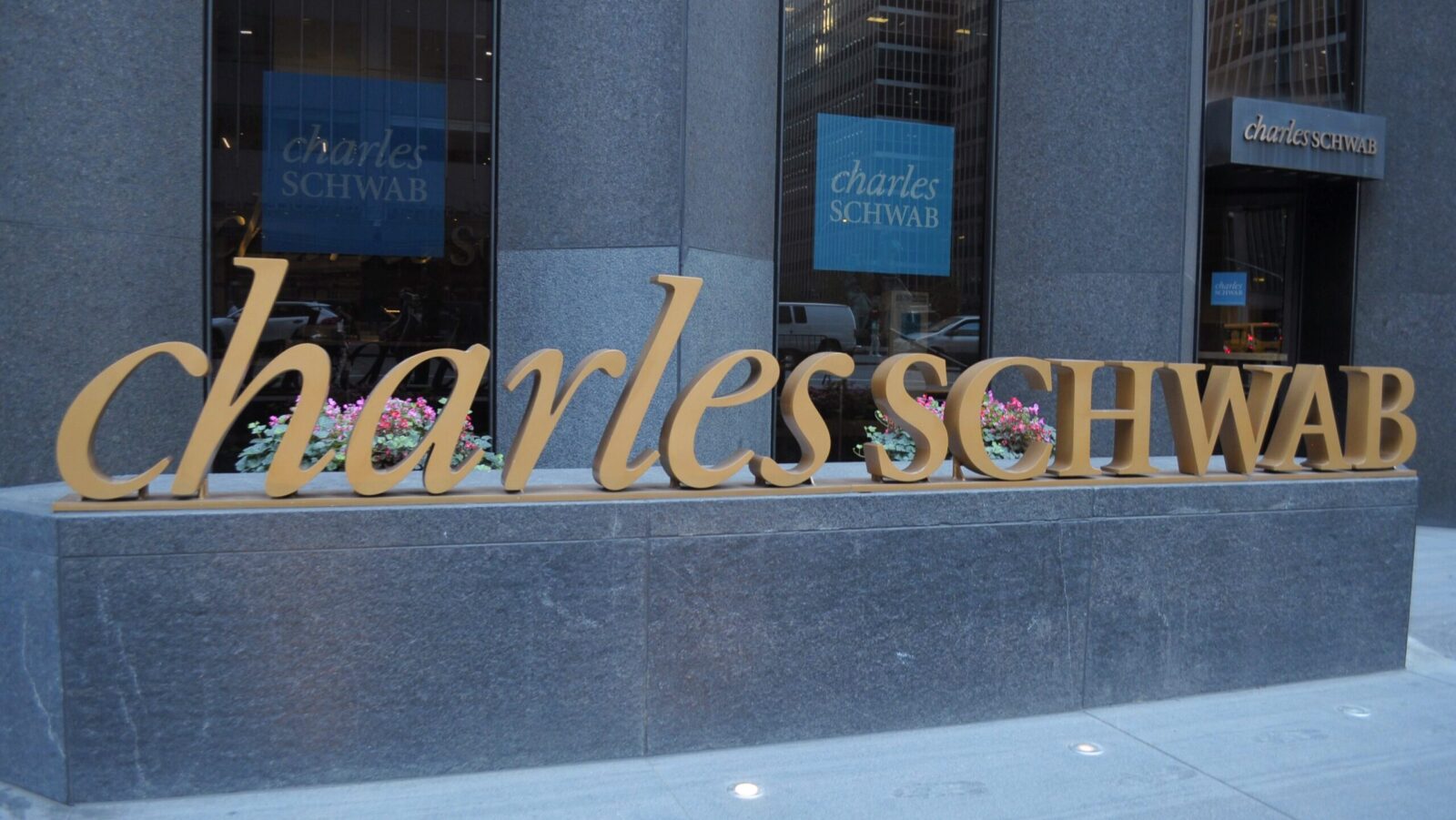
Charles Schwab is embodying the “How do you do, fellow kids?” meme by making its first foray into crypto trading. The 55-year-old company announced the move during its earnings call on Thursday, when it shared that its quarterly profit jumped more than 30% as trading activity surged across the industry.
Now, Schwab wants to give clients more assets to move around: digital ones. Schwab said it’ll soon add the top two tokens by market cap, bitcoin and ether, to its platform under the on-the-nose offering name, Schwab Crypto.
TradFi Blurs Digital Lines
It has been a banner earnings season for Wall Street firms. Schwab averaged a record 9.9 million trades a day in the first quarter, and CEO Rick Wurster tied the frenzied trading activity in part to geopolitical uncertainty swaying investors to hold smaller positions for shorter periods. Small-scale trading activity could surge further in the second quarter, depending on when a decision by regulators to end the $25,000 minimum equity requirement for day traders takes effect.
Adding crypto could also boost Schwab’s volume as investors, especially Gen Z ones, turn to alternative assets during uncertain times. In adding a crypto offering, Schwab joins a swath of other Wall Street institutions (a.k.a., Traditional Finance or TradFi) looking to compete with younger fintech firms like Robinhood:
- Fidelity Investments was relatively early to the crypto game. In 2022, Fidelity made crypto investing available in its 401(k) plans, and in 2024, it launched a spot bitcoin ETF. It began supporting bitcoin and ether trading in 2023 and later added litecoin and solana. This year, it even launched a stablecoin for trading on its crypto platform. Schwab plans to undercut Fidelity’s crypto trading fee, charging 0.75% per trade compared with Fidelity’s 1%. Schwab’s CEO has previously said that its clients already hold a little crypto, but they’ve had to do so through a competitor. Now, they could move their money back over.
- Morgan Stanley, meanwhile, recently started a bitcoin ETF while Goldman Sachs filed to create one of its own. Though much of TradFi has stuck to ETFs, which could help to maintain a degree of separation away from the actual assets, Bloomberg reported last year that JPMorgan was quietly considering offering crypto trading to institutional clients.
Not Your Father’s Firm: Gen Z started investing earlier than other generations and is more likely to pour money into alternative assets, particularly crypto. As boomers age and wealth moves to younger generations, Wall Street is making sure it’s offering the assets Gen Z wants. Traditional institutions could also be looking to up their cred with a generation that might be more familiar with fintech companies that have splurged on self-marketing, like Robinhood and Webull, than Wall Street’s old guard.
Rich Folks Want to Know What They’re Paying Advisors For

Think less “fish in a barrel” and more “plenty of fish in the sea.”
Wealthy investors, long considered the most attractive prospective clients, are increasingly open to paying for financial advice, according to a recent Cerulli study. Nearly 70% of affluent investors said they would work with a wealth manager last year, up from just under 40% in 2010. Fee compression and greater access to advice have helped drive that shift.
But while the pool of potential clients is expanding, retaining them is a challenge. When clients leave, the issue often comes down to a mismatch between what services advisors think they’re delivering and what clients believe they’re receiving. Many clients say they have a targeted financial plan, while advisors are more likely to characterize their services as comprehensive. Clients may not fully recognize what they’re getting, and when that happens, they might not stick around.
“It’s not enough for advisors to simply have particular services. They need to ensure clients are aware of those services and how they are being delivered,” said John McKenna, senior analyst at Cerulli. “Transparency and the breadth of services are key reasons clients are likely to stay with their advisors long-term.”
Send Help
American wealth is growing, particularly among the already wealthy. Since 2010, those with net worths of more than $2 million, have added over $40 trillion to their total assets, and like Biggie said: “Mo money, mo problems.” Still, advisor usage doesn’t scale neatly with wealth, the Cerulli study found:
- The rate of advised investors jumps from 35% among those with $100,000 to $250,000 in assets to 57% among those with $1 million to 2 million.
- But then it drops to just 45% among those with $5 million or more.
When an investor has that much money, they’re still open to an advisor, but they’re looking for more bespoke, high-net-worth-focused services like tax optimization, business succession planning, estate planning and elder care and insurance. “This highlights a challenge advisors face when it comes to retaining or acquiring clients: Do they know what services you offer or what they are using?” McKenna told Advisor Upside.
Digital Face Lift. Client acquisition is evolving, too. Referrals and recommendations are still important for growing a book of business, but a lot of the discovery process is moving online, McKenna said. “Advisors will need to ensure that their websites are presentable and can effectively communicate their value proposition to prospective clients after a first contact,” he said. “Firms that can adapt to this new terrain will have the most success obtaining and retaining new clients.”
- Get a step-by-step guide to launching a client segmentation program that can help unlock sustainable growth – Download the Segmentation Playbook.*
Diversification Topped Plain Vanilla Last Year. That’s an Outlier

If hindsight is 20/20, it might be more like 60/40 for investing.
Portfolios with minimal asset-class diversification, such as 60% US stocks and 40% US investment-grade bonds, seriously lagged those that included a wider range of assets last year. Blame 2025’s volatility and series of highly unusual events like the “Liberation Day” tariffs, but while a 60/40 portfolio returned about 13% during the year, a more diversified portfolio built by Morningstar researchers returned 18%, according to a paper the company published Tuesday. The difference was largely thanks to the 11-asset-class portfolio’s allocations to international stocks and gold, portfolio strategist Amy Arnott said.
“The US market had been so strong for so long that a lot of investors were starting to write off non-US markets,” she said. “The performance we saw last year was a pretty strong vindication for the merits of global diversification.”
Farsighted Findings
While the 60/40 portfolio idea is more of a benchmark than a contemporary investment philosophy, it’s not refuted by Morningstar’s findings. That’s because 2025 was an outlier. The 60/40 portfolio in the research did better in most of the past 20 years than more highly diversified strategies, and the 60/40 approach still managed to outperform stock-only portfolios on a risk-adjusted basis 80% of the time, as far back as 1976, the authors noted.
A look at returns over time:
- During the past three years through 2025, the 60/40 portfolio returned 15.4% on average annually, compared with 13.99% for the diversified portfolio.
- Over five years, the 60/40 portfolio still led, at 7.97% versus 7.01%.
- That was also the case up to 20 years out, at which point the 60/40 portfolio returned 8.22%, and the diversified portfolio returned 7.13%.
Vision Correction: As much as the findings show the benefit of a plain-vanilla strategy, it’s worth noting that international markets are on the up and up, Arnott said. As for gold, though, it’s worth keeping as a small percentage of assets, at most, given its volatility, she said. “If we continue to see a weaker dollar and better valuations outside of the US, there is still a pretty strong argument for international diversification.”
Edited by Sean Allocca. Written by Emile Hallez, Griffin Kelly, John Manganaro, and Lilly Riddle.
Advisor Upside is a publication of The Daily Upside. For any questions or comments, feel free to contact us at advisor@thedailyupside.com.
Disclaimer
*Paid non-client. Views may not be representative. See G2 reviews. Learn more.