
Good morning.
Ready for summer camp?
We can still remember the hikes, campfire songs and roasting marshmallows. America’s wealthiest families are also sending their children away this summer, but with lessons on portfolio management and financial planning instead of s’mores and Kumbaya. What was once a niche industry has grown rapidly, with multifamily offices, banks, and peer networks all offering financial literacy programs for the next generation of wealth holders, according to The Wall Street Journal. Firms like Novus Global and Bank of America host retreats aimed at teaching young heirs how to manage and preserve family fortunes. As wealth continues to grow among ultra-high-net-worth families, parents want to ensure their children can steward it responsibly.
The only thing we learned at camp was: “Leaves of three, let it be.”
By the way, don’t forget to subscribe to our brand new podcast The Advisor Upside Show to break down the trends shaping the wealth management industry. You’ll thank us later.
Wellington’s $1.9B Deal to Buy Hartford Funds

It’s not just sailors and punk-rockers shipping up to Boston.
Wellington Management has agreed to acquire Hartford Funds, the asset arm of The Hartford insurance group, in a deal valued at $1.9 billion. While the firms have partnered for decades, Wellington will gain direct access to Hartford Funds’ extensive advisor relationships through the deal. Hartford Funds, which offers mutual funds, ETFs and 529 college savings plans, manages more than $160 billion in client assets and will be integrated into Wellington’s US wealth business. With the deal, Wellington said it can offer financial advisors broader access to investments, better support and a deeper distribution platform. “The US wealth market has evolved dramatically in recent years and continues to do so at a rapid pace,” Jean Hynes, Wellington CEO, told Advisor Upside. “Advisors increasingly want access to broader capabilities, more vehicles and stronger support.
Buy ‘Em All
Boston-based Wellington, which is famous for its work on many Vanguard funds, oversees more than $1.3 trillion in assets, but hasn’t focused on M&A in the past. This is actually its first acquisition since the company went private over 50 years ago. As asset managers look to scale, acquisitions are quickly becoming a priority.
Over the next five years, some 1,500 mergers and acquisitions are expected in the wealth and asset management spaces, reducing the number of firms by 20%, according to a report from consultant Oliver Wyman and Morgan Stanley.
Major deals last year included:
- BlackRock purchased HPS Investment partners in July, bringing with it more than $150 billion in private credit assets.
- Japan-based Nomura Holdings bought Macquarie’s US and European public asset management business in December, acquiring $166 billion in retail and institutional client assets.
- Also in December, Janus Henderson agreed to sell itself to Trian Fund Management and General Catalyst Group Management, in a transaction now valuing the business at about $8 billion.
A Thin Line. The bar to profitability used to be lower and there was enough organic growth to go around, but now mid-sized players are operating on much thinner margins, as leaders take an increasingly disproportionate share of net new money, according to the report. “We expect the combination of these factors to drive consolidation as mid-sized players become attractive targets for leaders seeking further scale and diversification,” the report said.
How Advisors Can Give Lackluster Annuities New Life

Not every annuity deserves a lifetime commitment.
Financial advisors have traditionally struggled to address their clients’ held-away annuities and plan for the significant wealth tied up in those commission-based products. Annuities are inherently complex, and as a result, few advisors are in the business of dealing with them. However, there is a long-standing technique, known as a 1035 exchange, that allows annuity owners to effectively trade in existing annuities for a more suitable contract tax-free. New technology is making them much easier to implement and could help advisors add additional lifetime retirement income for clients.
“It’s a win-win situation,” said David Lau, president of DPL Financial Partners, which helps connect advisors with commission-free annuities and insurance products. “The annuity is converted into a billable asset for the advisor, while delivering superior value for the client. There’s no excuse for fee-based advisors to overlook annuities anymore.”
Nothing New
Though they have remained on the sidelines for many financial planners, 1035 exchanges have existed for decades. The basics are pretty straightforward:
- Section 1035 of the IRC allows clients to directly transfer funds from an existing annuity into a more suitable annuity contract without triggering tax consequences.
- Funds must be transferred directly between the two insurance companies, however, and clients who cash out one policy before buying another may owe taxes.
Traditionally, advisors considering 1035 exchanges had a lot of leg work to do, and many simply lacked the expertise to feel confident comparing annuities and making recommendations on their own.
Technology is quickly changing that, however. In about 70% of cases, Lau said, a given commission-based annuity contract can be mapped to a higher-value fee-based product available in the marketplace. Beyond facilitating 1035 exchanges, such tools can also help DIY investors who have previously shied away from annuities sift through products to identify those that closely fit their goals.
Annuities Reduce Anxiety. “The academic research and real-world evidence of [annuities’] value are overwhelming,” Lau said, adding that they can also improve outcomes and reduce retirement anxiety. “Failing to discuss them with clients approaching or in retirement isn’t just outdated, it borders on malpractice.”
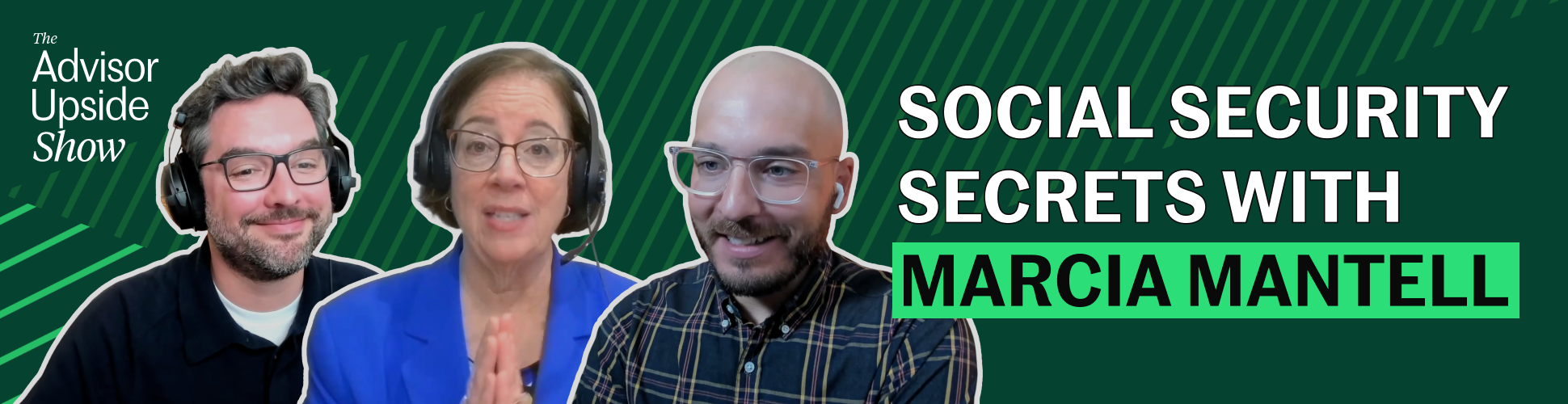
The Social Security Advice That Clients Resist. Claiming early permanently cuts monthly income for life — yet a third of retirees claim at 62 anyway, often unaware of the trade-off. In the debut episode of The Advisor Upside Show, retirement expert Marcia Mantell joins Sean Allocca and John Manganaro to uncover the mistakes that cost retirees thousands, and how advisors can catch them first.
 Listen to Episode 1 now.