

Good morning and happy Wednesday.
Shiny new object syndrome is definitely a thing right now in the ETF industry.
Loyal readers of ETF Upside already know that momentum in the market is swinging towards actively managed funds, and it’s not just anecdotal. Goldman Sachs data suggests as much as a third of ETF investments are going towards active products these days, and active ETFs now account for roughly 80% of new launches, per FINTRIX. That’s a major coup for active managers, who have really only been doing their thing since 2019, but one also shouldn’t overlook the enduring power of low-cost passive ETFs. Indeed, Morningstar’s 2026 US Fund Fee Study found that low fees are growing more potent as time passes, and while active ETFs offer some attractive features, passive funds provide access to time-tested indexes with little fee drag.
So, what’ll it be, active or passive?
SpaceX IPO Could Launch an ETF Buying Bonanza

Space investing is about to take off.
The mega-space tech company SpaceX is expected to begin trading publicly on Friday and investors are preparing for an offering that could shake up the space investing market, and the economy more broadly. But ETFs also stand to benefit, particularly those focused on the space and technology sectors. While some funds have requirements in place to vet for companies that meet index rules,others, like those tracking the S&P 500 and Nasdaq-100, will be forced to buy it. Some funds even have exposure to SpaceX through private holdings. The IPO is making investors interested in the industry more broadly, said Andrew Chanin, the CEO of ProcureAM.
“This pending IPO is … forcing inquisitive investors to try to determine what will happen,” Chanin said, “as well as how they may choose to position themselves afterwards.”
A Giant Leap for SpaceX. A Big Rebalance for ETFs
For investors already holding the relevant index funds, no action will be required to hold SpaceX. Still, many may want to up their allocation to the company by getting into space thematics. ProcureAM’s pure play space fund, UFO, is a passive product that tracks the VettaFi Space Index, which is expected to include SpaceX as soon as next week, Chanin said. “For us, UFO is a passive ETF, meaning it tracks a passive index, so we follow hard-and-fast set rules and try to replicate the underlying index,” he said. “[VettaFi is] looking at different metrics, such as the market cap, the price, the IPO price.”
Funds that track the S&P 500 and Nasdaq-100 indexes will need to absorb between $22 billion and $27 billion in SpaceX stock, according to ETF.com. Some of the biggest funds on the market that would hold SpaceX include:
- The Vanguard S&P 500 ETF (VOO), which oversees $1 trillion in assets and would need to buy roughly $5 billion in SpaceX following the IPO.
- The iShares Core S&P 500 ETF (IVV), which manages $859 billion and would also need to buy roughly $5 billion in SpaceX.
- The SPDR S&P 500 ETF Trust (SPY), which oversees $787 billion in AUM.
Space Time Continuum. Still, some questions remain, such as whether the company can sustain its hype post-listing. (One study looking at more than 9,000 IPOs between 1975 and 2021 found that about 60% delivered flat or negative returns three years after going public.) Another factor to consider is the company’s small relative float, or the number of shares available for public trading on the market.
“We’ve never seen a company this large go public,” Chanin said. “Will a much smaller available float create potential volatility, if people are really trying to get in or really trying to get out? Or are people saying, ‘Hey, this has been a great run, and I’ve seen great appreciation, and now I want to lock in those gains’? I think those [questions] are interesting.”
39% of the Market Sits in 10 Stocks. What’s Next?
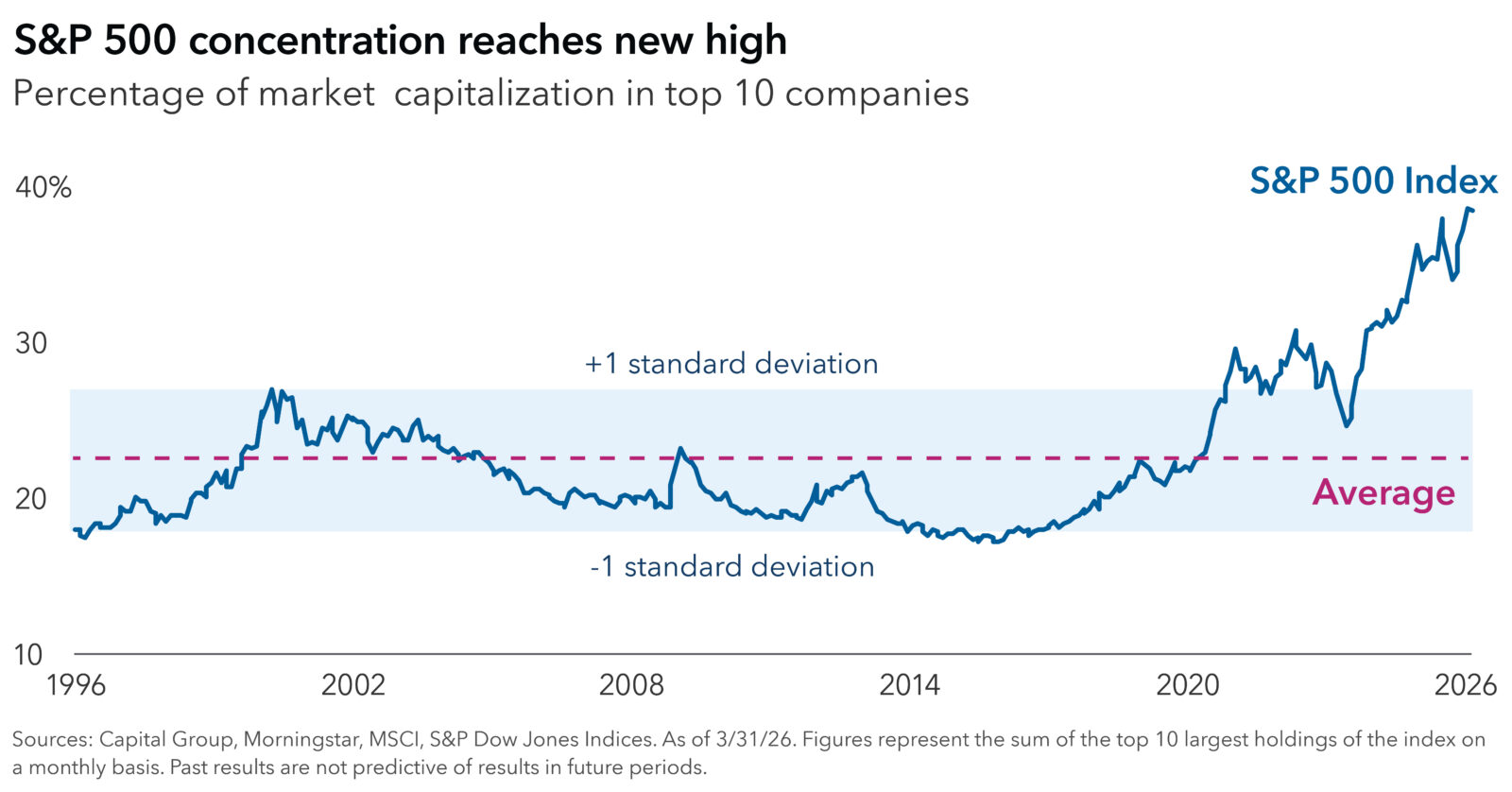
Concentration risk is looming, many US valuation measures are high and inflation worries are surfacing again. Yet, markets continue to surge with leadership broadening beyond Big Tech.
Flexibility matters in this environment. That’s why more advisors are considering a pivot to active management.
Capital Group’s investment process combines collaborative research, diverse perspectives and a long-term view.
It’s built for greater resilience and returns across various market cycles.
See how Capital Group’s active approach can strengthen your US equity allocation.
Northern Trust Becomes Latest Firm to Apply for ETF Share Classes

Everybody wants their fair share.
Northern Trust is the latest financial institution to file for ETF share classes that can coexist alongside traditional mutual fund share classes. This particular filing doesn’t concern Northern Trust’s own funds, but instead mutual funds launched by third-party asset managers on its fund platforms. It’s part of a broader industry push to capitalize on the growing demand for share classes, after Vanguard’s patent expired in 2023. Asset managers have raced to secure regulatory approval for the model, which allows them to offer both mutual fund and ETF share classes of the same fund, giving investors access to ETF benefits such as tax efficiency and intraday trading, while allowing firms to retain existing assets.
“It’s as much a defensive move as it is an offensive one,” said James Seyffart, senior ETF analyst at Bloomberg Intelligence. “If you have a client invested in a mutual fund and they’re considering moving to a competitor’s ETF, you can instead offer an ETF share class of the same fund without triggering a taxable event.”
What’s the Holdup?
Despite a wave of applications over the past three years, only a few asset managers have added ETF share classes to existing mutual funds:
- Earlier this year, Dimensional Fund Advisors added ETF share classes to its US Micro Cap Portfolio and later expanded the structure to its US Small Cap Growth Portfolio. The firm plans to add ETF share classes to 11 additional mutual funds.
- More than 100 other firms have filed for ETF share class structures, and while the overwhelming majority have gotten approval, only 10 have actually attached share classes to mutual funds so far, according to Morningstar.
However, just because they got approved, doesn’t mean the firms necessarily have ETF management capabilities, said Dan Sotiroff, senior manager research analyst at Morningstar. “That’s really where the bottleneck is and why it’s rolling out so slowly,” he told ETF Upside.
Gone Fishing. The opportunity is hard to ignore. While mutual funds still hold more assets overall, investor money continues to funnel into ETFs. Mutual funds ended last year holding almost $31.5 trillion in assets, a 10% increase from the previous year. Meanwhile, ETF assets increased 30% to $13.5 trillion. “There’s money pouring into ETFs in aggregate and tons of new funds coming to market,” Seyffart said. “The fish are borderline jumping in the boat.”