
Good morning and happy Monday.
BlackRock is already the largest asset manager in the world with $14 trillion under its belt, and now the company is looking to expand even further by targeting the most populous country in the world.
In August, BlackRock and its Indian partner, Jio Financial Services, plan to launch their first ETFs in the country where less than 300 funds are domiciled, just a fraction of the more than 4,500 US-based funds. The firm will kick off its new business line with equity-focused ETF strategies. India is a predominantly institutional investor market, but the retail base is building. “ETFs are a long-term play,” Sid Swaminathan, Jio BlackRock Asset Management CEO, told Reuters. “We can see from global trends how well ETFs have been adopted as a choice for investing.”
Maybe, we’ll see you there for a game of cricket?
Vanguard Dethrones BlackRock as America’s ‘Definitive King’ of ETFs
The ETF leaderboard has a new numero uno.
Vanguard is now the largest US exchange-traded fund issuer, surpassing BlackRock and ending the Larry Fink-run company’s more than two-decade reign. Vanguard manages around $4.39 trillion across 116 US-listed funds, according to data from Bloomberg, beating the $4.36 trillion managed by BlackRock. Founder Jack Bogle’s bet that investors want buy-and-hold investments at a low cost has paid off. After introducing the world to index funds in the ‘70s, he laid the groundwork for cheap funds, which his predecessors mimicked. In February, the firm shaved the expense ratios of 53 passively managed funds, which it estimated would save customers $250 million this year alone. Earlier this month, the Vanguard S&P 500 ETF (VOO) became the first ETF to hit $1 trillion in assets.
“Vanguard’s low-complexity, low-fee approach has been slowly winning the ETF race for the last decade,” said Dave Nadig, president and director of research at ETF.com. “They’re slow to launch new products, quick to lower fees and that’s landed with a whole range of retail and advisor clients.”
Slow and Steady
ETFs have surged in popularity of late and newer innovations such as leveraged single-stock and crypto funds have garnered significant attention. But Vanguard has quietly kept doing what it does so well, Nadig said: run beta at the lowest possible marginal cost.
“At Vanguard, asset growth reflects the enduring trust investors place in our time-tested, disciplined approach,” a Vanguard spokesperson said in an emailed statement. “Over the past 25 years, we’ve crafted a thoughtful selection of low-cost, broadly diversified ETFs across a range of asset classes to help investors pursue their goals with greater confidence.”
But don’t feel too bad for BlackRock since it’se still on top globally:
- iShares, BlackRock’s ETF arm, manages roughly $6 trillion in ETFs around the world, over $1 trillion more than Vanguard, according to data through the end of May from ETFGI.
- “iShares is an all-weather platform built to deliver for clients in every market environment,” a BlackRock spokesperson told ETF Upside. “We are focused on innovating alongside our clients to meet their evolving investment needs.”
Still, it’s hard to imagine another firm challenging Vanguard’s title of “definitive King of America” in both ETFs and mutual funds, given that it brings in roughly 50% more flows than anyone else, Bloomberg analyst Eric Balchunas said via LinkedIn.
Budget-friendly: Cost isn’t everything, Nadig said, pointing to “free” ETFs with waivers, upstarts like Corgi Funds trying to out-Vanguard Vanguard and large firms like Charles Schwab cutting fees of their own. “But there is something to the Vanguard brand, and no fee cut takes that away.”
When the S&P 500 Fell, Dividends Helped Returns
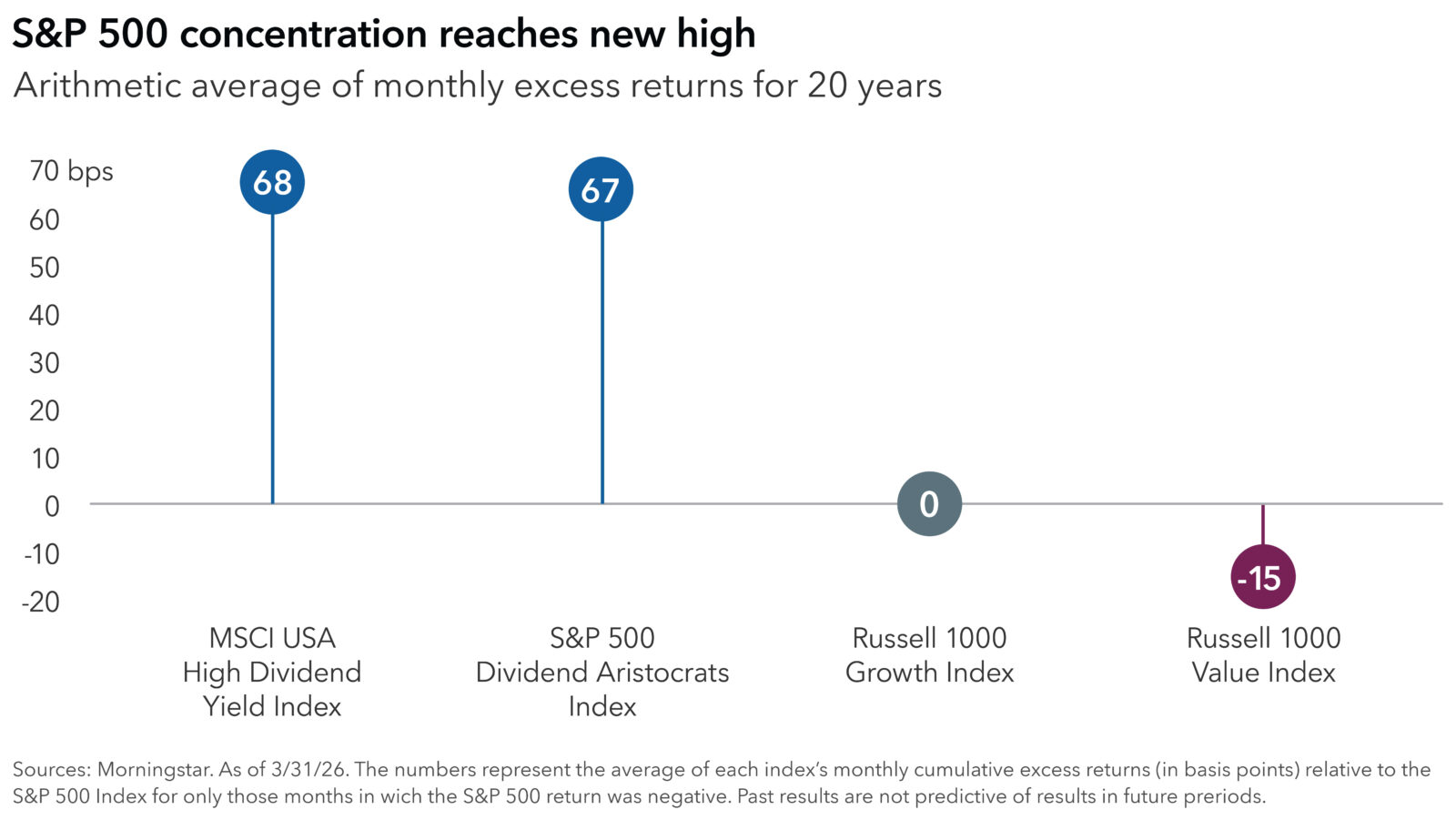
The S&P 500 is showing concentration risk with nearly 40% of its value in the top companies. Plus, growing uncertainty surrounding AI spending, inflation and the global economy are worrying more investors. This is why value investing is making a quiet comeback.
But over the past 20 years, in periods when the S&P 500 declined, so did value indexes. What held up?
The answer: Dividends.
CGDV – Capital Group Dividend Value ETF intends to allow you to participate in growth while defending with dividends. This approach has translated into higher yields, stronger returns and less downside than the S&P 500.
See how CGDV can strengthen your US equity allocation in this current market.
Schwab Follows Vanguard With Fee Cuts on 4 ETFs

Four Charles Schwab funds are taking just a little of the top.
The brokerage giant cut fees on four passive equity index ETFs last week, trimming expenses by one or two basis points per fund, adding even if just minimally to the seemingly never-ending game of fee-compression poker between asset managers. In fact, Schwab is seeing some of its competitors and making bets of its own. “I don’t think we should necessarily see massive inflows into these funds because of the changes,” said Zach Evans, an analyst at Morningstar. “It’s more symbolic of Schwab’s commitment to offering the lowest-cost strategy in a given category,” he added, noting that each of the fee cuts matches reductions Vanguard made to comparable funds earlier this year.
A Real Cut-up
Out of Schwab Asset Management’s 24 market-cap weighted, index equity and fixed income ETFs, 16 are now offered at only three basis points, according to the firm. “We believe that even small cost differences can have a meaningful impact over time, while also reinforcing our longstanding leadership in low-cost investing,” said John Sturiale, head of investment products at Schwab Asset Management.
Among the funds that received cuts last week:
- Both the Schwab US Mid-Cap ETF (SCHM) and the Schwab US Small-Cap ETF (SCHA) dropped one basis point to 0.03%.
- Meanwhile, the Schwab International Small-Cap Equity ETF (SCHC) and the Schwab Emerging Markets Equity ETF (SCHE) lowered from 0.08% and 0.07%, respectively, to 0.06%.
The company noted an investor with $10,000 would incur annual fund expenses of just $3 to $8, with positions in both stocks and bonds, using its suite of index ETFs.
Less Is More: The average fee for asset weighted funds continues to decline, and that more than anything, is a result of flows into low cost products. “Investors overwhelmingly prefer cheap funds to expensive ones,” Evans told ETF Upside. “Whether it’s mutual funds, an ETF, an active fund or a passive one, investors want cheap products.” He added that broadly speaking, lower costs translate to better returns. “The fee you pay on a fund takes a chunk out of your return each year, and if you can minimize that chunk, you give yourself the best opportunity for the best performance.”