
Good morning and happy Monday.
Looks like Elon Musk isn’t the only one with 13 digits to his name.
Less than halfway through the year, (an incredible pace, by the way), flows into US-listed ETFs have already surpassed the $1 trillion mark, according to ETF Database. The standout has been the Vanguard S&P 500 fund (VOO), which recently reached $1 trillion in assets under management of its own, tacking on roughly $125 billion in net inflows this year alone. Meanwhile, flows into active products surged 70% year over year in the first quarter, maintaining one of the industry’s strongest growth trends.
“After back-to-back years of record ETF net inflows, it is hard to be surprised by the industry’s growth,” said Todd Rosenbluth, head of research at VettaFi. “However, crossing $1 trillion before many people take summer vacation has shocked me.”
ETFs Get Tropical With New Fund Filings Targeting MANGOS

Who doesn’t love a mango? They’re sweet, tangy and now chock full of artificial intelligence goodness.
Asset managers Yorkville America and Corgi Securities both filed for ETFs last week targeting MANGOS. Not the juicy fruit native to northern India, but rather the acronym representing the big tech and AI space, standing for Meta, Anthropic, Nvidia, Google (Alphabet), OpenAI and SpaceX. It’s not only the latest of Wall Street’s alphabet-soup colloquialisms, but it could also be the next big investing strategy, with Yorkville and Corgi aiming to be pioneers. It’s just like the doctor says: a MANGO fund a day keeps the FOMO away.
Nature’s Candy
Corgi has quickly made a name for itself this summer, bursting on to the scene with roughly 70 funds, mostly thematic and leveraged plays, in a matter of just two months. Meanwhile, Yorkville is the manager behind the Trump family’s suite of Truth Social ETFs and its “America First” investing philosophies. Now, both are looking to package the AI ecosystem into a single tradeable basket:
- The Corgi product will allocate 80% of its assets toward the six MANGOS companies, according to a filing.
- The Yorkville ETF may provide exposure to seven other companies in the AI space, including, SanDisk, Micron, Dell and others, per its filing. The firm also filed for another version of the fund that seeks to generate income through an actively managed option-writing strategy.
MANGOS Mania: Though Anthropic and OpenAI are private (for now), the funds may invest in them directly as an ETF can hold up to 15% of its portfolio in illiquid securities. But mostly they’ll be capturing them by proxy, buying shares of public companies tied to their growth, as well as using a series of derivatives to mimic their price movements.
Now, excuse us while we go grab a mango smoothie.
Three Reasons Active ETFs May Boost the Value Prop of Your Business
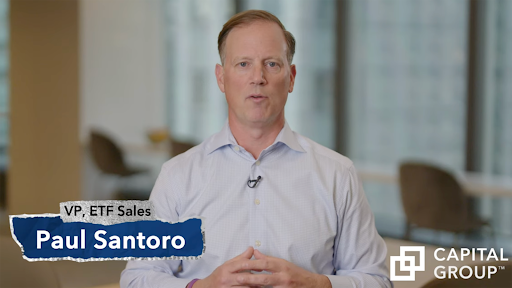
Capital Group’s Paul Santoro believes it comes down to a few core concepts: choice, diversification, and value.
All of them, though, are rooted in the same core principle: showing your value as an advisor by giving your clients the best chance to outperform the broader market over long stretches of time.
Capital Group’s suite of ETFs is built on that foundation: equipping advisors with tax efficient solutions coupled with active management that pursues better-than-market results.
Get a handle on Capital Group’s active approach to ETFs.
Capital Client Group, Inc.
What Will ETFs Look Like in 2027? State Street Gazes into Its Crystal Ball

Predicting industry trends is like reading tea leaves, and experts at State Street just put on a new pot.
Assets moving into exchange-traded funds are outpacing predictions by double-digit percentages, with total flows expected to surge past $30 trillion by the end of the decade, according to a recent report from the asset manager. But the firm also made industry predictions about everything from the skyrocketing use of derivatives to which part of the world will have the fastest growth. (Spoiler: It’s the Asia-Pacific, specifically Japan.)
“Many people who follow the ETF industry believe that the next leg of growth is in geographies,” said Michael Arone, chief investment strategist at State Street Investment Management. “As more platforms are available to more investors, do-it-yourself investors … have access to more information, more accounts. This is an overlooked growth area of the ETF market.”
Crystal Ball’in It
Another overlooked aspect of the industry is the massive breadth of challenges that new products address, Arone said. “When ETFs started, the question was: ‘What index do I want to own? What market do I want to be [in]?’ Those types of things,’” he told ETF Upside. “Now, it’s a conversation about: ‘What outcome am I trying to achieve?’ and the sheer number of use cases across ETFs, whether it’s options strategies, buffer strategies or income-oriented.”
Bartolini and Arone made several long-term bets on how the industry will evolve:
- Over the next five years, a majority of ETFs will use derivatives. (Over the past five, low-volatility funds had cumulative outflows of $37 billion, while defined-outcome products had inflows of $5 billion.)
- In the next three decades, funds will morph into tokenized investment platforms trading all day, every day, globally.
- Although ETFs currently account for 14% of global investable assets, that figure could rise to 50% within the next decade.
Instantaneous Rate of Change: When it comes to derivatives, Arone said, part of their outsized growth is actually due to the appeal of income-generating products. Even though bond yields are high, a diversified portfolio of stocks and bonds might yield just a couple percentage points, which would be below the rate of inflation. As a result, many investors (particularly retirees who rely on stable finances) are turning toward derivative-oriented ETFs to generate income.
“We’re seeing real appetite from investors [for derivatives],” Arone said. “Despite the fact that bond yields are higher, in globally diversified portfolios, incomes continue to be a challenge, particularly given where inflation is.”