China’s Aerospace Industry Gains Altitude Slowly After Taking Flight
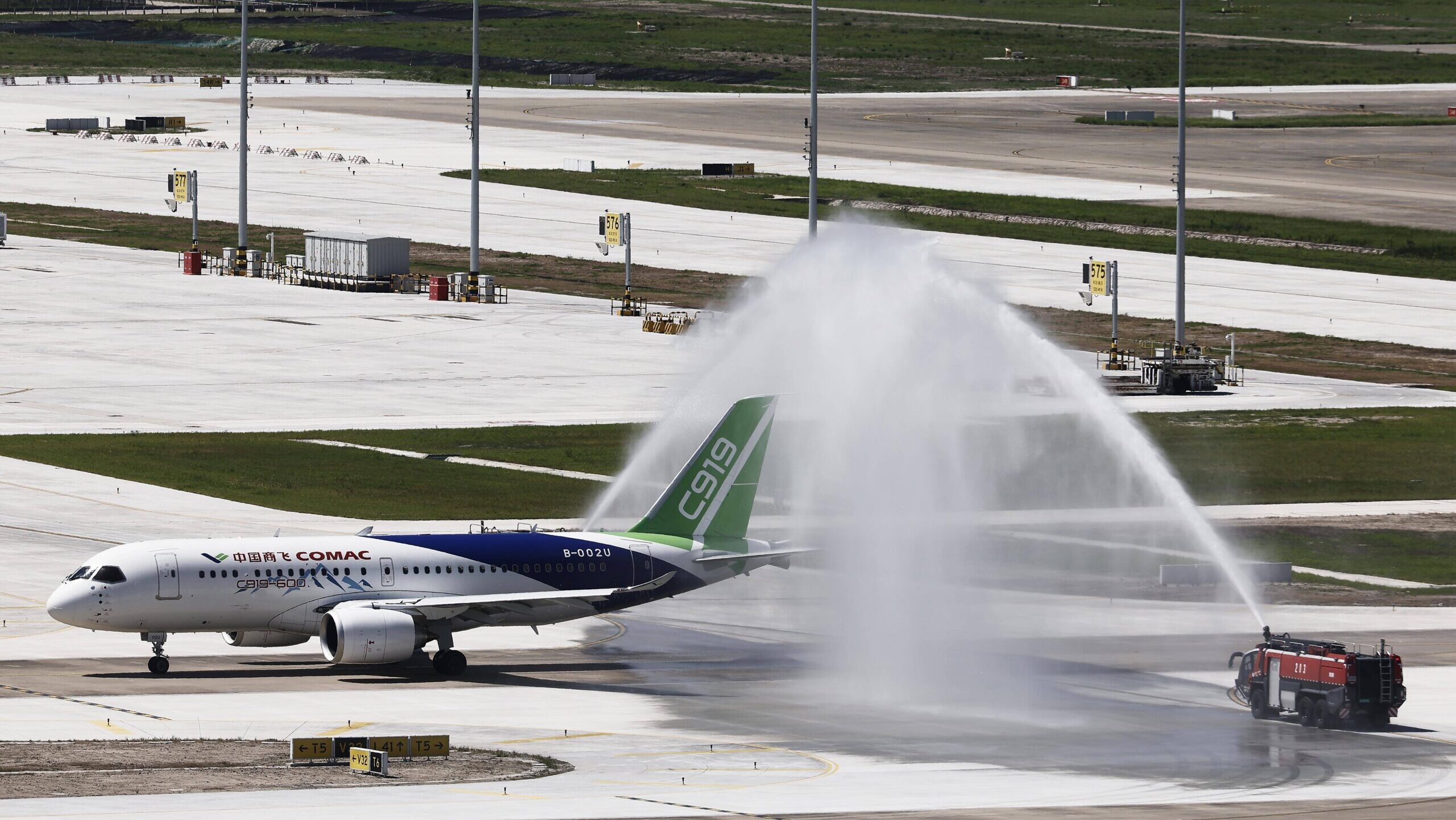
A C919 aircraft built by the state-backed COMAC completed an international commercial flight for the first time last week.
Sign up for smart news, insights, and analysis on the biggest financial stories of the day.

COMAC left the tarmac, landed in a different country, and put Boeing and Airbus on notice that it’s coming for them, though it won’t get there fast.
Last week, a C919 aircraft built by the state-backed Commercial Aircraft Corporation of China (COMAC) completed an international commercial flight, departing from Beijing and arriving in Ulaanbaatar, Mongolia. That’s only some 750 miles, or roughly the distance from New York City to Jacksonville, Florida. But for China’s homegrown aerospace industry, it’s a leap into the stratosphere, marking the first time a COMAC aircraft has completed an international commercial trip. Just don’t start thinking the company is flying as high as Boeing and Airbus. Yet, anyway.
Assembled in China
Milestones aside, it’s still better to think of the C919 as “Assembled in China,” and not exactly “Made in China.” Honeywell has supplied components including brakes and flight control packages. Collins Aerospace has supplied avionics. And the engine comes from a joint venture between GE Aerospace and the France-based Safran Aircraft Engines. The diverse and international supply chain, unsurprisingly, has its drawbacks. For instance, said engine was ensnared by export controls for multiple weeks at the height of last year’s trade war.
The supply chain turbulence has long prevented COMAC’s production capacity from reaching cruising speeds:
- While hard data remains opaque, some reports suggest COMAC delivered as few as 15 C919 planes to customers last year. That’s well short of its goal of 75, and nowhere near the 600 and 793 aircraft delivered by Boeing and Airbus, respectively.
- The company may have delivered only three planes in the first quarter of the year amid more production delays, according to a report by the South China Morning Post. It had previously set a goal of delivering 200 planes annually by 2029.
Not Cleared for Takeoff: Shoring up its production capacity is one thing, but finding willing buyers is another. COMAC has not received approval from either US or European aviation regulators, constricting its market. In May, Bloomberg reported that Chinese regulators were intentionally slow-walking approval for Airbus planes in apparent retaliation for Europe’s aviation regulator taking its sweet time certifying the C919. To paraphrase the old saying: China plans for centuries, Europe plans for long lunch breaks and longer summer vacations.
Recent News

-

Photo illustration by Connor Lin / The Daily Upside