

Good morning.
Get ready to rock around the clock. The beautiful thing about tokens (digital representations of securities, vehicles and real world assets) is that you can trade them pretty much whenever. However, actually creating new tokens or redeeming old ones typically only occurs during market hours. Until now.
Ondo Finance, which serves international clients, has upgraded its platform and claims to be the first service to allow 24/7 minting and redemption of tokenized US stocks and ETFs on Ethereum and BNB Chain. Right now, that capability is available on just six tokens representing the SPDR S&P 500 ETF Trust (SPY), the Invesco QQQ Trust (QQQ) and a few individual stocks. Earlier this month, Ondo added 173 tokenized stocks and ETFs to its catalog.
Wall Street may sleep, but tokens want to party all night long.
Bitcoin ETF Outflows Hit Record Highs As Crypto Winter Sets In

Not long ago, spot Bitcoin ETFs were the hottest thing in the fund industry. Those were the days, eh?
About $6.4 billion flowed out of the products over the past month, marking the category’s largest 30-day pullback on record. Bitcoin itself has fallen roughly a third this year, now trading under $60,000. Meanwhile, the once-soaring iShares Bitcoin Trust ETF (IBIT), which neared $100 billion in assets last October, currently manages about half that. Investors are trimming risk amid concerns about higher interest rates and broader market uncertainty. But, even amid a new crypto winter, there are opportunities for advisors.
“Investors got out over their skis and have just seen the continued deleveraging of the system, which has led to more selling, which has led to more deleveraging, which has led to more selling, and more deleveraging,” said Ryan Rasmussen, head of research at Bitwise. “This is typical in Bitcoin cycles, which historically have run every four years … that’s what’s happening here.”
Taking Hits on All Sides
The crypto trade is facing headwinds from several directions. Interest rates are expected to go up, which is historically bad for assets like Bitcoin. Assets are rotating toward AI stocks, with the recent SpaceX public offering and anticipated debuts of Anthropic and OpenAI. Then there are the forced sellers, who are unwinding positions, said Don Friedman, the CEO of the Digital Assets Council of Financial Professionals. “This is mechanical, non-directional selling, rather than a bearish bet,” he said.
The three largest Bitcoin ETFs have all seen significant outflows this year:
- iShares Bitcoin Trust ETF, with $47.2 billion currently under management, shed $475.8 million in assets this year, as of the closing bell on Friday, according to data from ETF.com.
- Fidelity Wise Origin Bitcoin Fund, with $11.3 billion in assets under management, lost $1.6 billion.
- Grayscale Bitcoin Trust ETF, with $8.7 billion under management, dropped $1.9 billion in assets.
Spring Is Coming: While we’re in the midst of another crypto winter, the theory behind Bitcoin remains robust and there are a couple of long-term tailwinds for crypto as an asset class, said Rasmussen. “If you think that the world’s money supply is going to continue to grow … then the need for assets like gold and bitcoin will continue to grow,” he said. Plus, with the upcoming great wealth transfer, younger investors tend to favor digital assets over traditional assets like gold. “Most of the wealth managers we speak to who hold Bitcoin positions already are maintaining those positions or adding to them during this drawdown, and those that don’t hold it are considering this as a good entry point.”
When the S&P 500 Fell, Dividends Helped Returns
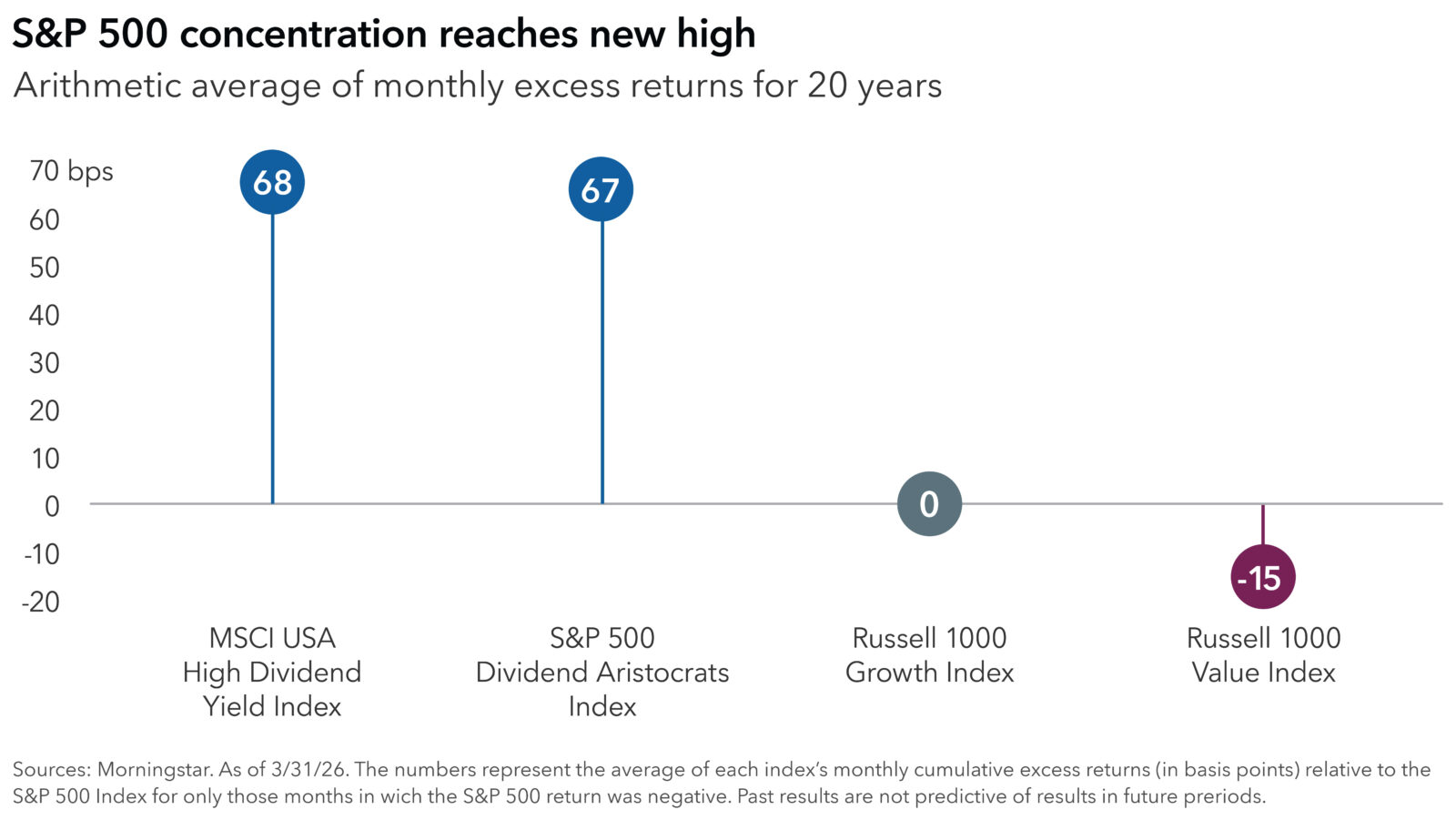
The S&P 500 is showing concentration risk with nearly 40% of its value in the top companies. Plus, growing uncertainty surrounding AI spending, inflation and the global economy are worrying more investors. This is why value investing is making a quiet comeback.
But over the past 20 years, in periods when the S&P 500 declined, so did value indexes. What held up?
The answer: Dividends.
CGDV – Capital Group Dividend Value ETF intends to allow you to participate in growth while defending with dividends. This approach has translated into higher yields, stronger returns and less downside than the S&P 500.
See how CGDV can strengthen your US equity allocation in this current market.

Why Gold ETFs Are Suddenly Tarnishing

What goes up, must come down.
Gold ETFs have enjoyed serious upside in recent years, with the price of the precious metal increasing 64% in 2025 after a 26% climb the year before. That drove strong performance in exchange-traded funds like the SPDR Gold Shares (GLD) and the iShares Gold Trust (IAU), both boasting a near 100% return between early 2025 and February of this year.
Lately? Not so much. The price of gold itself has fallen about 6% so far this year and more than 10% since the start of June. It’s always hard to say exactly why the markets do what they do, but the inflation and interest rate outlook clearly isn’t helping gold ETFs at the moment. The consensus today is that rates are likely to either stay flat or rise, and that’s dulling gold’s luster. It’s a pretty bleak outlook for funds that track the spot price of gold, which fell below $4,000 last week for the first time since November 2024.
It may be high time for advisors to take a fresh look at gold, and help clients best position those assets in their portfolios. “The interest rate outlook is not just a story about inflation, Iran or oil,” Stephen Laipply, global co-head of iShares fixed income ETFs for BlackRock, said on CNBC. “It’s an economic growth and resilience story that’s playing out here.”
Where Rates May Be Heading
While the traditional inverse relationship between gold prices and real interest rates is holding strong, there’s also reason to believe gold could recover sooner than later if inflation cools. There’s also the potential for retail ETF inflows and institutional buying to pick up. These factors could help gold climb back toward all-time highs, with ETFs following suit. Unfortunately, the year-over-year change in the Personal Consumption Expenditures print hit a three-year high when it was released last week.
Gold ETFs are feeling the pain:
- SPDR Gold Trust has dropped about 6% this year after paring some losses Friday.
- Most peer funds are in that negative range, including the iShares Gold Trust (IAU) and the Physical Gold Shares ETF (SGOL) from Aberdeen Investments.
A New Pattern? The inverse correlation between interest rates and gold has held for decades, but recent market dynamics have thrown that into question. Particularly since 2022, sustained high inflation and massive sovereign or central bank gold-buying have occasionally caused gold and interest rates to rise in tandem, breaking their traditional seesaw dynamic. Morgan Stanley analysts, among others, have some hope this dynamic could help gold prices recover.