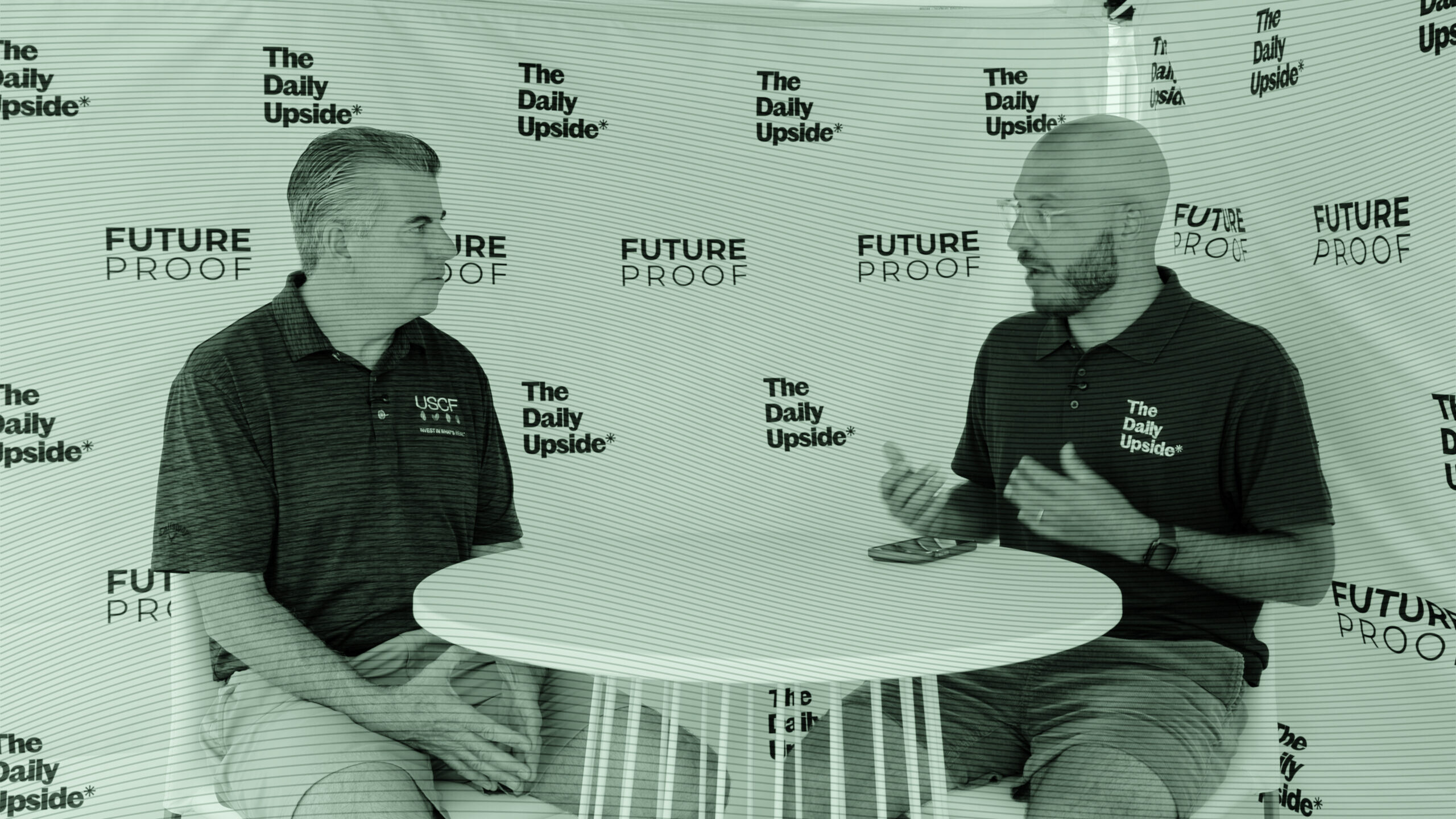
The periodic table hasn’t changed, but what sets the price of its most valuable elements has. Ask John Love, president and CEO of USCF Investments, and he’ll tell you why. We caught up with him at Future Proof Festival 2026 to talk through OPEC’s slipping grip, gold’s unusual year, silver’s industrial shift, and his bull case on copper.
The Daily Upside: Commodities used to have fairly clean explanations. Oil moved on OPEC, gold on inflation, copper on Chinese construction. Do those explanations hold up in 2026?
Not entirely. They’re not gone, but take OPEC. Right now, with the Iran war going on, OPEC as a force doesn’t have a lot of power, because their power was always that they could raise output to meet demand or drop output to meet demand. Now output’s been reduced for them when the demand is still there, so at this moment they don’t have much pricing power at all. Longer term, once this crisis is over, they’ll still be a factor, but the US and other countries around the world have more power now. It’s a very different world than the 1970s, ‘80s, and ‘90s. You have OPEC+ bringing in Russia, but you also have disagreements among the members and members leaving the cartel. It’s not the same as it was.
The Daily Upside: When we last spoke, the Iran war had just broken out. Are the dynamics you’re describing here to stay?
Nobody knows for sure, but things don’t look great on the surface of where we are right now in mid-September. You look at the attacks in Saudi Arabia in the last week and it seems like the situation’s getting worse. The worst part is that we’ve collectively drawn down reserves. The US has drawn down our strategic petroleum reserve. China drew down theirs and has now moved back into the market as a buyer, so they’re competing for cargoes. China not buying in the spring was a bit of a relief valve for 15% to 20% of the world’s oil being offline. And then there’s the routing through Saudi Arabia, where the pipeline has been bombed. They’re saying probably weeks before it’s back up, and who’s to say it doesn’t get hit again. There’s a lot of chaos in the world, and I don’t see it abating anytime soon. We’ll have moments where it looks better, but right now there’s such a lack of trust.
The Daily Upside: Moving from energy to metals, gold’s had an unusual year. What have you seen there?
Gold did fantastic over the past three years, so part of this is that it had run up and has given a little back. The other factor is rates. The 10-year hitting 5% is a key headline, and that devalues all assets to some degree, which weighs on gold. On the flip side, we still have central banks buying gold, which was a big driver of the run-up over the last three years. It’s a little more up and down than it was, but China’s still buying pretty consistently and Poland has been buying a ton. Inflation is still a factor too, though we actually think broad commodities might be a better inflation hedge than gold. And then there are all these dislocations, all this fear about conflicts and geopolitics. Gold has probably disappointed this year, but it’s still high if you’ve been a long-term investor. With the exception of the interest rate story, I think the other factors are bullish.
The Daily Upside: Silver is often thought of as gold’s little brother. Is that the right way to think about a silver allocation?
I don’t think so, actually. Gold is a precious metal. Silver has always had industrial uses, but those uses have increased dramatically over the past few decades. I think it’s now well over 50% of silver’s usage going toward industrial applications, some of that for the electrification story in data centers. It’s not as much as copper, but there’s a different driver to silver now. It is true that when gold runs up, what you tend to see toward the late stage of a rally is silver catching up and, in the short term, surpassing gold. We saw that at the end of last year, and then it tends to abate. So silver often trails, catches up, and can go down with gold. There’s some correlation there, but I think there’s also correlation to industrial metals.
The Daily Upside: Could you talk more broadly about industrial metals, and which ones people should be thinking about?
Industrial metals are a big story for the next decade at least. Even if we had a recession, or the AI bubble pops, there’s so much demand that in five or 10 years there’s still going to be more need for metals than currently exists. In particular, copper. I can’t say what happens in three or six months, but as a long-term play we’re very bullish on copper. There simply isn’t enough to meet the demand. You would have to have a complete decimation of the global economy for that to change, and I don’t think that’s likely. You’re looking at electrification, you’re looking at data centers. There’s been pushback on that, but they’re still going forward. And then there’s traditional manufacturing. Nobody’s opened a new copper mine in forever, and it takes a long time to do. They used to call copper Dr. Copper, because it could forecast the state of the economy, but I think it’s dislocated somewhat from that old story, because it’s no longer just manufacturing driving it.
The Daily Upside: On the broader energy question, with the build-out of data centers and EVs, are we going to have enough to fuel what we want to accomplish?
If you look around the world right now, clearly no. We’re seeing people competing for fossil fuels, among other things. We need energy from all sources, and we need to look at novel sources as well as traditional ones. Liquefied natural gas is a hugely expanding story, and people are competing for cargoes there too. One of the big shifts over the last two to three years is that people were averse to fossil fuels as an investment, and now that’s come back. From an investment standpoint, fossil fuels have reemerged as a critical energy source going into the next few decades. Some people would not be happy to hear that, but the reality is we need everything, and fossil fuels are what we’re primed to produce right now. Until we build that bridge, we need it.
Recent News
-
Having the Talk: How Advisors Can Encourage Caregiving Conversations

Photo by Jomarc Nicolai Cala via Unsplash -
Your Young Clients Might Be Big Art Connoisseurs
Photo by Zalfa Imani via Unsplash -
Betterment Aims to Make ‘Mega Backdoor Roths’ Easier for Advisors

Photo by Osarugue Igbinoba via Unsplash -
Benchmarks, Private Markets’ Beast of Burden No Longer
Photo by Vale Arellano via Unsplash -
Spotify Surges on Premium Subscriber Success

Photo via Edmond Sadaka/SIPA/Newscom -
Blackstone’s Burgeoning AI Business and Inflows Spark a Rally

Photo via Richard B. Levine/Newscom -
Procter & Gamble Rosy with Thorne
Photo via Richard B. Levine/Newscom -
Fighting Entitlement Is Part of the Family Business

Photo by Kévin JINER via Unsplash -
The Floor Is Lava: BlackRock Joins Protected Bitcoin ETF Party
Photo by tian dayong via Unsplash -
Porsche Board Member’s Advice for Aspiring CFO Directors
Photo via Melissa Di Donato