The Bond Market’s Tokyo Story
Japanese economic policy is suddenly at the heart of the global bond selloff and US consumers should be paying attention.
Sign up for smart news, insights, and analysis on the biggest financial stories of the day.

The Japanese budget deficit, central bank policy and currency are all playing an immediate role in the intensifying global bond selloff, leading to knockdown effects on American consumers who end up saddled with higher borrowing costs.
Tomorrow, a major exercise in trust building will take place. Japanese Prime Minister Sanae Takaichi is expected to assure legislators that her government is pursuing a “responsible, expansionary fiscal policy” in an address to the country’s parliament, the Nikkei broadsheet reported last week.
In recent months, Takaichi’s government has made record spending requests, with a mind to boosting Japan’s slow (and slowing) economic growth. The concern is where all of that is going to come from.
For instance, Takaichi has touted a 14 year, 370 trillion yen ($2.3 trillion) private-public investment plan without specifying what chunk of that the public will pay for.
It’s not the only potential future budget line that’s not fully accounted for.
Last month, Japan’s cabinet gave the go-ahead to a proposal to slash a consumption tax on food from 8% to 1% for two years, and to issue payouts to households equal to the remaining 1%, effectively getting rid of the levy altogether.
But Takaichi hasn’t explained how this will be fully funded, either. Oxford Economics analysts estimate that at least half of the annual reduction in revenue, equal to roughly five trillion yen or $32 billion, will end up financed with debt.
That means a few more shovels full will be added to Japan’s $9 trillion public debt pile, which at roughly twice the size of its economy makes it the most indebted advanced nation on earth.
To make matters more complicated, in an August interview with the Yomiuri newspaper, Takaichi said the government intends to cap the issuance of new government bonds at 40 trillion yen next year, or about $255 billion.
Unsurprisingly, the mix of increased spending, cuts to revenues and limiting debt financing has raised more eyebrows on the bond market than a silverback gorilla bathing in a hot spring reserved for Japanese macaques.
For Japan, this cloudy outlook has accelerated the rapid bond market sell-off that’s impacting economies around the world.
The bond market has effectively told governments in recent weeks: “If you want us to loan you money for a decade or 30 years while you’re spending more and more, you’re gonna need to pay us a higher premium for taking on the risk.”
Last week, the yield on Japanese 10-year bond yields rose to 3.1% and is hovering near three decade-highs.
Adding to those pressures are circumstances out of Japan’s control. Central banks, including the Bank of Japan, have been pressed to hike interest rates because the U.S.-Iran war has raised the cost of energy and especially of diesel.
This makes myriad goods around the world more expensive, and the BoJ last month hiked interest rates to a 31-year high of 1.25% in an effort to combat inflationary forces.
Governor Kazuo Ueda told a press conference in Tokyo that the bank’s focus flipped from trying to raise the country’s persistently low inflation to its 2% target to trying to stabilize inflation against the upward pressures caused by the war, the massive global spending on AI and a weakened yen.
According to a summary of the BoJ’s meeting, most policymakers believe they should follow last month’s rate hike with more.
The American Angle
All of this activity in Japan, the world’s fourth largest economy and one of its most heavily financialized, impacts the U.S. bond market and, ultimately, American consumers.
The most straightforward impact is simple, upward pressure. The decades-high government yields in Japan, the U.K. and Europe are all driving each other higher, as investors try to lock in better returns, and U.S. bonds are no exception. “As [yields] move up, they are pulling each other up,” Zurich Insurance Group Chief Market Strategist and Economist Guy Miller told the Financial Times last week.
The 10-year U.S. Treasury yield, a key benchmark for borrowing costs, rose to 5.34% on Thursday, the most since 2002. In the third quarter, it rose nearly 90 basis points, or the most in any quarter in over 25 years. (Japan’s 10-year government bond yield has risen by double digit basis points for five straight quarters).
The U.S. bond yield, of course, is also being driven up by inflationary pressure and increasing investor concerns about its own government spending and debt, which is nevertheless considerably smaller than Japan’s when measured as a percentage of GDP. The enormous volume of private sector spending on artificial intelligence is also exerting upward pressure on yields.
“As more and more of the AI CapEx is financed in debt markets, we are seeing there’s some competition now for government borrowing,” said George Cole, the head of European rates strategy at Goldman Sachs Research, on a podcast last month.
But there’s another reason for Japan’s outsized impact on the U.S. Treasury market: Japan is the largest foreign holder of U.S. debt. As of July, the country had roughly $1.1 trillion U.S. Treasuries, equal to 12% of all foreign held U.S. debt, as of July, according to Treasury Department data.
This was in large part a function of the country’s relatively low interest rates, which for decades depressed bond yields and incentivized investors to seek out better returns abroad.
The normalization of interest rates and rise of bond yields at home means Japanese investors have less reason to place their money abroad.
A TD Bank analysis earlier this year found these shifts mean Japan’s insurers and pension funds, which have been “a key source of stable, long-duration demand for U.S. Treasuries,” will likely keep their money at home, reducing Treasury demand and thus driving up borrowing costs for the U.S. government.
Another factor that weighs on Japanese investors is the yen, which has flirted with four-decade lows this year.
A weak yen makes life more expensive at home for the Japanese, forcing Tokyo to consider selling off its dollar assets including Treasurys, which would threaten the U.S. with even higher borrowing costs. It also makes it harder for U.S. companies to compete in Japan’s important retail market because imports are suddenly much more expensive.
This is why U.S. Treasury Secretary Scott Bessent has aggressively moved to boost the Japanese currency. “I am the house now, and you can bet against me if you want,” he declared last month, after U.S. and Japanese officials confirmed a joint intervention to support the yen worth of tens of billions of dollars.
Along with the BoJ’s latest rate hike, the intervention helped the yen add 3.3% against the dollar in the third quarter, making it the top performing currency in the G10 for the period, according to Deutsche Bank.
Other policy factors were likely under consideration.
“A weak yen tends to put pressure on other Asian currencies, and it could make it harder for China to continue to allow a slow appreciation of its currency,” wrote Brad W. Setser, a senior fellow at the Council on Foreign Relations, in August. “All these currencies are very weak, and that was more or less working against the Trump administration’s goals to reindustrialize the United States.”
On the other hand, Bessent and the BoJ have to be careful about balancing the currency’s strength with rate hikes in Japan. The suddenly surging yen has caused headaches for investors who use the so-called carry trade, a term for borrowing cheap Japanese currency to invest it in assets with higher yields. If the yen keeps rising and the BoJ proceeds with planned rate hikes, borrowing in yen will suddenly become more expensive.
Many market observers fear that could force investors to sell U.S. stocks and Treasuries to close out the trade. Some say it’s already happening.
“A more likely explanation for the global bond market rout [than inflation] is that the yen-carry trade is unwinding as the Bank of Japan raises its policy rate, forcing carry traders to sell government bonds they bought worldwide with proceeds from cheap yen loans,” wrote Yardeni Research President Ed Yardeni last week. “This trade allowed many governments to run budget deficits without putting upward pressure on their bond yields. Now, the chickens have come home to roost.”
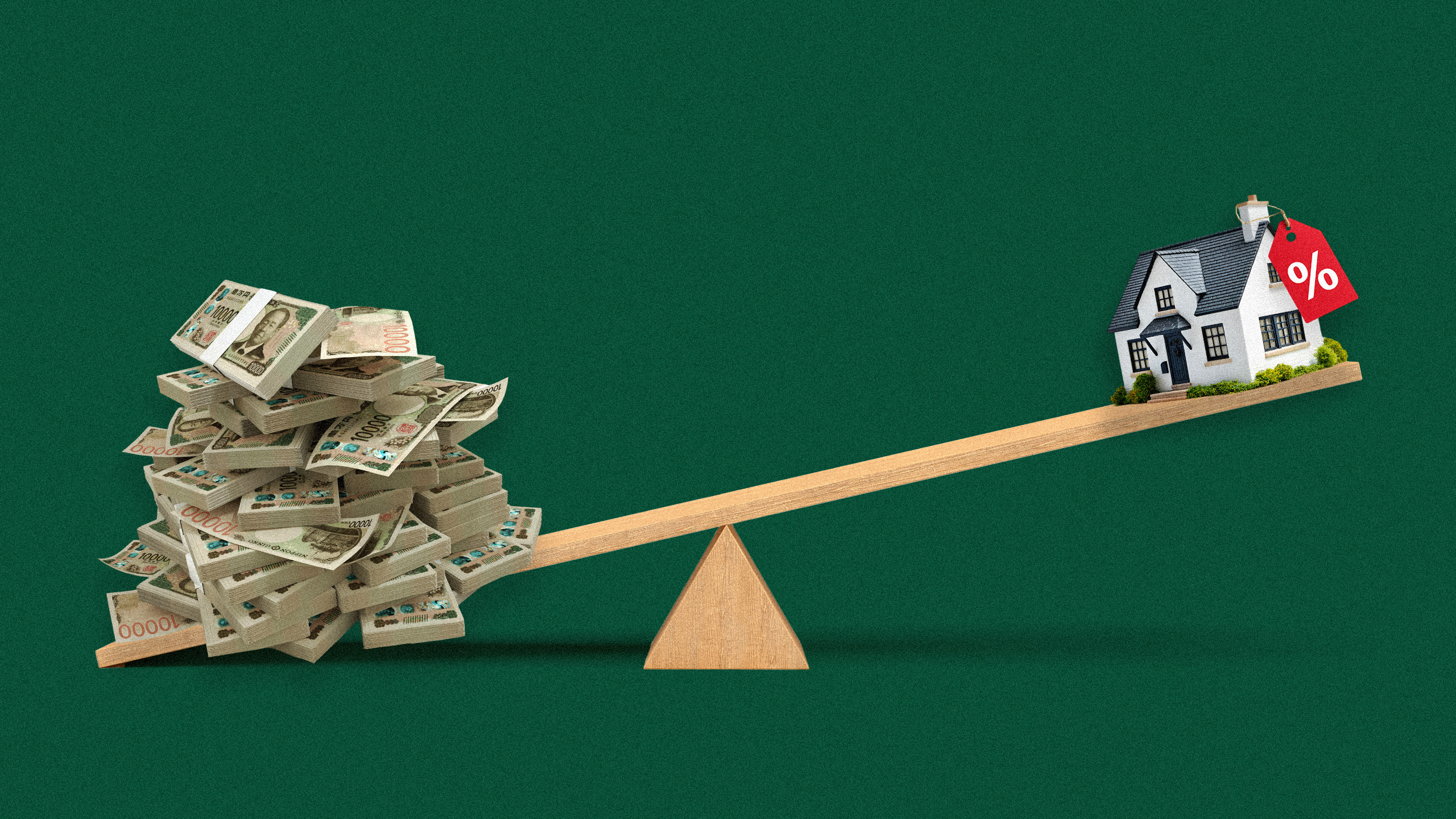
In the immediate term, the rising bond yields in Japan, the U.S. and elsewhere are dictating the terms for borrowing costs across economies, which includes mortgages, auto loans and student debt. Borrowing becomes expensive for consumers and companies, not just governments.
Japan may be a long way away, but surging 30-year U.S. home loan rates have blown up the playbook for would-be borrowers, topping 7% while home prices remain at record highs. The rising sun is just over the horizon line.
Recent News
-

Photo illustration by Connor Lin / The Daily Upside