Has Index Investing Gone Too Far?
Critics say markets become less efficient when too much money floods into indexed products, but that doesn’t tell the whole story.

Sign up for market insights, wealth management practice essentials and industry updates.

Blame it on Bogle.
John “Jack” Bogle launched the first publicly available index fund, which became the Vanguard 500 Index Fund, 50 years ago (in August 1976). Today, according to the Investment Company Institute, US stock index funds, comprising both mutual funds and ETFs, hold 50% more assets than active funds. While critics say markets become less efficient when too much money floods into indexed products, that doesn’t tell the whole story. Historically, though, whenever money pours into any investment style, bad things tend to happen. So, will index funds suffer a similar fate?
The Bogle Effect
While there are many criticisms of indexing, one of the loudest is that it makes financial markets less efficient with little to no price discovery. When investors buy index funds, the fund must buy the underlying stocks in that index. That is to say, they must buy in proportion to the market capitalization of the shares that float freely, without restrictions, in the market. The argument is that stock prices become less about company fundamentals and more about index membership.
If the above were true, then the dispersion of returns of the index constituents would decrease as the correlation would increase. A report from LPL Financial shows just the opposite, with dispersion increasing a bit and correlations declining. (Though I disagree with its conclusion that this “creates opportunities for active management,” it does refute the argument that price discovery is now more inefficient. Quite frankly, if Eastman Kodak and Enron were still in a total stock or S&P 500 fund, there wouldn’t be enough sellers to bring the stock value to virtually zero.)
Now, there are other criticisms such as reconstitution and rebalancing costs, but those don’t pass muster either. Morningstar data show that low-cost index funds even make up some of their expense ratio, with performance very closely aligned with the total return of the index. While it’s true that the big three fund companies, BlackRock, State Street and Vanguard, own a very large share of the largest companies in America, I actually think this increases shareholder value. These fund companies have staff to read the individual company proxies and vote the way they deem to be in the best interests of the fund shareholders. I also don’t know of any individual stockholders, including me, that have read a full proxy and voted.
60% = 18%
As shown in the ICI data, index funds comprise 60% of mutual funds and ETFs combined. However, this doesn’t mean that only 40% of the US stock market is active. That’s because only about 30% of stocks are held by mutual funds and ETFs. So 60% of the 30% translates to approximately 18% of US stocks being held by index funds. The rest are held directly by individual investors, pensions, hedge funds and the like. Furthermore, the 18% has held fairly steady over the past three years (as shown in the chart below).
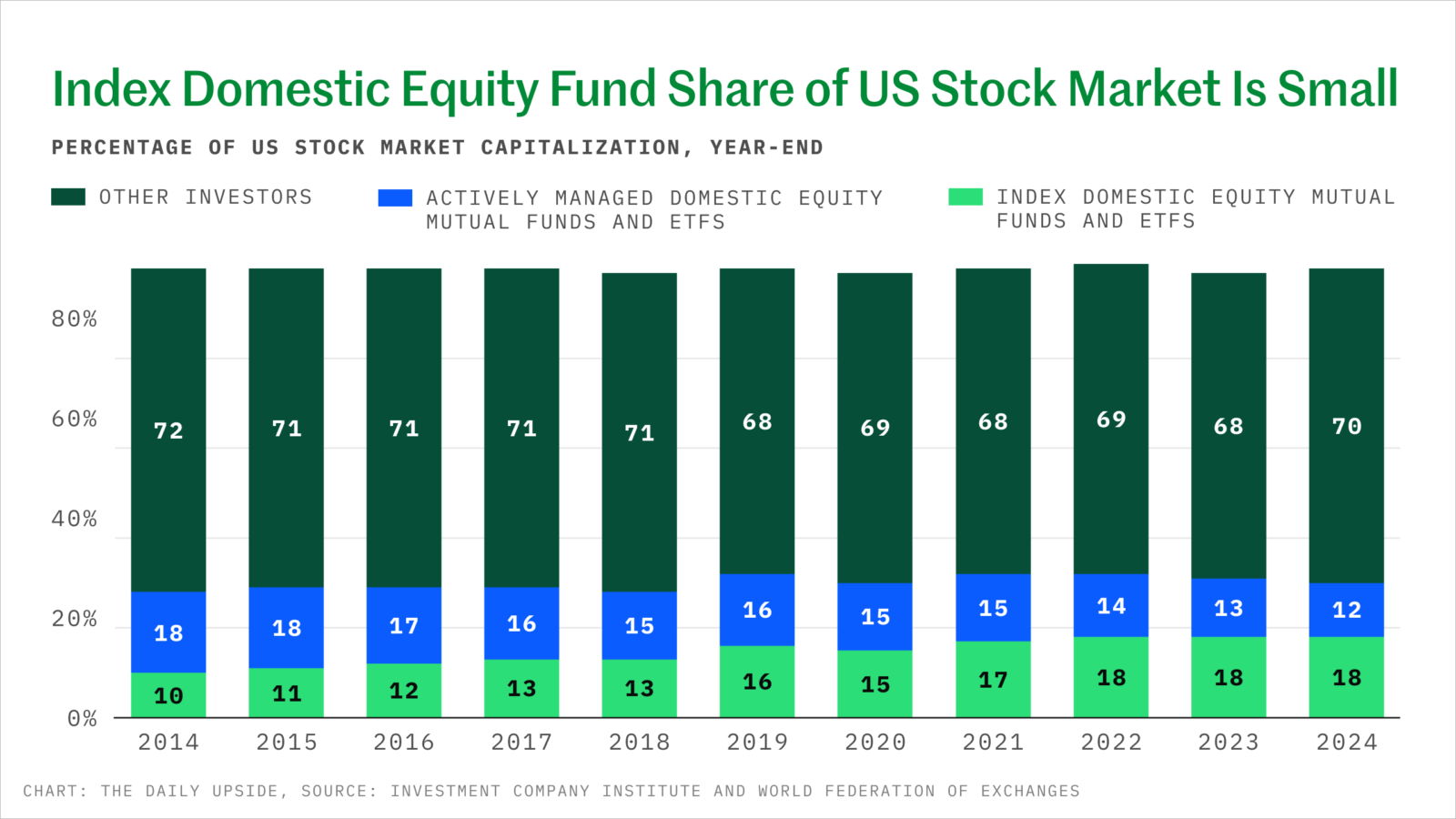
18% < 18%
While about 18% of US stocks might be in index funds, it doesn’t mean that all of this money is in indexing. Let me explain. An index fund could be something like a small-cap value index fund that picks part of the market to outperform. Narrow indexing is active management. Even huge funds like the Invesco QQQ Trust, with $466 billion in assets, pick 100 extremely tech-heavy stocks to own. Predictably, investors flee narrow funds when performance lags. Arguably, even the S&P 500 index fund is active as it excludes just over 3,000 US-based equities. I am happy to say the ICI data doesn’t appear to include levered or inverse index funds, which have nothing to do with indexing.
This Doesn’t Mean I’m Not Worried
I’m also happy to say that less than 18% in total stock index funds doesn’t translate to too much money being in index funds. That said, the recent market concentration is worrisome. While all share classes of the $2.3 trillion Vanguard Total Stock Market Index Fund (VTI) own 3,524 individual stocks, the largest 10 account for just under 32% of the assets. But that’s not because too much money is in indexing. Rather, it’s because active investors have deemed these mega caps worth hundreds of billions or trillions of dollars. Thus, diversifying with international stocks and high-quality bonds could be prudent.
A Message to Active Investors. As an index investor since 1988 (12 years after Jack Bogle’s launch of the S&P 500 fund), I’ve been an advocate of switching into low-cost broad index funds. These index funds take all of the information from millions of investors to own the stocks according to their total free float market capitalization. I tell people they can harness this knowledge to mathematically beat most investors with virtual certainty.
Though the value proposition of indexing remains strong, I have changed my position. A couple of decades ago, when people came to me claiming they beat the market, I would benchmark the portfolios to show them they underperformed the comparable index funds. Today, when I hear this claim, I congratulate them, rather than argue, because it’s those active investors that keep markets efficient and give us indexers a free ride, or even better than a free lunch. For those like AllianceBernstein who say that indexing is worse than Marxism, I say thank you and keep it up.
Recent News








-
What’s Behind Vanguard’s Deal to Buy Altruist?

Photo via Rafael Henrique/ZUMAPRESS/Newscom